Top 75 Scariest Places in the World
- Welcome to WatchMojo, and today we're counting down our picks for planet earth's most terrifying locations..
- Stull Cemetery
- Lake Karachay
- Dadipark
- Mapimí Silent Zone
- The Akodessawa Fetish Market
- Okpo Land
- Lake Natron
- Holy Land
- Ospedale Psichiatrico di Volterra
- Cortijo Jurado
- Willard Asylum
- La Recoleta Cemetery
- Steilneset Memorial
- Kolmanskop
- Veijo Rönkkönen Sculpture Garden
- Bodie
- Chateau Miranda
- Craco
- The Burma Railway
- Castle of Good Hope
- Bell Witch Cave
- The Darién Gap
- Hashima Island
- Skinwalker Ranch
- Dyatlov Pass
- The Bermuda Triangle
- Pyongyang
- The Wreck of the Titanic
- Australian Outback
- Hiljainen Kansa
- Tuol Sleng
- Whittier, Alaska
- Eastern State Penitentiary
- Skull Tower
- Edinburgh Castle
- The Amazon Rainforest
- Area 51
- The Black Forest
- North Sentinel Island
- Iultin
- The Kola Superdeep Borehole
- Lake Lanier
- Weston State Hospital
- Auschwitz
- The Death Zone
- Overtoun Bridge
- The Hanging Coffins
- El Caminito del Rey
- Christ of the Abyss
- Bhangarh Fort
- Hoia Baciu Forest
- Catacombs of Paris
- Cecil Hotel
- The Tower of London
- The Hill of Crosses
- Edinburgh Vaults
- The Great Blue Hole
- Montpelier Hill (AKA the Hell Fire Club)
- Alcatraz Federal Penitentiary
- Loftus Hall
- Houska Castle
- The Stanley Hotel
- Poveglia Island
- Bran Castle
- Sedlec Ossuary
- Aokigahara Forest
- Chillingham Castle
- Snake Island
- North Yungas Road
- Catacombe dei Cappuccini
- The Door to Hell
- Beelitz-Heilstätten
- Centralia
- Island of the Dolls
- Pripyat
#75: Stull Cemetery
USA
Tucked away in a quiet corner of Kansas, Stull Cemetery looks unassuming at first glance. It's a small graveyard with a few weathered headstones and the ruins of an old church. But for decades, it’s been surrounded by one of America’s strangest legends: that this is a gateway to hell. Stories claim the devil himself appears here twice a year, drawing in thrill-seekers and paranormal hunters alike. Most of that reputation took off in the 1970s thanks to local lore and a now-infamous newspaper article. Still, the place has an undeniable atmosphere. Between the crumbling structures and the weight of its reputation, Stull Cemetery feels like the kind of place where the stories could just be true.
#74: Lake Karachay
Russia
If you’re looking for one of the most dangerous places on Earth, it’s not a ruin, a jungle, or a volcano. Lake Karachay, located near the Mayak nuclear facility, was a decades-long dumping ground for radioactive waste. By the mid-20th century, it had become so contaminated that standing near it for even a short time could deliver a lethal dose of radiation. At one point, a single hour on its shores was estimated to be enough to kill a person. In the 1960s, a drought dried parts of the lake, allowing radioactive dust to spread. Hundreds of thousands of people were exposed. Today, the lake has been filled in and covered with concrete. The radioactive danger lurks beneath the surface.
#73: Dadipark
Belgium
At first glance, Dadipark doesn’t look terrifying. It looks… sad. Opened in the 1950s, Dadipark began as a small playground for local children. Over the years it grew into one of Belgium’s most popular amusement parks. Everything changed in 2000, when a young boy lost his arm on a ride, triggering a wave of safety concerns and lawsuits. The park closed for renovations and just never reopened. It was left to rot. Rides rusted, paint peeled, and nature slowly reclaimed the grounds. For years, it became a magnet for urban explorers, vandals, and thrill-seekers drawn to its eerie silence. Today, much of Dadipark has been demolished. For a time, it stood as a haunting reminder of how quickly places built for joy can turn unsettling.
#72: Mapimí Silent Zone
Mexico
In Durango, Mexico, no one can hear you scream… at least, not over radio, and only if urban legend is to be believed. We’ll let you be the judge. In 1970, an American missile test went off course, landing in the middle of this desert area. Since the rocket was carrying radioactive cobalt, rumors say the area has never been the same. We’re talking magnetic anomalies, mutated foliage, and even alleged alien sightings! While it’s all hearsay at the end of the day, it’s still not a place you want to stay overnight. Especially since the radiation apparently stops all forms of communication from coming in, or out.
#71: The Akodessawa Fetish Market
Togo
This isn’t your typical street bazaar. Akodessawa Fetish Market is one of the world’s largest centers for traditional Vodun practices. Street vendors sell animal skulls, bones, skins, and preserved parts used in rituals and medicine. To outsiders, it can be deeply unsettling. Tables are lined with dried animal remains - everything from birds to monkeys - laid out for spiritual use. But for practitioners, this is a place of healing, protection, and cultural tradition. That contrast is what makes it so striking. It challenges expectations, sitting at the intersection of belief, ritual, and mortality in a way that’s hard to forget.
#70: Okpo Land
South Korea
Okpo Land was built for family fun, but it shut its doors after tragedy. Opened in the 1990s, the park became notorious following a series of reported accidents. Its infamous duck-themed ride was said to have injured riders repeatedly, including a fatal incident involving a child. The park closed in 1999, reportedly abruptly. Equipment was left behind, untouched, as if the place had been frozen in time. For years, it became a mechanical graveyard before most of it was eventually demolished. Okpo Land is a relic; a place designed for delight that carries a darker story.
#69: Lake Natron
Tanzania
Lake Natron in Tanzania doesn’t look real. The water can shift into deep reds and oranges. While beautiful, the lake is one of the most alkaline bodies of water on Earth. Its extreme temperatures and caustic chemistry are harsh enough to irritate skin and damage eyes. Natron may as well be called “Lake Medusa” thanks to its reputation for turning animals to stone. That’s not quite what’s happening, but it’s close. When animals die in the lake, mineral deposits can preserve their remains, leaving behind eerie, statue-like forms. And yet, life still finds a way. Flamingos breed here in massive numbers, thriving where almost nothing else can. It’s a place that feels deadly to everything - except the things that belong there.
#68: Holy Land
USA
This place was meant to inspire faith, not fear. Holy Land USA opened in Connecticut in the 1950s as a Christian theme park, complete with biblical displays, miniature recreations of Jerusalem, and a massive illuminated cross overlooking the city. For decades, it drew thousands of visitors but it eventually went out of business. By the late 1980s, the park was abandoned, left to decay on its hillside. Statues crumbled, buildings were vandalized, and the once peaceful attraction took on a darker tone. In 2010, the site became the scene of a tragic murder, cementing its reputation as something more than just forgotten. Parts of Holy Land have since been restored, but its eerie past still lingers over the hilltop.
#67: Ospedale Psichiatrico di Volterra
Italy
Founded in 1888, Ospedale Psichiatrico di Volterra wasn’t just a hospital - it was a city within a city. At its peak, thousands of patients were housed here, many of them committed under questionable circumstances during a time when mental health care was poorly understood. Conditions inside were often inhumane, with overcrowding and isolation shaping daily life. One of the most haunting remnants is the massive graffiti carved into the walls by a patient known as NOF4 - an endless, sprawling inscription that reads like a fractured diary. The hospital closed in the late 20th century, but much of it still stands abandoned.
#66: Cortijo Jurado
Spain
Cortijo Jurado was built in Malaga in the 19th century as a grand estate for a wealthy family. It became known for something else entirely. Over time, the mansion became the center of many disturbing rumors. People spoke of disappearances, strange occurrences, and occult activity in the surrounding area. None of it has ever been proven, but the estate's reputation was set in stone. The building doesn’t do itself any favors. Its layout includes hidden passageways and sealed-off rooms, giving it a maze-like, closed-in feel that adds to the creep factor. It sits abandoned to this day, covered in graffiti and decay. Whether the stories are true or not, it’s the kind of place where they feel like they could be.
#65: Willard Asylum
USA
Willard Asylum for the Chronic Insane was built in upstate New York to house those that society often pushed aside. Opened in 1869, it became a long-term institution for patients deemed incurable. Sadly, many who entered never left; some spent decades inside its walls. When the asylum closed in 1995, thousands of patients’ belongings were discovered stored in the attic. Suitcases, letters, photographs—entire lives packed away and forgotten. Much of the site still stands, a haunting memorial to the people who passed through it. Their stories, hopes, and dreams were quite literally abandoned, packed into suitcases and never reclaimed.
#64: La Recoleta Cemetery
Argentina
La Recoleta Cemetery is a real-life city of the dead. Built in the early 19th century, it’s filled with elaborate mausoleums, towering statues, and narrow pathways that twist like streets between the tombs. Argentina’s most famous figures are buried here, including Eva Perón. But it’s not the history that unsettles people so much as the atmosphere. The scale is massive and the silence inside is oppressive. Visitors can't help but be filled with the sense of being surrounded on all sides by the dead. Some tombs have fallen into disrepair, with cracked walls and exposed interiors. It’s beautiful, yes, but there's also no denying its eeriness.
#63: Steilneset Memorial
Norway
Salem, Massachusetts isn't the only town haunted by its legacy of witch hunts. Opened in 2011, the Steilneset Memorial is built on the site of 17th-century witch trials in Vardo, Norway. Dozens of innocent people were executed there, most of them women. The design of their memorial is unforgettable. A long, narrow wooden structure stretches along the shoreline, with a single light marking each victim. Inside, the space feels enclosed and unsteady, shifting with the wind. Nearby, a separate installation features a burning chair surrounded by mirrors, representing the paranoia and fear that fueled the trials. It’s quiet, stark, and emotionally heavy.
#62: Kolmanskop
Namibia
Kolmanskop was once one of the richest towns in the region. Built in the early 1900s after diamonds were discovered in the Namib Desert, German settlers developed a mine and a town to serve it, and Kolmanskop quickly became a strange pocket of luxury. It had its own hospital, ballroom, and even one of the first X-ray stations in Africa. But the wealth only lasted as long as the mine. As diamond supplies dwindled and richer deposits were found elsewhere, the town was abandoned by the 1950s. What’s left is something surreal. Doorways open into dunes. Windows frame nothing but drifting desert. The sand has slowly taken over, filling homes room by room.
#61: Veijo Rönkkönen Sculpture Garden
Finland
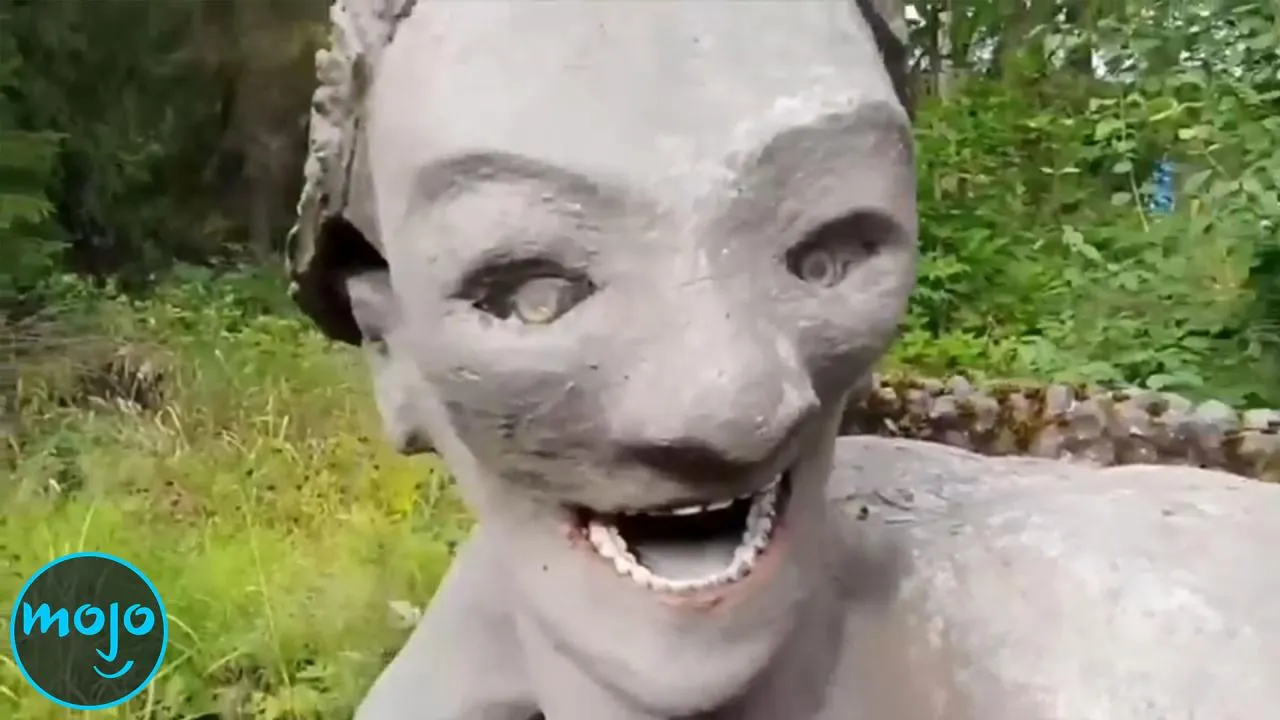
Hidden in a quiet Finnish forest, Parikkala’s Sculpture Garden feels like walking into a strange woodland hell. Over several decades, artist Veijo Rönkkönen created more than 500 life-sized human figures, many posed mid-yoga among the trees. If you look closely enough, the art may fully freak you out. Some of the sculptures are equipped with real human teeth. The meaning of the installation appears to have died with the artist. Rönkkönen kept to himself and rarely explained his work, and died in 2010. The figures remain exactly where he placed them - silent, scattered through the woods, and impossible to fully take in at once.
#60: Bodie
USA
Time left Bodie, California behind it. Once a booming gold rush town in the late 1800s, Bodie grew fast, packed with miners, saloons, and a reputation for violence and lawlessness. Then the gold ran out. In a few short decades, the town died bit by bit as its residents moved away. What makes Bodie different is what happened next. The state of California chose to preserve Bodie in a condition known as “arrested decay.” Inside the buildings, everyday objects still sit where they were left. Goods have been stocked on shelves, belongings were left scattered. It's an entire town coated in a thick patina of dust.
#59: Chateau Miranda
Belgium
Château Miranda was built in the 19th century as a summer residence for a wealthy Belgian family. It didn’t stay that way for long. After World War II, the castle was turned into a children’s home and holiday camp, filling its halls with a very different kind of life. That didn’t last either. Before the end of the century, Château Miranda had been abandoned. Weather, vandalism, and time led to slow structural collapse. Its towers and staircases became a magnet for urban spelunkers, drawn to a Disney-esque castle gone to rot. In 2017, it was demolished after years of failed restoration plans.
#58: Craco
Italy
Perched on a steep ridge in southern Italy, Craco looks like it’s holding on by sheer will. The town dates back centuries, but its decline came fast in the 20th century. A combination of landslides, flooding, and earthquakes made the area increasingly unstable, forcing residents to leave. By the 1960s, most of the population had relocated. The buildings remained, but life drained out of the town. Now the streets are empty, and many of the structures have cracked and shifted as the ground beneath them gave way. Today, Craco still stands - fragile, exposed, and slowly weathering over time.
#57: The Burma Railway
Thailand
Built through dense jungle under brutal conditions, the Burma Railway was born in blood. Constructed during World War II by the Japanese Empire, the railway was built with forced labor. Allied prisoners of war and hundreds of thousands of Asian laborers toiled for years, laying down track through thick vegetation. The conditions were horrific. Workers faced starvation, disease, extreme heat, and relentless physical labor. It’s estimated that over 100,000 people died during its construction. Today, parts of the railway are still in use. But sites like Hellfire Pass stand as stark reminders of what it took to build it.
#56: Castle of Good Hope
South Africa
Originally built by the Dutch East India Company as a military fort, Castle of Good Hope has stood since the 17th century. It’s the oldest surviving colonial building in South Africa. The castle was used as a prison and military headquarters. Stories of brutal punishments of its prisoners have followed it ever since. Over time, those stories took a supernatural turn. Visitors and staff have reported sightings of figures along the walls, footsteps in empty corridors, and the so-called “Grey Lady” said to wander the grounds. Whether you believe the stories or not, the weight of its dark past is hard to ignore. It’s a place where history and legend sit uncomfortably close together.
#55: Bell Witch Cave
USA
Bell Witch Cave is tied to one of America’s oldest and most famous haunting legends. In the early 1800s, the Bell family of Tennessee reported being tormented by an unseen entity. It allegedly spoke, moved objects, and specifically targeted family patriarch John Bell. The story quickly spread, becoming part of American folklore. Over time, the cave on the Bell property became closely associated with the local legends. Some claim it's the entity’s home. There’s no evidence the events actually occurred as described, but that hasn’t stopped the stories from sticking. Visitors still report strange experiences, and the legend has endured for over two centuries.
#54: The Darién Gap
Panama/Colombia
Darién Gap is both incredibly remote and nearly impassable. This dense stretch of rainforest forms a break in the Pan-American Highway, with no roads connecting the two continents. What exists instead is a maze of rivers, swamps, and thick jungle that resists almost any attempt to cross it. That hasn’t stopped people from trying. In recent years, hundreds of thousands of migrants have made the journey on foot, facing extreme conditions along the way. Flash floods, disease, exhaustion, and dangerous terrain are constant threats. Criminal groups also operate in the region, adding another layer of risk. The Darién Gap is terrifying because it’s a very real danger - one that continues to claim lives.
#53: Hashima Island
Japan
Hashima is also known as “Battleship Island,” and it sure looks the part, almost like a battleship rising out of the sea. Hashima was once one of the most densely populated places on Earth, built to house workers for an undersea coal mine. Life there was harsh, especially during World War II, when forced laborers were brought in under brutal conditions. When the mine shut down in 1974, the island was suddenly abandoned. Everything was left behind - apartments, schools, shops - frozen in place as the ocean slowly ate away at its edges. Today, parts of the island are open to visitors, who can explore its desiccated ruins, but much of it remains off-limits due to structural instability.
#52: Skinwalker Ranch
USA
Skinwalker Ranch has built a reputation on one thing: every horrible thing you could imagine has happened there. UFO sightings, strange creatures, unexplained lights; if there is a supernatural conspiracy involved, chances are Skinwalker Ranch has a relevant story. Much of that notoriety comes from the 1990s, when the Sherman family publicly described a series of disturbing events. They reported glowing objects in the sky, mysterious animal mutilations, and phenomena they couldn’t explain. Their accounts quickly spread, turning the ranch into a focal point for paranormal investigation. There’s no confirmed evidence behind the claims, but the stories haven’t gone away. Today, Skinwalker Ranch remains a magnet for researchers, skeptics, and believers alike.
#51: Dyatlov Pass
Russia
In 1959, nine experienced hikers set out into the Ural Mountains. They never made it back. Dyatlov Pass became the site of one of the 20th century’s most enduring mysteries when search teams discovered their abandoned campsite. The tent had been cut open from the inside. Footprints led away into the snow, some barefoot. The bodies were found scattered across the mountainside, with injuries ranging from hypothermia to severe trauma. Some details only deepened the confusion, fueling decades of speculation. Recent investigations point to a likely natural explanation involving an avalanche or snow slab. But even with that, the scene itself is hard to shake: a place where something went very wrong, very fast.
#50: The Bermuda Triangle
The Atlantic Ocean
Alright, we know that the Bermuda Triangle isn’t actually cursed, but the mythology certainly makes an impression, doesn’t it? As kids we were taught to fear the Bermuda Triangle, an area of the Atlantic Ocean that is said to swallow planes and boats through some type of interdimensional portal. Or something, we don’t really know. Point is, a lot of people have supposedly gone missing within the triangle thanks to some type of creepy magic. The legend is so pronounced and persistent that many regulatory bodies have conducted studies disproving the legend. But those three words - The Bermuda Triangle - are still enough to send shivers down the spine.
#49: Pyongyang
North Korea
The capital of North Korea is less “living, breathing city” and more “lifeless movie set.” It really is something. Streets are largely devoid of vehicles or pedestrians, gigantic monuments to dictators dominate the skyline, and propaganda posters litter the walls. Much of Pyongyang also feels curated, as visitors are strictly chaperoned and intensely scrutinized. Then there are the weird buildings, some of which are staged for tourists or just outright empty, like the looming Ryugyong Hotel, which has sat unfinished for decades. Oh, and if you step a toe out of line you’re in deep, deep trouble. Pyongyang is like a ghost town in the unsettling guise of a modern city.
#48: The Wreck of the Titanic
The Atlantic Ocean
If you have a fear of deep water (thalassophobia if you’re fancy), then you probably can’t even look at the wreck of the Titanic. It lies over 12,000 feet below the Atlantic, and its massive structure just sits there in the dark and silent deep, a rusting underwater graveyard. Its rotting mass is an unbelievably eerie sight, just sitting there in the pitch black. Even worse, human objects like shoes, suitcases, and dishes still sit scattered on the seabed, frozen in time, making the monument feel ever more ghostly. And for the more philosophical, there’s the uncanny contrast between its contemporary symbol of wealth and its current state of ruin. There’s a haunting sadness about the whole thing.
#47: Australian Outback
Australia
It’s hard to imagine just how massive the Australian Outback actually is. This thing preys on the likes of psychology, fears of the unknown, and base survival instincts, being a vast and barren expanse of nothing. You could show us a picture of the Outback and a picture of Mars and we wouldn’t know the difference. It often feels like an endless void where everything looks the same, and with no ambient noise save the likes of rustling brush and distant animal calls, it can feel incredibly uneasy. Giant spiders, venomous snakes, and dingoes prowl the landscape, abandoned villages dot the roads, and then there’s the most palpable fear of all - that if something goes wrong, you are truly on your own.
#46: Hiljainen Kansa
Finland
An extremely creepy art installation, “Hiljainen Kansa” means The Silent People, and the name couldn’t be more apt. It’s found in the barren region of central Finland, about thirty kilometers outside the village of Suomussalmi. The installation consists of hundreds of scarecrows dressed in human clothes, arranged in rows across a remote field. Just imagine coming across this thing while driving and having no idea that it was there. At first glance, the scarecrows resemble a motionless crowd of people which can feel especially creepy in foggy weather or the dark. Visitors often describe the scene as if the figures are silently watching them - or perhaps waiting for something unknown.
#45: Tuol Sleng
Cambodia
Nestled inside Phnom Penh is the Tuol Sleng museum, or, as it was once called, Security Prison 21. Once a secondary school, the building was converted into a detention center under the Khmer Rouge regime in the mid 1970s. Between 1975 and 1979, thousands of men, women, and children were imprisoned here, and the building now stands as a sober reminder of the country’s dark past. The rooms still bear the likes of iron bed frames, shackles, and even bloodstains, and the walls are lined with chilling photographs of past prisoners, their expressions ranging from abject fear to reluctant resignation. Walking its sordid halls is an experience unlike any other.
#44: Whittier, Alaska
USA
Wandering into the Alaskan town of Whittier is like wandering into another dimension. Found nearly sixty miles southeast of Anchorage, Whittier feels insanely creepy because almost the entire population lives inside a single building, the Begich Towers, a stark concrete structure that looms over the otherwise desolate town. Inside the towers, residents share not only apartments but essentials like a grocery store and post office, creating an uncanny “all-in-one” environment that may come across as unsettling to outsiders. And surrounded by foggy mountains and accessible by just one tunnel, the dark and isolated setting only adds to its eerie atmosphere. The empty streets and looming presence of one singular building where everyone lives can feel like something out of a nightmare.
#43: Eastern State Penitentiary
USA
There’s nothing like a giant, rotting prison to get the blood pumping. Opened in 1829, the famous Philadelphia prison was one of the first to use solitary confinement as punishment, leaving behind stories of suffering and psychological torment. Naturally, this has led to its now-famous reputation as a haunted prison. But even if you don’t believe in ghosts, there’s still plenty to find spooky about Eastern State. The imposing stone walls, crumbling cellblocks, and rusting iron doors create a palpably eerie feeling, and visitors are often left unsettled by its long and silent corridors. It’s one thing to see it on TV. It’s something else to walk through its hallowed, and probably haunted, halls. Eastern State stands as a decayed relic of a barbaric past.
#42: Skull Tower
Serbia
You know those giant pillars of faces in “Game of Thrones?” Well, that’s kind of a real thing. We’re talking about Serbia’s Ćele Kula, or Skull Tower. Constructed in 1809 by the Ottoman Empire after the Battle of Čegar, the tower was made with the skulls of Serbian rebels who died in the skirmish. 952 skulls were originally embedded into the structure’s walls as a brutal warning to discourage further uprisings. Today, only about fifty skulls remain, but they still have the power to provoke complete and utter fear. The sight of real human remains stacked together in a giant wall is obviously unsettling, but beyond its physical appearance, the tower serves as a chilling symbol of conquest. Yeah, it’s pretty darned creepy.
#41: Edinburgh Castle
Scotland
Take a trip over to Europe and you’ll find buildings older than some countries. That’s certainly the case with Edinburgh Castle, which dates back to the 11th century. The fortress has witnessed centuries of bloodshed and executions, and prisoners were once held in its dank dungeons, where cramped cells and iron chains left lasting marks. And maybe some ghosts. The castle is world-renowned for its ghost haunts and historic tours, with tales of violence abounding. But even ignoring its dark history, Edinburgh Castle is an imposing beast, a dark stone fortress perched mightily atop Castle Rock and overlooking the ancient city that it protects. It’s just begging you to attack it.
#40: The Amazon Rainforest
South America
If you want to experience true wilderness, look no further than the Amazon rainforest. An endless expanse of trees and rivers, it reminds us of a bygone era. The towering trees are incredibly dense, and often to the point of blocking out sunlight and creating an oppressive atmosphere. It’s also alive with constant sounds, whether it’s distant animals, buzzing insects, and rustles from its countless venomous and dangerous inhabitants. The unknown plays a large role too: scientists estimate that millions of species remain undiscovered within its borders, and entire regions are still unexplored. Add in the legends of lost civilizations and spirits, and you’ve got one seriously otherworldly place. And you thought the woods next to your house were creepy.
#39: Area 51
USA
Countless myths, stories, legends, tales - whatever you want to call them - have been made about Area 51. The alien capital of America, the secret base is said to be closely associated with UFOlogy, either housing aliens, conducting otherworldly experiments, reverse-engineering UFOs, or whatever else. But even without the folklore, Area 51 is one creepy place. Such is often the case with restricted areas and forbidden access. Deeply hidden in the Nevada desert, surrounded by threatening signs and armed patrols, and with its secret operations being strictly classified and hidden from public view, Area 51 fuels the imagination like no other place on Earth.
#38: The Black Forest
Germany
Schwarzwald, or The Black Forest, has long been renowned for its eerie, almost otherworldly atmosphere. Its dense canopy of towering evergreens blocks much of the sunlight, leaving the forest floor in deep shadows, even at high noon. Mist often lingers between the trees, adding a beautiful but undeniably mystical quality. Local folklore only amplifies this feeling - centuries of German fairy tales place witches and monsters within its trees, and the scattered abandoned medieval settlements give off a bygone storybook atmosphere, like the characters could have lived there at one point in time. This mixture of natural gloom and mythic storytelling makes the Black Forest a place where the boundary between reality and legend constantly feels blurred. Don’t explore it alone.
#37: North Sentinel Island
The Bay of Bengal
Nestled in the Bay of Bengal is North Sentinel Island, which is one of the last places on Earth untouched by modern civilization. The island is home to the Sentinelese, a voluntarily-isolated tribe that has resisted all outside contact for centuries. Attempts to approach are met with fierce hostility, with arrows and spears often shot at outsiders and their vehicles. People have actually died attempting to contact this tribe and reach the island’s prohibited shores. And as almost nothing is known about the tribe’s language or culture, the mystery only deepens. It’s a forbidden place where humanity’s ancient past still thrives, untouched and fiercely protected.
#36: Iultin
Russia
It’s amazing how fast a city’s fortunes can turn. In 1989, Iultin, near the northeastern peak of Russia, was a mining hub housing over 5,000 people. By 1995 it was a ghost town. Iultin was liquidated shortly after the dissolution of the Soviet Union, and its residents abandoned the settlement almost overnight, leaving behind schools, apartments, machinery, and personal belongings literally frozen in time. The isolation, combined with the crumbling Soviet-era architecture and snow-covered ruins, creates a post-apocalyptic atmosphere you have to see to believe. There were even reports that the town’s utilities were shut off before all of the residents could move out, leaving them stranded in the harsh Arctic tundra.
#35: The Kola Superdeep Borehole
Russia
What is the Kola Superdeep Borehole you may ask? Well, it’s a hole, it’s super deep, and it’s in Russia. Back in the 1970s, the Soviet Union thought “How deep into the Earth can we drill?”, and conducted the experiment. By 1989, they had gone over 40,000 feet into the planet’s crust, making the deepest human-made hole ever made. It’s freaky more in theory than practice - knowing that there’s a hole that goes 40,000 feet down is just brain-breaking. That’s airplane cruising altitude. That’s 11,000 feet more than Mount Everest. That’s fifteen Burj Khalifas. Even the site itself is quite creepy these days - while the hole has been welded shut, the surrounding building has fallen into significant disrepair.
#34: Lake Lanier
USA
On the surface, Georgia’s Lake Lanier is just another body of water. But look a little deeper, literally, and you’ll see something truly creepy. Before the 1950s, the surrounding area was just everyday farmland and housed multiple small towns, including Oscarville. But the rapid growth of nearby Atlanta necessitated more water, so the Army Corps constructed Lake Lanier. In the process, they evacuated and then completely flooded these small towns - and without demolishing them first. So, laying under the surface of the water are the skeletal remains of homes, roads, and businesses. Many locals now believe that Lanier is haunted, the ghostly hands pulling swimmers down to join their watery graves…
#33: Weston State Hospital
USA
Drive through central West Virginia and you won’t find much of note. But nestled within the endless trees is the small town of Weston, and there you’ll find one of the most gorgeous buildings in America. Also one of the scariest. It’s Weston State Hospital, which housed patients for over a century between 1864 and 1994. The building’s old, gothic architecture is incredibly imposing, striking both awe and fear before you even step foot through its doors. The place also has a dark history of mental health treatment, including overcrowding, filthy conditions, and electroshock therapy, contributing to its reputation as one of America’s most haunted buildings. Since closing in 1994, much of the hospital has fallen into significant disrepair, further contributing to its ghostly aura.
#32: Auschwitz
Poland
The scale of suffering and death that occurred at Auschwitz is just unimaginable. With about one million people murdered there, the aura of misery within its walls is palpable. But even if you had no idea of the camp’s history, you would still find this place more than a little “off.” The camp’s physical structures are cold and utilitarian, it is hauntingly quiet, and the likes of barbed wire, barracks, and watchtowers give off a clear prison-like atmosphere. And of course there are the human artifacts left behind, including the likes of shoes, glasses, and suitcases with names still written on them, their owners long gone. Auschwitz is simultaneously an ordinary set of buildings and one of the most horrifying places in human history.
#31: The Death Zone
Mount Everest
“The death zone” refers to the areas of a mountain that go above 8,000 metres, or 26,200 feet. At those altitudes, a sense of severe isolation begins to set in, oxygen deprivation causes disorientation and hallucinations, and many climbers report feeling a surreal, almost dreamlike atmosphere in an alien landscape. That’s scary enough, but Everest’s Death Zone has multiple meanings. You see, climbers who have died in the death zone remain there to this day, as rescue in those horrid conditions is extremely difficult and dangerous. As such, they still litter the path up, their frozen corpses and bright, fluorescent clothing often serving as waypoints for other climbers.
#30: Overtoun Bridge
Scotland
It’s hard to believe that such a beautiful location could have such a dark history. Completed in the mid-1890s, the Overtoun Bridge in West Dunbartonshire, Scotland operated smoothly for decades– until a strange phenomenon started occurring. Several dogs began leaping from the structure to their own demise, which eventually earned it the nickname “The Bridge of Death.” One occurrence is tragic enough, but theories started flying once the incidents became semi-regular. Some locals speculate that the scents of nearby animals may be luring the canines to jump, while others believe that something more supernatural is at play. Regardless of the cause, we recommend keeping your pooch on a short leash if you choose to walk this path.
#29: The Hanging Coffins
Philippines
Burial practices vary widely across societies all over the globe. While some choose to bury or cremate their dead, others embrace more unconventional methods. The rituals in Sagada, Philippines have been taking place for thousands of years. Elderly members carve out their coffins, and when they pass, they’re added to a rock wall filled with other suspended sarcophagi. The result is visually unsettling yet breathtaking, serving as a poignant reminder of the brevity of life and how one can be celebrated even after dying. While this practice isn’t carried out for everyone, it remains a staple in the culture. It’s undeniably unique, but it’s still chilling to see an individual's final resting place in such a precarious position.
#28: El Caminito del Rey
Spain
This is perfect for the adrenaline junkies in your life. Hiking is a physically strenuous activity, even on the most well-preserved trails. Things get even harder when the walkway is crumbling to pieces. El Caminito del Rey, a passage along the side of a gorge in Málaga, Spain, was built in the 1900s, and began to fall apart less than a century later. But that didn’t deter adventurers from attempting to cross it. Some sections had completely broken off, causing hikers to jump over large gaps. The trail was so dangerous that several deaths occurred over time. While it has since reopened with new safety measures, we still wouldn’t recommend this trek– especially if you’re scared of heights.
#27: Christ of the Abyss
Italy
There are a few different versions of this sculpture around the globe, but for this list, we’ll be focusing on the Italian original. The statue was sculpted by Guido Galletti and placed in the Mediterranean Sea in 1954, where it has since become a popular attraction for both sightseers and divers. The piece depicts Jesus Christ with his hands lifted up in a sign of peace. While it’s undeniably beautiful, there’s also something haunting about it. This effect is heightened by its unusual placement underwater, as well as its proximity to the location where an Italian diver had unfortunately drowned. The fact that it can be viewed in reverence or discomfort is proof of how effective the art is.
#26: Bhangarh Fort
India
There are plenty of fables behind the older sites found on Earth, and this is no exception. Bhangarh Fort was constructed in 1573, and had a small town within it. Even today, there are still remnants of temples and palaces within its walls. There are several legends behind this fort, and how it came to fall. One tells the tale of a holy man who believed that his home should be the tallest, lest it lead to the village’s destruction. Another suggests a priest used black magic to curse the town after a princess accidentally killed him while denying his advances. While these stories obviously haven’t been corroborated, they’re still the closest thing to an explanation as to how this formidable citadel fell.
#25: Hoia Baciu Forest
Romania
As if Transylvania wasn't frightening enough already. Besides being the home of some iconic fictional monsters, it’s also home to the very real Hoia Baciu Forest. It’s considered to be the world’s most haunted woodland, which has only added to its creepy allure over the years. With the eerie, almost unnatural curved trees and general ominous vibe, it’s no wonder it’s gotten such an intense reputation. Some visitors have reported experiencing strange symptoms after visiting, including nausea and paranoia. While there isn’t any concrete evidence of ghosts in the area, that hasn’t affected its standing amongst lovers of the paranormal. The woods are so visually strange that you’ll feel uncomfortable– even if you don’t see any specter.
#24: Catacombs of Paris
France
Much like Sagada in the Philippines, Paris also had an unorthodox way of honoring their dead. The massive underground ossuary known as the Catacombs extends across the city, and houses the remains of over six million people. It was created to store those who couldn’t fit in cemeteries– preserving them in a striking yet unnerving manner. Here, the remains of all– from commoners to aristocrats– were laid to rest. Originally a place for novelty shows, it eventually morphed into the macabre attraction it is today. The renovator spared no effort in maximizing the creep factor with menacing signs and a room full of deformed skulls. Everything about this landmark makes for a stomach-turning tour that you’ll never forget.
#23: Cecil Hotel
USA
It’s the heartbreak hotel– but not because relationships have ended here. Now known as “Stay on Main,” this once lavish location became the source of countless catastrophes throughout the 20th and 21st centuries. Within its walls, several lives have been ended, which have overshadowed any potential positive aspects. Even more, some notorious serial killers, including Richard Ramierez, once made the establishment their temporary residence. Among the most recent tragedies was the 2013 case of Elisa Lam, a young woman who mysteriously died shortly after she was filmed in the hotel’s elevator. It was later converted into low-income housing, but it remained plagued by various issues. As of 2024, the property is up for sale– and it’s unsure what its future will hold.
#22: The Tower of London
England
Not only is it one of the oldest buildings in England– it’s also supposedly one of the most haunted. Erected in 1066, the Tower of London initially started as a symbol of an oppressive government. It underwent various transformations over the years, with the most famous iteration being a prison and execution chamber. One of the most ghastly incidents was the alleged murder of two young princes. This, along with other unsavory happenings, helped shape its reputation amongst locals and visitors. It’s said that these victims– along with other famous historical figures– haunt it to this day. While there is no official evidence, numerous firsthand accounts from both employees and tourists describe ghostly activity.
#21: The Hill of Crosses
Lithuania
While it’s intended to be a place of remembrance, its disturbing nature and the sheer amount of offerings has made it into an unintentionally terrifying place. This field, located in Lithuania, is filled with crosses and other Catholic memorabilia. The exact amount of effigies isn’t known, but the number exceeded 100,000 in 2006– so you can only imagine how many more there are now. The site was nearly destroyed during Soviet occupation by the KGB, who deemed it a contradiction to their beliefs. Despite their efforts, the site endured, serving not only as a religious and political piece, but also as a reminder of the indomitable human spirit.
#20: Edinburgh Vaults
Scotland
Inside the arches of South Bridge, built across a valley in Scotland’s capital city in the 1780s, are dark, damp chambers, once used as taverns, workshops, and storage spaces for the business above. However, once the businesses left, Edinburgh’s poorest residents moved into the vaults, and they became dens of illegal activity - even being used by bodysnatchers. Eventually, the vaults were closed down and forgotten about for over a century. Today, organized tours take visitors through the chambers. But they should still beware the malevolent spirits that supposedly roam the halls.
#19: The Great Blue Hole
Belize
Belize’s Great Blue Hole isn’t the only marine sinkhole in the world, but it is the largest, at 1,000 feet wide and over 400 feet deep. Several divers have become lost and died inside it. In fact, a 2019 expedition to the bottom discovered two bodies of long lost divers. Not only is the hole dangerous to inexperienced divers, but also to the sea life around it. The bottom is so full of hydrogen sulfide that life can’t survive inside for long. Unfortunately, many reef-dwelling crabs learned that lesson firsthand.
#18: Montpelier Hill (AKA the Hell Fire Club)
Ireland
A sinister, derelict building stands at the top of Montpelier Hill near Dublin, Ireland. This foreboding location was once the hunting lodge home to one branch of the infamous Hell Fire Club. Hell Fire Clubs existed across the British Isles as bases for societal elites in the 1700s to engage in all kinds of debauched and potentially even violent practices. The organization remains somewhat mysterious to this day thanks to the secrecy surrounding it. So it’s not clear exactly what happened during its meetings. But while we don’t know whether the darkest tales of horrifying rituals are true or not, it’s been said that this Hellfire Club spot supposedly hosts a number of spirits.
#17: Alcatraz Federal Penitentiary
USA
For thirty years, Alcatraz was an ominous presence on a lonely island in the middle of San Francisco Bay. Since it was in a relatively isolated position, it was frequently cited as totally inescapable. And although three people notably did escape in 1962, they were never seen again after leaving the island. Even while it was still in use, Alcatraz was a dangerous, decaying place. Its prisoners were often mistreated since it was designed to feel as hostile as possible. Though it’s been shuttered for far longer than it was ever in operation, that hostile atmosphere persists. Today, you can tour the prison and experience its horrors – and many alleged ghosts – for yourself.
#16: Loftus Hall
Ireland
It’s been named the most haunted house in Ireland for a scarily good reason. Located in County Wexford, its most famous ghost story involves a visit from the devil himself. He apparently arrived one evening to play cards until his identity was revealed. Satan supposedly flew up through the ceiling and left a hole that remains today. For about a decade, Loftus Hall was open to brave souls who wanted to go on a ghost tour. There were even overnight stays offered for anybody desperate to test their mettle. In 2020, it was put on sale for a hefty sum of around $3 million. It was listed as sold in 2025.
#15: Houska Castle
Czech Republic
This creepy castle has long been rumored to be built over an actual entrance to hell. Naturally, this has given the castle a nearly unmatched reputation for supernatural entities. You’ll find it just outside Prague open to all visitors brave enough to enter. It was built around 800 years ago and has been home to many royals and nobles over the centuries. The so-called “gateway to hell” is an enormous, supposedly bottomless pit that the castle was constructed over the top of. The pit was deemed so horrific that, according to legends, prisoners were sent to investigate it and returned with stories of indescribable horrors.
#14: The Stanley Hotel
USA
Master of horror Stephen King stayed in this hotel in 1974 when he and his wife were the only guests in the entire place. This spooky atmosphere served as the inspiration for “The Shining,” the novel that was later adapted to film and became one of Stanley Kubrick’s scariest movies. Just knowing that the Stanley was the inspiration behind the Overlook Hotel will send a chill down your spine. Located in the Rocky Mountains in Colorado, the hotel is supposedly haunted by numerous ghosts. It’s become a prime destination for paranormal tourism since the book was released. Stay the night at the Stanley, if you dare.
#13: Poveglia Island
Italy
Known as one of the most haunted spots in Europe, Poveglia Island has a long and gruesome history that dates back centuries. It first began to gain its reputation in the late 18th century when it was used to quarantine victims of various diseases. It’s reported that over 100,000 people passed away and were buried and/or cremated on the island. To make matters creepier, an asylum was constructed there in the twentieth century. While Poveglia is closed to visitors today, the derelict asylum still stands. The Venetian government has been looking for someone to redevelop it. But nobody has yet been bold enough to sign the lease.
#12: Bran Castle
Romania
Long before the Stanley Hotel inspired a horror legend, the Bran Castle may have inspired another scary icon. Located in Transylvania, Romania, Bran Castle has built an entire business around the claim that it was the basis of Bram Stoker’s “Dracula.” While there isn’t actually much evidence for this, or the claim Vlad the Impaler stayed there, it still can be a terrifying destination. Many deaths occurred within the castle walls due to its use as a hospital in the Second World War. Whether you believe Bran Castle was the true home of Count Dracula or not, it’s still an impressive and intimidating fortress right in the heart of vampire country.
#11: Sedlec Ossuary
Czech Republic
On the outside, the Czech Republic’s Cemetery of All Saints seems like any other quaint, small town cemetery. But underneath, it looks like a serial killer’s lair. The Sedlec Ossuary is located below the Cemetery of All Saints in Sedlec, Czech Republic, and it contains the skeletons of up to 70,000 people. The bones are artistically arranged to form various “attractions” and furnishings, including a chandelier composed of every bone in the human body. The area has been a desirable burial site since the 13th century, and it contains many victims of the Black Death and Hussite Wars. The ossuary itself was built around 1400 to house the bones of those buried on the property in mass graves.
#10: Aokigahara Forest
Japan
This woodland in Japan has an extremely distressing reputation. It’s widely known as a place where people frequently take their own lives. In an attempt to combat this disturbing trend, the local authorities have put up messages encouraging people to think again about what they intend to do. Dozens of people each year sadly lose their lives when they journey into these woods. However, it’s never been entirely clear why the forest has seen so much tragedy. Many believe that it may have roots in Japanese folklore. While the forest itself is beautiful, the history of what’s happened there is decidedly dark.
#9: Chillingham Castle
England
The suitably named Chillingham Castle is certainly chilling all right. Located in northern Northumberland, this Medieval castle dates back to the 12th century, when it served as a monastery. It was even visited by King Edward I of England in the late 13th century, while he was traveling to fight William Wallace. It is said to be the most haunted castle in all of Britain, known primarily for its resident “blue boy.” Guests would supposedly hear a loud wailing noise and witness a blue halo floating above their beds. However, the hauntings have reportedly stopped after renovation work uncovered the bones of a young boy buried within the walls.
#8: Snake Island
Brazil
You can probably guess what occupies Snake Island. Ilha da Queimada Grande is a small, 106-acre island located off the southeastern corner of Brazil. It is inhabited by untold numbers of snakes, who became trapped on the island once rising sea levels cut it off from the mainland. It remains the only place on Earth to host the endangered golden lancehead, a highly venomous pit viper that devours birds. It is estimated that up to 4,000 golden lanceheads reside on the island. Snake Island cannot be visited by citizens, both to protect the endangered snakes from prying eyes and the humans from becoming snake victims. The only people allowed there are select researchers and members of the Brazilian Navy.
#7: North Yungas Road
Bolivia
Health and safety? Pshaw. Yungas Road is located in Bolivia, linking the city of La Paz to the greater Yungas region. Chillingly nicknamed the Road of Death, Yungas Road was famous for its complete lack of safety precautions. The road itself is very thin, which doesn’t allow for many mistakes. There are no guardrails, the slopes are steep, and the area is regularly hit by heavy rain and fog cover, making travel an extremely dangerous expedition. A new road has been built for driving, but Yungas remains a popular tourist destination owing to its stellar mountain biking - even though 18 cyclists have died on the route since 1998.
#6: Catacombe dei Cappuccini
Italy
Forget the Paris Catacombs. These catacombs located in Palermo, Sicily originated in the 16th century when monks excavated crypts below the overpopulated Capuchin monastery. It soon became a status symbol to be buried within the Capuchin catacombs, and it was maintained through donations paid by the rich relatives of the entombed. It’s estimated that the catacombs contain 8,000 corpses and 1,252 mummies, all of which are visible to the public, and even set in various poses. Each of the bodies are categorized into different “sections” of the catacombs, including Men, Women, and Children. The catacombs are also famous for hosting Rosalia Lombardo, a one-year-old child whose preserved body remains in exceptional condition.
#5: The Door to Hell
Turkmenistan
Turns out, the door to Hell exists, and it’s located in Turkmenistan. The village of Derweze is home to the Darvaza gas crater, which was unintentionally created in 1971 while Soviet engineers were drilling for oil. Fearing the release of dangerous methane gas, the engineers decided to light the crater on fire in the hopes of burning off the methane. The crater has continued to burn throughout the decades and shows no signs of slowing down. So now, in the middle of the Karakum Desert, there’s a 100-feet deep crater that is persistently on fire. Naturally, the site is off limits to both tourists and almost all documentarians. You wouldn’t want to get pulled into Hell, would you?
#4: Beelitz-Heilstätten
Germany
Abandoned and deteriorating hospitals are inherently creepy places - never mind one with such a rich and disturbing history. Located in Beelitz, Germany this large hospital complex encompasses around 60 different buildings. The hospital was originally used as a tuberculosis sanatorium before it was converted to a war hospital. During World War I, it housed injured soldiers of the Imperial German Army, including Adolf Hitler after he was wounded at the Battle of the Somme. It was later occupied by the Red Army throughout World War II and remained as a Soviet military hospital well into the ‘90s. Most of the complex is now a derelict ghost town, having been completely abandoned in 1994.
#3: Centralia
Pennsylvania
There’s an area of Pennsylvania that has essentially been on fire since 1962. In the early ‘60s, Centralia hosted roughly 1,500 residents, but the area suffered a horrific coal mine fire that is estimated to keep burning for another 250 years. The major detrimental effects weren’t really known until 1981, when a sinkhole randomly opened and nearly killed a 12-year-old boy. The government bought out most of the residents and had them relocated, leaving just 63 people by 1990. Today, the town hosts under a dozen citizens, and various signs are littered throughout the area warning of sudden ground collapse and fatal levels of carbon monoxide. A “graffiti highway” that became a destination spot in the area has been paved over as of 2020.
#2: Island of the Dolls
Mexico
Turns out there are many areas throughout the world populated by dolls. There’s a village in Japan called Nagoro which has become a famous tourist attraction due to its countless lifesize dolls. But perhaps the freakiest of all is Mexico City’s La Isla de las Muñecas, which is located in the canals of Xochimilco. The island contains hundreds of dolls, most of which are hung from the trees. Legend states that the spirit of a young girl haunted the island, forcing its owner to hang dolls from the trees to appease her ghost. The owner passed away in 2001 and the island became a popular tourist destination, even though some locals refuse to go there owing to superstition.
#1: Pripyat
Ukraine
Now here’s a ghost town. Pripyat is what was called a nuclear city, housing the employees of the nearby Chernobyl Nuclear Power Plant. It was the home of thousands of citizens until the power plant famously exploded on the morning of April 26, 1986, spreading an unbelievable amount of radiation into the area, including Pripyat. The town was not immediately evacuated, despite dozens of people falling ill and showing signs of acute radiation sickness. The evacuation was finally ordered 36 hours after the blast, and the city remains abandoned for long-term residents, although governmental authorities still did work in the area and there is now limited tourism. It is now part of the wider Chernobyl Exclusion Zone.
Would you brave any of these destinations? Tell us which you’d risk - and which you’d avoid at all costs - in the comments below!