25 Things You DIDN'T Know About Super Mario 64
Real World Background
Heres one that 90% of players dont know, unless youre a fan of Out of Bound Secrets. Wet-Dry World is one of the more intriguing levels in the game AND also one of the more hemorrhoid inducing, but for once we arent talking about my hemorrhoids. At the highest point of the level the skybox becomes visible, and it does seem a little bit out of place. Instead of a typical sky or abstract backdrop like in most levels, Wet-Dry World features a photo-realistic image of an actual city. Data miners uncovered that the image is of a real Egyptian city, and also uncovered that their time data mining could have been better spent literally doing anything else.
Exclusive Launch
Its been almost 30 years since the N64 launched, so modern players arent aware just how exclusive Mario 64 was. These days, it's almost standard for a new console to launch with at least a dozen games, but when the Nintendo 64 launched, players had just two options: Super Mario 64 and Pilotwings 64. I dont need to tell you this, but Mario was better.
The Many Faces of Mario
If you follow my topics, I LOVE it when there are secrets and easter eggs that are exclusive to the Japanese version of a game, as stuff often gets stripped before Western releases. Although this WAS exclusive to Japanese players, Super Mario 3D All-Stars made it available to us filthy Westerners. By pressing the shoulder buttons on the title screen, a swirling spiral of smaller, animated Mario faces appears. It adds an extra layer of weirdness to an already surreal startup screen where Marios face can be stretched and pulled in every direction, though thats been available to everyone since 1996.
End Credits Directed By
Did you know that you can add a lovely personal touch to the end credits of Super Mario 64 by connecting a second controller? Theres absolutely no reason to even touch a second controller in this game, so most players missed that with it, you can adjust the cameras angle during the credits, essentially taking on the role of director. Though its not as free-form as the in-game camera, you can still shift the view to focus on different structures and characters. Unfortunately, you cant recast.
Almost Annoying
Super Mario 64 wasnt just Marios first leap into 3D, it was also the first time players heard him speak in-game... Well, except for Mario Teaches Typing from 1994, but Im not here for semantics. For the N64, Nintendo opted for a cheerful, high-pitched voice from the brilliant Charles Martinet. But, there is a dark alternate reality not too far from ours where Mario was FAR more annoying. Early beta footage reveals Marios original voice was painfully shrill, and it was downright ear-piercing. Imagine the noise SNES Yoshi makes when you jump on him stretched out for all eternity.
Super Mario 16
Nintendo 64 took a wild turn for the company, using their tech to bring 3D gaming to the forefront, but did you know that the Super FX chip that was built into the SNES cartridges was powerful enough that Nintendo had started experimenting with 3D, getting geared up for a WAVE of 3D games, including a 3D Mario game that ended up being Mario 64? Many of the core concepts behind Super Mario 64 were first imagined during the SNES era, and the only real reason the move to N64 happened was due to the controller, rather than the graphical requirements.
The Impossible Coin & Doomed Goomba
In Super Mario 64, most levels are packed with well over 100 coins, and collecting that amount usually earns players a Star. But in Snowmans Land and Tiny-Huge Island, lone coins are hidden out of sight behind walls, only visible if you mess with the camera. But thats not the only thing hidden out of bounds. In Bowser in the Sky, theres a Goomba thats supposed to appear on a platform, but hackers eventually discovered that the Goomba spawns far below the level and falls to its death almost immediately. Why does everyone else always live my dreams?
The Corpse of The Fallen King
The first major boss battle in Super Mario 64 pits you against King Bob-Omb, which requires a fairly easy climb in terms of platforming climbs in this game. The only true obstacle on this climb are the two giant black balls that roll down the hill. After defeating the big boy himself, a third big black ball mysteriously appears in that same path. Coincidence? Nope. Complete with a big crown, King Bob-Omg is forced to spend the rest of his eternity rolling down the same hill. Jesus.
Man of Many Hats
Have you guys ever heard of the double hat glitch? It happens when Mario picks up two hats in quick succession. The games unusual solution? It places one of the hats in Marios right hand, as if hes holding it. Now head to the Snowmans Land level. After Marios hat is blown off by the giant snowmans icy breath, players can use the warp beneath the nearby tree, which duplicates the hat, and picking up both will activate the glitch, causing Mario to visibly hold one hat while wearing the other.
Angry Mother
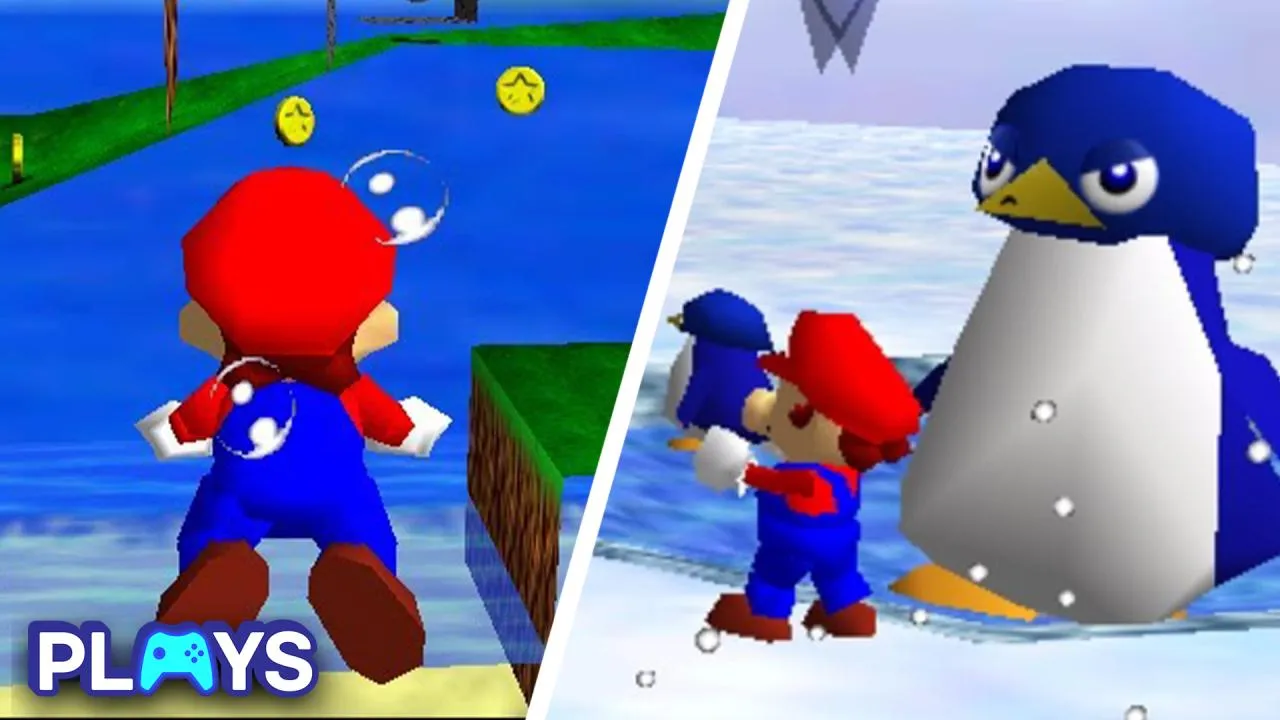
One cute little quest in Mario 64 requires Mario to carry a baby penguin from the top of the snowy level down to its mother at the bottom. Successfully reuniting the pair earns you a Power Star, and thats where most players think theyre done with this lil cherub. If you try to pick up the baby again after returning it, the mother becomes visibly upset and will chase after Mario until he puts her chick down. By the way, this also happens in real life.
Left Speechless
Mario made a good amount of noise through Mario 64, but Princess Peach's voice was heard only twice in the entire game. However, the Japanese release of Super Mario 64 originally left out Peachs voice entirely. Despite her lines being present in every other version, Japanese players experienced the game in total silence where her voice should have been. Guess Japan is more of a Daisy country.
That Sounds Familiar
Reusing and repurposing assets is a common practice in game development. It saves time and resources, and when done creatively, it can be surprisingly effective. With the Mario franchise being home to some of the most iconic villain laughs in gaming history, you might expect them to be the creation of recycling. Boos unsettling laugh in Super Mario 64 is actually just a modified version of Bowsers roar. With a few clever tweaks, the developers turned one fearsome laugh into another. Well done, devs.
Same Song, Different Sound
Anyone whos spent a good amount of time in Mario 64 will instantly recognize the sound that plays when jumping into a new level. Marios voice chimes in, followed by a catchy, oddly familiar tune. I sing it all the time around the house, to the point where I get yelled at for it. You might assume its just part of the consistent sound design across Mario titles, but its actually a sped-up version of the overworld theme from the original Super Mario Bros. Just like Boos laugh being a remixed Bowser chuckle, a slight tempo change gave the old tune a distinctive feel.
Star Recolor
With the goal of the game basically being collect stars, Mario 64 made this easy to track. As you explore, stars you've already collected are marked as a translucent dark blue. But interestingly, that wasnt always the case. In early builds of the game, collected stars were actually gray. Its likely Nintendo felt the gray didnt stand out enough against the games vibrant environments, and opted for the darker blue so they were easier to spot, and avoid.
Blowing Up The Chain Chomp
One of the red coins in Bob-Omb Battlefield hovers just above the post where the massive Chain Chomp is chained, a spot thats tough to reach. Fortunately, theres a clever workaround. If youre fast, you can grab a Bob-Omb from the nearby field, time your approach carefully, and toss it just beneath the Chain Chomp. When it explodes, the blast will launch the Chain Chomp straight into the air, giving you a brief window to safely grab the red coin. Most players dont know this is an option, instead opting for taking damage and just getting in there.
Controlling Tick Tock Clock
What many players of Mario 64 dont realize is that the clock in Tick Tick Clock is controllable by the player. The speed, and behavior of the stage can be controlled based on the position of the minute hand when you enter. Jump in when its on the 3, and everything moves slowly. Enter at 6, and the pace speeds up. A 9 causes the machinery to move unpredictably and out of sync, while a 12 freezes all motion completely, turning the level into a still-life platforming puzzle. Its a great way to manipulate the level to your advantage.
Mario the Hedgehog
Development on Super Mario 64 began around mid-1994, when neither the consoles hardware or its controller had been finalized. Early builds of the game were developed on high-powered Onyx workstations, and in the absence of a finished N64 controller, the development team turned to modified Sega controllers, which at this point in time feels like a betrayal of the highest order.
Getting all Stars
Everyone knows that collecting all 120 stars in Super Mario 64 earns you a trip to the roof of Peachs Castle, where Yoshi is waiting with 100 extra lives as a reward. But reaching that milestone actually does more than just unlock a boring old roof. For example, the penguin you raced in Cool, Cool Mountain is heavier and tougher to beat. And if you face off with Bowser again, he delivers a slightly different message. But Ill let you guys experience it... Fine Ill tell you, he says Hey f*** head go **** your ****.
Reversing Death
Video game consoles often struggle with large numbers... Same. In Super Mario 64, Marios coin counter typically maxes out at 999. However, during the final battle with Bowser in Bowser in the Sky, his fireballs can turn into coins when they hit the ground, making it possible to collect just enough to push the total to 1,000. Doing so triggers a strange glitch: Marios life counter will display as M25, and if he falls off the level and dies, hell actually gain a life instead of losing one. Im not smart enough to know why this is, so lets just say its magic.
Marking the End
Anyone who played the original Super Mario Bros. remembers racing to the flagpole, hoping for a high score or maybe even a bonus life. Or if youre me, you were completely convinced you could jump over the pole, idiot. But in Super Mario 64, the flagpole was notably absent. Given Mario 64s more open-ended world design, the developers cut the flagpole. BUT did you know, development plans did include flagpoles, but the team felt that exploring and collecting items better complemented the 3D gameplay?
Looney Tunes
Obviously Charles Martinet is the man, and defined Nintendo voice acting for over 25 years. But before Martinet put his beautiful pipes on wax, Nintendo actually used stock Looney Tunes sound clips as temporary placeholders during development for Mario 64. Of course, there was never any intention to include those lines in the final game, but its a fun peek into the behind-the-scenes process.
64 Was A Lie
Dont let Big Nintendo tell you lies, although the console had a powerful 64-bits of processing power, a lot of the games - MARIO 64 INCLUDED - actually ran using just 32-bit processing. Which feels like false advertising. There were two main reasons for this choice: Storage limitations, and smoother, faster gameplay. Obviously, they made the right choice, and yes Super Mario 32 would have been a terrible name.
Quit Horsing Around
Remember how much of a game changer it was in Ocarina of Time, when you unlocked the horse? Interestingly, rideable horses were originally considered for Super Mario 64 during early development. Which doesnt seem like a good fit, especially considering YOSHI IS RIGHT THERE. While the idea never made it into the final game, it was reportedly discussed in depth. And its believed that these discussions are what influenced Ocarina of Time in the end.
Brothers in Arms
Speaking of Yoshi not being included, another notable absence is Luigi, Marios brother, who appears to have been intended for the game. The creators revealed that an early prototype actually featured both Mario and Luigi as playable characters, along with split-screen multiplayer... WHAT HAPPENED!? WHY WAS THIS CUT?? Ultimately, Nintendo decided to focus on a streamlined single-player experience, forever cementing them as my greatest enemies.
The Sequel That Never Was
Whenever discussions about Super Mario 64 wrap up, they often circle back to the persistent rumor of a sequel that never was. But its true, a sequel, commonly called Super Mario 64 2, was ACTUALLY in development. This game was said to feature Luigi as a playable character and possibly include multiplayer, ideas that werent surprising, given the previous entries. It was a game that would have been awesome to play, but since we got Super Mario Sunshine and Galaxy 1 and 2 next, were not complaining.

