The 15 Most INFLUENTIAL PS2 Games
“Burnout 3: Takedown” (2004)
Arcade racers are nearly as old as gaming itself, making it hard for developers to innovate on the established formula. The Burnout series had slowly been gaining momentum with its vehicular combat and rewards for driving recklessly, but it was the series’ third entry that remains not only its best, but also its most impactful. With brilliant track design and improvements to the endlessly replayable Crash mode, Burnout 3 was an instant hit with racers and critics. However, it's the game’s Takedown system that remains the most impressive. By slamming, crashing, and psyching out other racers, vehicles would careen into other cars or obstacles and the player would be rewarded with slow-motion shots of the destruction and carnage, with realistic physics sending shrapnel flying. This unique approach to vehicular combat, particularly the destruction and slow-mo has become the standard for not only other arcade racers but any game featuring vehicular combat.
“Ico” (2001)
Nobody likes escort missions in video games. And if they tell you different, they’re lying. Being forced to care for the well-being of an NPC with all the intelligence of a stick can lead to some of the most frustrating moments in our favorite video games. However, Team Ico set out to break this stigma with their game Ico. With the child-like Yorda, players needed to guide her through the game’s many puzzles and obstacles while also keeping her safe from the shadowy creatures trying to drag her away. The game’s AI and narrative were built entirely around this concept and players became incredibly protective over the young girl through the game’s beautifully conceived world and gameplay. In a time when players were used to NPCs running into the line of fire (looking at you, Natalya), Ico proved this to be a worthwhile gameplay mechanic that has been repeatedly iterated and improved upon.
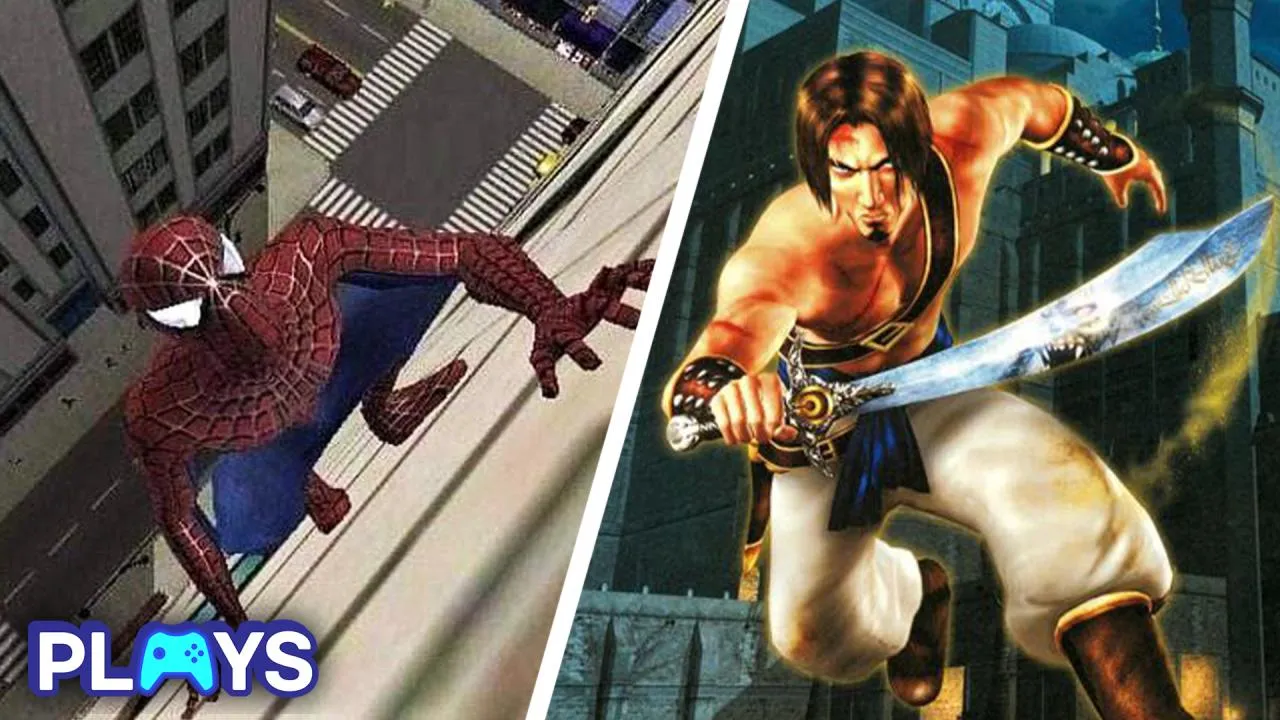
“Spider-Man 2” (2004)
Spider-Man has had countless adaptations of his adventures over the years, and while these games let you swing, wall-crawl and battle baddies, none of them truly let players feel like they were really Spider-Man. That all changed in 2004 however with the tie-in game of all things for Sam Raimi’s blockbuster sequel film. Not only were players given a fully open world New York to swing around to their heart’s content, but the swinging actually mimicked what we always imagined swinging from rooftops would feel like. Whereas in other Spidey games, the webs would shoot into the stratosphere with no purpose beyond keeping Spidey airborne, Spider-Man 2 made the webs tangible and required surfaces or buildings to grab onto. Combined with updated combat mechanics, numerous side activities and upgrades, and Spider-Man 2 set the benchmark for all future web swinging adventures that is still being imitated even today.
“Need for Speed Underground 2” (2004)
Need for Speed had been racing around the circuit since the 90s, and through numerous entries and spinoffs, it became well known for constantly reinventing itself. But it was the sequel to the much beloved spin-off Underground that ended up having the biggest impact on the racing genre. Whereas previous games would allow players to select their races and events from the menu, Underground 2 had players drive around an open world looking for their next challenge. By allowing players to familiarize themselves with the city and streets before races, players could more strategically plan their routes and decide which events they wanted to attempt next, earning new cars and parts for the game’s deep vehicle customization. This not insignificant change to the standard racing formula sent shockwaves through the industry to the point where it’s now almost impossible to find a racing game that ISN’T open world.
“Persona 3” (2006)
JRPGs were the life blood of the PS1 and PS2 era, introducing millions of players to turn-based combat and deep, engaging storylines and memorable characters. However, few managed to have the impact on the genre the way the Persona series, in particular the third entry, did. Managing the day-to-day activities of attending classes, maintaining friendships and relationships, all while battling hellish creatures in the game’s many dungeons offered a new approach to JRPGs and life simulators to create something new that deeply resonated with players. Not only did this style of gameplay appeal to fans of the genre, but the game’s approach to social elements and eye-catching art style drew in fans looking for an interactive way to experience their favorite anime. The success of the Persona series has led to innumerable spinoffs as well as imitators with the game’s mechanics and focus on player choice finding its way into nearly every modern RPG.
“Max Payne” (2001)
The action shooter genre wouldn’t be what it is without Max Payne. One of the earliest titles from Remedy, the game’s use of dark, gritty noir visuals and narrative along with its equally dark and gritty protagonist was enough to set it apart from other shooters, but it was the use of the extremely popular Matrix-esque “bullet time” that made it iconic. Max’s ability to slow time and line up his shots became a genre staple with countless games making liberal use of the feature in everything from Call of Duty’s door breaches to Red Dead Redemption’s Dead Eye mechanic. This seemingly simple gameplay mechanic along with the game’s advanced enemy AI and Max’s impressive maneuverability made the player feel like every encounter held real life-and-death stakes with bullets constantly whizzing by the player, narrowly ending their playthrough.
“Prince of Persia: The Sands of Time” (2003)
3D platformers had been in the spotlight for quite some time by the time The Sands of Time released, and their mechanics hadn’t evolved much in that time. There was the standard jump, double jump, and if you wanted to get really fancy, you could perform an attack while jumping. However, The Sands of Time took a more realistic approach to the Prince’s movements, adapting the budding parkour culture into the Prince’s traversal. What Ubisoft inadvertently created was some of the smoothest traversal in the genre. Not only could the Prince run and jump, but he could wall run, slide and even use some of these moves in the game’s combat, leaping over enemies for a surprise strike from behind. The movement system became the standard for Ubisoft 3rd person platformers and eventually evolved into the Assassin’s Creed parkour traversal while other developers would even adapt this system into first person games.
“Devil May Cry” (2001)
Action hack and slashers have been getting players’ adrenaline pumping since the OG days of gaming, but none managed to do it with such style and finesse as Dante in Devil May Cry. The hack and slash genre was still fun and engaging, but the combat usually revolved around a couple sword strikes, rinse and repeat. Devil May Cry introduced the genre to mechanics usually reserved for fighting games, such as combos and juggling, all while giving players one of the coolest protagonists in gaming history, able to take on enemies two to three times his size with nothing more than his confidence and swagger. The myriad of different weapons, upgrades and rewards for combos gave players more incentive to experiment than the genre was traditionally known for and is still influencing action games to this day. Although no one has managed to dethrone the king himself.
“Shadow of the Colossus” (2005)
You wouldn’t think a game focused almost entirely on boss fights would have such a significant impact on gaming, but you would be wrong. Not only is Shadow of the Colossus a work of art in nearly every aspect, but it also introduced gameplay mechanics that have been infinitely replicated and referenced in the two decades since its release. The groundbreaking climbing mechanics tied to the player’s upgradable stamina, coupled with the expansive open world, have been clear inspirations for numerous open world games including The Legend of Zelda Breath of the Wild and Tears of the Kingdom. The ability to climb the numerous creatures to attack their weak point has become synonymous with many traditional action RPGs and is almost universally referred to as “Shadow of the Colossus” climbing mechanics. The game’s gorgeous world design and minimalistic story has also become the blueprint for numerous indies to tell their stories.
“God of War” (2005)
Video games tend to be seen as a child’s pastime, and with the deluge of bright and vibrantly colored platformers with cutesy mascots, it isn’t hard to see how that comparison came to be. While there were of course some outliers such as the GTA series, few games attempted to tell a mature narrative to go along with their fun and compelling gameplay. God of War presented players with a deeply violent and oftentimes reprehensible protagonist, someone the player almost needed to struggle to sympathize with, but the game’s incredible combat and over-the-top action kept driving them forward to the game’s conclusion. God of War’s exhilarating and brutal combat, various weapons and abilities, and darkly adult subject matter changed not only how developers looked at their narratives in gaming but also changed PlayStation forever, encouraging them to create games for a younger audience as well as their older ones.
“Silent Hill 2” (2001)
While the majority of early horror titles were focused on jump scares or giving players an arsenal with which to fight back the horrors, Silent Hill terrified players with its fog laden streets and horrific creatures hiding in the dark. The follow-up changed the genre forever, focusing not only on the terrors lurking in the fog, but also the horrors within ourselves, blending elements of traditional horror with the unsettling imagery and psychological horror of films like Jacob’s Ladder. Silent Hill 2 told arguably the most mature story in the series, uncovering the mystery that led them to town and the horrific reasoning behind the many creatures relentlessly pursuing you. Silent Hill 2 stuck with players not for its terrifying creatures and imagery but for its fantastic use of foreshadowing and brilliantly and realistically horrific narrative that is still being dissected today.
“Metal Gear Solid 3: Snake Eater” (2004)
Naturally Hideo Kojima’s baby, the Metal Gear series, has been substantially influential to video games, having birthed the stealth genre itself. But it’s with arguably the best game in the series Metal Gear Solid 3: Snake Eater, that Kojima crafted the most influential title in the series and the stealth genre. Not only is Snake Eater his most tightly constructed narrative in the series, expertly told through film-quality cinematics, but the additions to the traditional stealth mechanics can still be found ever evolving in video games today. It combined traditional stealth with camouflage options and survival mechanics and, while arguably not the first, it certainly popularized hiding from enemies in tall grass, a trope that plagues countless titles to this day. The stealth genre wouldn’t be what is today without Snake Eater or the Metal Gear series.
“Kill Switch” (2003)
While some will attribute the mechanic to Winback, Kill Switch was actually the very first 3rd person cover shooter. While games such as the aforementioned Winback and even Metal Gear Solid would allow players to take cover, Kill Switch was the first game that allowed them to shoot from a covered position, whether by blind fire or leaning over cover for more accuracy. By pressing a button, players would latch onto cover, shielding them from enemy fire and allowing them to fire back from safety. This mechanic was so revolutionary, it has become the industry standard for almost every single game with 3rd person shooting mechanics. The mechanic was so influential that the lead developer of Kill Switch was hired by Epic for their Gears of War series where the cover mechanic arguably reached its pinnacle of popularity and influence.
“Resident Evil 4” (2005)
As if almost single-handedly creating the survival horror genre wasn’t enough, for the series’ 4th mainline entry, Capcom made arguably their most significant stamp on the entire gaming industry. Forgoing the series’ traditional fixed camera, Shinji Mikami put the camera directly behind Leon, allowing players to aim directly over Leon’s shoulder, and history was made. Not only was this new perspective revolutionary, but it also allowed for more player interactivity with the game’s world as well as the reactionary enemy AI. The precision aiming from the new perspective has been combined with multiple other gameplay mechanics such as the previously mentioned cover mechanic to create entirely new genres from this one simple gameplay change. Much like many other entries on our list, this one changed all of gaming forever, finding its way into nearly every genre and is without a doubt one of the most imitated gameplay mechanics since the double jump was created.
“Grand Theft Auto III” (2001)
Arguably no video game, PS2 or otherwise, has had such a substantial impact on gaming as Grand Theft Auto 3. Taking their cops and robbers formula to 3D, Rockstar ushered in the deluge of open world sandbox games where player freedom is at its very core. With each subsequent entry, Rockstar improved on the formula, adding additional game mechanics and side activities to further immerse the player in the world. Giving players an open map and setting them loose to explore and engage in as much or as little as the world had to offer was the biggest shake up in the gaming industry since 3D graphics became the standard. Within the same generation, we had countless imitators, homages, and even games shifting completely to the open world GTA formula, and even today, developers are continuing to fine tune the formula originally crafted by Rockstar over two decades ago.
Which PS2 game do you think had the biggest impact on gaming? Share your thoughts in the comments below.

