Top 75 Greatest Archeological Discoveries Ever
- Handwritten Copy of Sonnet 116
- Tikal
- The Jade Burial Suit of Liu Sheng
- The Nefertiti Bust
- The Tomb of Philip II of Macedon
- The Uluburun Shipwreck
- The Dead Cities of Syria
- Prehistoric Calendar
- Öseberg
- Ancient City of Peñico
- Tomb of Te' K'ab Chaak
- Ħal Saflieni Hypogeum
- Great Zimbabwe Ruins
- The Royal Cemetery at Ur
- 2,000-Year-Old Nabataean Temple
- Al-Natah
- Evidence of Moche Matriarchy
- Ancient Babylonian Hymn
- Oldest-Known Fingerprint
- L'Anse aux Meadows
- Dinosaur Tracks
- The Tomb of Qin Shi Huang
- Angkor Wat
- Oldest Known Cave Paintings
- Tomb of Thutmose II
- Akrotiri
- The Mummification Workshop of Saqqara
- The Pet Cemetery of Berenice
- Skara Brae
- The Sacrifices of Huanchaquito
- Lost Golden City of Aten
- Europe's Oldest Map
- Dragon Man
- Harappa's Lost Civilization
- Lost Leaders of Jamestown
- The Herculaneum Papyri
- Kabwe 1 Skull
- Blombos Cave
- Oldest War Monument
- The Earliest Story
- Tombs of the Pyramid Builders
- Petra
- Voynich Manuscript
- Hurrian Hymn No. 6
- The Atlantis of the Sands
- Suontaka Grave
- Staffordshire Hoard
- The Gold Mask at Sanxingdui
- The Benin Bronzes
- Neolithic City of Shimao
- Homo Naledi in Rising Star Cave
- Derinkuyu
- Aztec Calendar Stone
- Neanderthal Genome in Vindija Cave
- Easter Island Moai
- Göbekli Tepe
- The Oldest Footprints in North America
- Richard III's Grave
- Madaba Map
- The Serapeum of Alexandria
- Knossos
- Ötzi the Iceman
- Mohenjo-daro
- Antikythera Mechanism
- Troy
- Tutankhamun's Tomb
- Sutton Hoo
- Olduvai Gorge
- Cave of Altamira
- The Terracotta Army
- Dead Sea Scrolls
- Pompeii
- The Library of Ashurbanipal
- Lucy
- The Rosetta Stone
#75: Handwritten Copy of Sonnet 116
Imagine this: you’re casually flipping through a museum founder’s items, and find literary gold. That was essentially what happened in 2025, when Dr. Leah Veronese got the opportunity to look through Elias Ashmole’s papers at Oxford University. Nestled within the pages of a 17th century anthology was a handwritten copy of Sonnet 116. It had been transcribed with altered and added lines, and shockingly didn’t mention Shakespeare at all, despite the fact that he’d originally written the piece. It was eventually discovered that it was a rare analysis of the work that viewed it through a political lens, rather than a romantic one like it is now. It proved how widely-accepted modern interpretations of old works aren’t always as sound as we might think.
#74: Tikal
Even the most prominent cities are susceptible to being forgotten about. That was the case for Tikal, a prominent Maya metropolis that was lost to time once the civilization collapsed. For centuries, it went untouched in a Guatemalan rainforest, and wasn’t officially found again until 1848. Archaeologists took to the site soon afterward, and since then it has been an invaluable resource in understanding the ancient culture. From large, looming temples to Mesoamerican ballgame courts, we’ve been able to learn so much about how they operated day-to-day. Modern technology has revealed thousands of additional structures that have remained concealed by the dense flora — meaning there’s even more historical secrets just out of reach that are waiting to be solved.
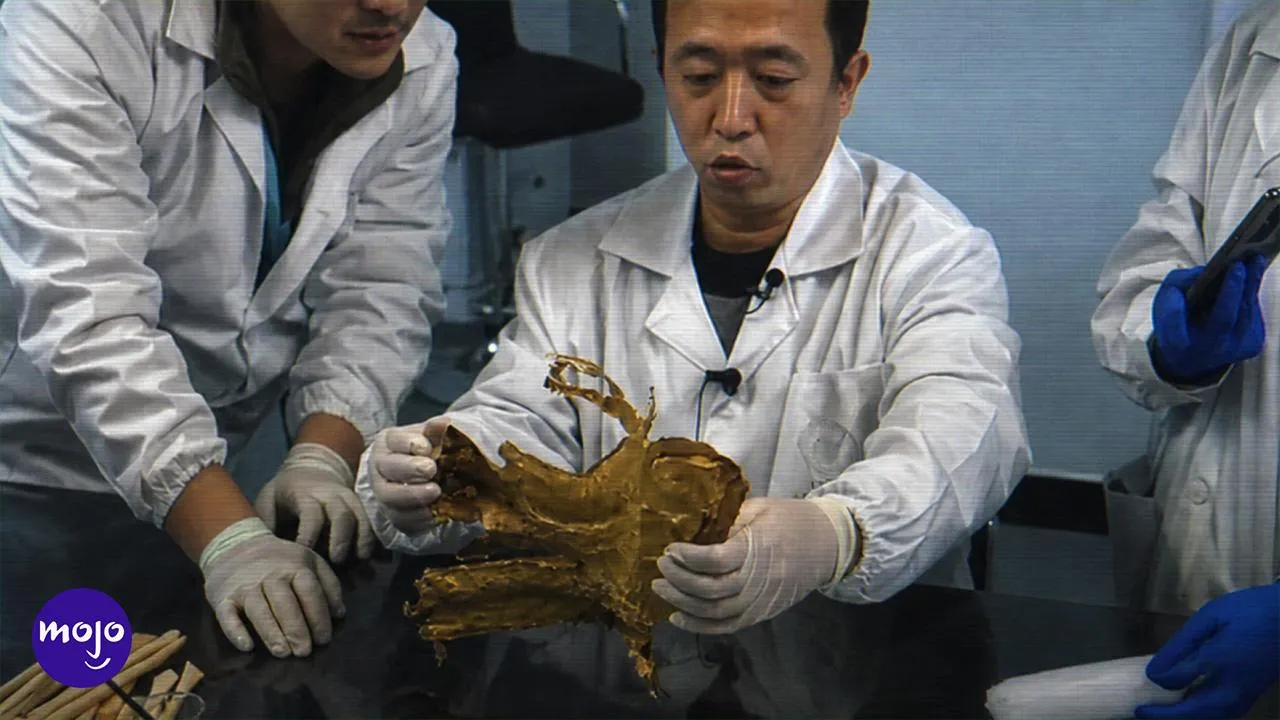
#73: The Jade Burial Suit of Liu Sheng
All it took was one dig to confirm one of history’s biggest rumors. For some time, stories of ancient Chinese royals being entombed in intricate gemstone suits had been written down, but never confirmed. That all changed for good in 1968. That year, members of the army knocked down a wall in order to build a shelter, and came across a burial chamber. There, they found the bodies of Liu Sheng and Dou Wan encased in suits made from thousands of jade pieces and golden thread. For the first time in modern history, their existence was proven. The beautifully-crafted garments offered unseen insight into China’s foregone funerary rituals — including a belief that jade could prevent a body from decomposing.
#72: The Nefertiti Bust
Its iconic design has made it one of the most widely known archaeological discoveries in history. For centuries, the Nefertiti Bust had been locked away in a derelict workshop that had once been owned by Thutmose, an iconic ancient sculptor. The intricate work remained hidden from view until 1912, when it was uncovered by Ludwig Borchardt. The bust, which is estimated to have been made in 1345 BC, has enchanted the world at large. From the pigments to the facial features, it has helped us understand both the art style and the beauty standards of the time. It has not only ensured that Queen Nefertiti herself has remained relevant — it has also become one of the most recognizable pieces of the Ancient Egyptian era.
#71: The Tomb of Philip II of Macedon
Although the excavations may have begun in the 19th century, it would take over a hundred years before anything of note was found. In 1977, archaeologists in Vergina, Greece finally found what they were looking for in a hill called the Great Tumulus. Upon investigating, they came across four royal tombs that they believed belonged to members of Alexander the Great’s family. Of these, the most significant was that of his father, King Philip II of Macedon. The find was contested, until a study in 2023 confirmed that the initial conclusion had been correct the entire time. The other remains were also found to have been his grandfather and son, giving us a clear picture of Alexander's lineage in just one site.
#70: The Uluburun Shipwreck
How many dives would you be willing to embark on to uncover prime archaeological treasure? For those excavating the site of the Uluburun shipwreck, the answer was simple: 22,413. Those began shortly after the ruins were discovered in the Bay of Antalya in 1982. The ship, which has been estimated to have sunk at the end of the 14th century BC, is home to ancient building materials which would have once been used for trade. The items ranged from ingots made of copper and glass to jars filled with ancient versions of turpentine, along with other miscellaneous objects and weapons. All in all, it served as a perfect time capsule of the era — making all of those trips the divers took 100% worth it.
#69: The Dead Cities of Syria
Tikal isn’t the only city to have been lost to time. In Syria, the remains of over 700 abandoned settlements have become the main proof of former life. Many of the areas date back to between the 1st and 7th centuries, with one of the most prominent being Serjilla. The former metropolis was first studied back in the 1860s, and since then several structures have been identified. Each Forgotten City is home to its own unique architecture and sites. It's believed that they may have succeeded as a trading spot during the Byzantine empire, but lost their significance once it fell. Although there’s still so much to learn, they have already proven to be some of the most fascinating sites in the region.
#68: Prehistoric Calendar
Göbekli Tepe alone was an extremely significant find. However, within the site itself is another gem: evidence of the first lunisolar calendar in human history. While studying a pillar on the site in 2024, researchers came across several carvings that they believed represented various days. It was concluded that the calendar consisted of twelve months, and a well-kept log tracking the phases of the sun, moon, and stars. Beyond that, researchers have also posited that it was created to commemorate a comet strike that brought on a mini-Ice Age. Should they be correct, it could be proof of ancient humans keeping track in an attempt to predict future events. While that hasn’t been proven yet, it would reveal the true intellectual capabilities of our ancestors.
#67: Öseberg
If you thought the Uluburun shipwreck was cool, just wait until you hear about this. In 1904, a farmer examined a burial mound on his property, and found one of the most fascinating artifacts in archaeological history: a preserved Viking longship that had been buried during mid-800 CE. The vessel alone was impressive enough, but the items buried near it even more so. The grave also consisted of various artifacts, from figurines depicting Buddha to intricately decorated sleighs. Alongside the items were the bodies of two women, with one believed to have been in a position of power, and the other to have been a victim of sacrifice. These discoveries have been valuable in helping understand Viking culture — including ones of its darkest components.
#66: Ancient City of Peñico
Although we know how far back human history goes, it can be hard to truly visualize. Finding abandoned cities, such as Peñico, have made it easier to understand just how long we as a species have been building — and destroying — civilizations. The Peruvian city dates back thousands of years, towards the conclusion of the Caral–Supe era. The site was studied for nearly a decade before being revealed to the rest of the world in 2025, which gave experts time to find over a dozen identifiable buildings. They also found objects that provided clues into the culture of the time. Researchers believe that the city holds the key to understanding why the civilization eventually collapsed, and what happened to the population afterwards.
#65: Tomb of Te’ K’ab Chaak
The discovery of various items are just one piece of the puzzle when it comes to understanding our past. Finding evidence of people who lived back then — particularly leaders — offer insight into their funerary practices. This was proven in 2025, when archaeologists at the University of Houston found the tomb of Maya king Te’ K’ab Chaak in Caracol. He was the city’s first known ruler, making it an even more valuable find. It was made better with the revelation of several high-value items, including jewelry and a mask carved from jade and just under a dozen ceramic jars. It allowed us to see just how much those with power were revered at the time, and how they were treated in death.
#64: Ħal Saflieni Hypogeum
Sometimes, the best discoveries are those that were made accidentally. While workers were innocently working on creating cisterns one day in 1902, they stumbled across a massive underground chamber. Soon, studies into the Ħal Saflieni Hypogeum began. Initially, the excavations were done haphazardly, which led to several valuable items and human remains being foolishly discarded without a second thought. Subsequent excavations were much more thorough, which have allowed us to actually look into and understand the findings. Researchers hypothesized that the Hypogeum was used for thousands of years, which would make it home to multiple eras worth of artifacts. Everything from the thousands of people buried inside to the mysteriously resonant Oracle Room has helped us understand the Salfieni phase.
#63: Great Zimbabwe Ruins
Racism affects everything– even the way historical sites are analyzed. One of the most unfortunate examples of this are the ruins of Great Zimbabwe, which served as the capital of the region in ancient times. It was rediscovered by European Adam Render in 1867, who immediately scoffed at the idea that it had been built by the native population. Beyond that controversy, the site is home to several fascinating structures and building techniques, including one area that was constructed without the use of mortar. With it dating back to the 11th century CE, it serves as significant evidence of Africa’s advancements. Today, the site is a powerful reminder of how bias twisted historical interpretation for generations.
#62: The Royal Cemetery at Ur
As we’ve seen in some of the other entries on this list, burial spots can be home to a plethora of incredible historical discoveries. The Royal Cemetery at Ur in Iraq is the perfect example. Beginning in 1922, British citizen Sir Leonard Woolley excavated the funerary site, which led to multiple small items being uncovered. Woolley excavated over 1,800 graves over the course of a dozen years. With those came the uncovering of over a dozen royal graves and a wide variety of goods. They ranged from musical instruments and goat statues to various types of jewelry, the latter of which providing potential proof that they traded with those in the Indus valley. With just one man’s determination, centuries worth of history was uncovered.
#61: 2,000-Year-Old Nabataean Temple
Seemingly random finds can rewrite everything we once knew about a culture. Take the Nabatean civilization, for example. For some time, their reign was primarily associated with the ancient city of Petra, and surrounding areas. A new discovery in 2025 revealed that they had also successfully built near modern-day Italy as well. That year, a submerged temple was found off the coast of Pozzuoli, and marked the first of its kind outside the Middle East. It dated back at least two thousand years, and its placement suggests that it was used to trade while the Nabateans built a relationship with the Roman Empire. It gave important insight into their success, and suggests that there may be more like it in the Mediterranean area.
#60: Al-Natah
With how advanced modern-day Saudi Arabia has become, sites like this are a reminder of where it all began. In 2024, a fortified town believed to be at least four thousand years old was found. Al-Natah showed an interesting side to human development — the desire to take it slow. Unlike its contemporaries at the time, the Bronze Age settlement took its time to grow its population and make moves to urbanize. Their construction methods made it harder for unwitting excavations to be carried out, making it virtually untouched by the time it was discovered. That has made it ideal for investigation, leading to the uncovering of artifacts that give more glimpses into their way of life. Only time will tell what will be excavated next.
#59: Evidence of Moche Matriarchy
Although items found during archaeological digs are valuable and priceless in their own right, some of the most fascinating discoveries are those that challenge the way we think. One of the best examples was the revelation that the Moche civilization may have been matriarchal. It all began in 2006, with the discovery of the Lady of Cao. Her mummified body was buried alongside valuable items, leading some to suggest that she was a high-ranking ruler or priestess. Prior to that point, it was believed that only men within the culture held those positions. However, that was only the beginning. Since then, several other tombs belonging to powerful Moche women have been found, along with throne rooms that indicate they may have ruled over others.
#58: Ancient Babylonian Hymn
When modern technology and ancient history unite, the result is simply mind blowing. Take the likely centuries-long lost Hymn to Babylon, for example. The 250-line musical composition had seemingly been lost to time, with there being no way to decipher it. That is, until AI came around. In 2025, experts used the tech to connect thirty different scripts from around the same time period. The result was a translation praising everything from the city’s architecture to the Euphrates River. Other sections commemorate the god Marduk, which provided information into some of the religious traditions at the time. The finished product was a historical and technological marvel— and best of all, it’s a sign that even the most elusive texts will be made known to us.
#57: Oldest-Known Fingerprint
With so many advancements in AI and other technology in recent years, discoveries like this remind you of where it all began. In 2022, archaeologists came across what seemed to be a normal rock in a Segovia shelter. However, there was one defining mark: a single red dot. This was no ordinary mark, however. This was a fingerprint— the world’s oldest at that. Researchers predicted that it was at least 43,000 years old, and that it may have been placed intentionally around other markings in order to replicate a face. The Neanderthal that did so may have been experiencing pareidolia, which causes humans to recognize facial features in random objects. If that’s true, it could be the world’s first documented case of such a thing.
#56: L’Anse aux Meadows
Long before Columbus sailed the ocean blue in 1492, different colonists made their way towards the Americas. The group consisted of Norse settlers, who traveled to the highest point of Newfoundland and built a settlement there. Their community was eventually found in the 1960s, long after they had disappeared from the area. The site — named L’Anse aux Meadows — soon proved to be one of the most significant findings of the 20th century. Besides containing architecture and items that coincided with European sites dating back to 1,000 CE, it also proved something new about migration during ancient times. To this day, it’s still the only confirmed site to have belonged to the Norse population prior to the Colombian voyage.
#55: Dinosaur Tracks
With how far intelligent life on Earth has come, it can be hard to remember that we once shared it with now-extinct species. Physical proof has remained the biggest reminder, and this finding in particular was practically impossible to dispute. In 2025, scientists in the United Kingdom revealed that the Dewars Farm Quarry was home to nearly 200 footprints belonging to various types of Jurassic-era dinosaurs. Five trackways were found, with four of them being credited to a massive sauropod. The fifth in particular stands out, with it being made by a Megalosaurus. The discovery not only helped us learn more about dinosaurs’ travel habits — it also gives us an idea of how different the world looked back when they roamed.
#54: The Tomb of Qin Shi Huang
On a normal day in 1974, history was made. It all started when Yang Zhifa attempted to dig a well in Xiyang, China — only to find an assortment of items. It was later found that they had dug into the tomb of Emperor Qin Shi Huang, the first leader of the Qin dynasty. Although the Terracotta soldiers are well-known, that isn’t all the mausoleum contains. Besides the pits filled with artifacts and figures, his own burial mound remains untouched in the center. There are countless untold secrets lying in wait within the chambers, but with its vast size, a full-on dig unfortunately isn’t possible yet. While we don’t know the full contents, it's still one of the best-preserved museums dedicated to him and his rule.
#53: Angkor Wat
Since its construction, it has remained one of the most iconic religious sites the world has to offer. Angkor Wat has been seen consistently throughout history, either by those who utilized it or those who happened to come across it. It was officially rediscovered and written about on a mass scale in 1860 by Henri Mouhot, who helped popularize the site. It already had a rich past with it having stood since roughly 1150 CE. The site is also just one piece to a larger puzzle in ancient Cambodian history, with it just being one of many buildings making up a city that thrived during the Khmer regime. To this day, it's still one of the most culturally-significant places in the world.
#52: Oldest Known Cave Paintings
In recent years, Indonesia has proven to be one of the most archaeologically significant countries on the planet. Why? It has two of the oldest known cave paintings in human history. Originally, a drawing in Leang Karampuang cave depicting pigs was believed to have been the most ancient. At the time of discovery in 2024, it was said to have been 51,200 years old. Little did they know the country was about to break its own record. In 2026, researchers found a stenciled hand in the Leang Metanduno cave. This was dated back 67,800 years — making it roughly 17,000 years older than the previous champ. This seems to show that creative thought was as much of an instinct as basic survival was.
#51: Tomb of Thutmose II
In 2025, archaeologists finished collecting a set they had started over a century beforehand. Their final piece was the tomb of Egyptian pharaoh Thutmose II. His body had been found centuries beforehand, but his intended resting place was another story. That is, until a sealed burial spot was found in 2022. The area had remained elusive thanks to intense flooding, which created so much debris that it obstructed the mausoleum. Three years later, they were finally able to open it. All it took was one look at the ceiling painted with stars to know they had come across a King’s tomb. Not only were researchers able to learn more about his reign, they had finally found the resting place and corpse of every Tutankhamun-era leader.
#50: Akrotiri
Beneath the volcanic cliffs of Santorini, an ancient city slept for 3,500 years. In 1967, archaeologists uncovered Akrotiri - a prehistoric town frozen in time. Like Pompeii, it was preserved by volcanic ash, but it’s even older. Inside, researchers discovered shockingly advanced technology. There were multi-story homes, paved streets, frescoes still bright with color, and an advanced drainage system. Streets and squares stretched across the site, showing a city that once thrived on trade and artistry. Akrotiri opened a window into the Bronze Age Aegean, revealing how sophisticated early civilizations could be. Many believe it inspired the legend of Atlantis, since its people vanished before the eruption. Their fate remains one of history’s great mysteries.
#49: The Mummification Workshop of Saqqara
In 2023, archaeologists made a chilling discovery beneath the sands of Saqqara, Egypt. They uncovered a 2,300-year-old mummification workshop. There, ancient embalmers prepared the dead for eternity. Inside they found stone beds for the bodies, alongside measuring cups, oils, and resins; all of the tools of the macabre trade were frozen in time. The workshop seems to have been built around two tombs, each predating the main dig by hundreds of years. The find pulled back the curtain on how Egyptians treated death. While we are all somewhat familiar with mummification thanks to Hollywood, this find is unique. Researchers now have a window into the practice, helping us to understand the ancient Egyptians more than ever.
#48: The Pet Cemetery of Berenice
Stephen King, eat your heart out: in 2011, archaeologists uncovered a forgotten cemetery in the ancient port city of Berenike, Egypt. What made this discovery remarkable is that it wasn’t for humans but for pets. Archaeologists uncovered hundreds of carefully buried cats, dogs, and monkeys. Many were lovingly wrapped in blankets or nestled in baskets. Some animals were buried in their ancient collars, lovingly laid to rest by their human companions. The site is nearly 2,000 years old - dating back to 1st and 2nd century CE. That makes it the earliest known pet cemetery on earth. It confirms that humans’ love for their furry family is as old as modern civilization.
#47: Skara Brae
In 1850, a violent storm hit the Orkney Islands of Scotland. When the winds died down, something extraordinary was left behind. Hidden beneath the sand dunes was Skara Brae: a 5,000-year-old Stone Age village, older than the pyramids of Egypt. Archaeologists uncovered stone houses, beds, shelves, and hearths, all remarkably preserved. Even stone-lined toilets and drainage systems were intact. Skara Brae became one of the best-preserved neolithic settlements in Europe. It offered historians and scientists a rare glimpse into daily Neolithic life. Even 5,000 years ago, our ancestors knew the importance of hearth and home.
#46: The Sacrifices of Huanchaquito
In 2011, archaeologists made a haunting discovery near Chan Chan, Peru. They uncovered the remains of 140 children and 200 llamas, buried together in shallow graves. The site dates to around 1450 CE, during the height of the Chimú civilization. This is the largest known child and animal sacrifice site in history. It represents a ritual unprecedented in documented scale. Researchers believe the Chimú people performed the ceremony during catastrophic flooding. They think it was meant to calm the weather and save their kingdom from collapse. When nature turned violent, so did ancient belief.
#45: Lost Golden City of Aten
Egypt is famous for its well-documented pyramids, tombs, and temples. But in 2021, archaeologists uncovered something rarer: an entire lost city. Beneath the sands of Luxor, they found Aten - a 3,400-year-old metropolis from the reign of Amenhotep III. Walls rose from the ground. Houses, kitchens, and workshops were discovered, still stocked with tools, pottery, and jewelry. It was as if the occupants had all instantly vanished, right before the city was lost to the sands. Scholars call it the biggest Egyptian find since King Tut’s tomb. Aten is a direct glimpse into the daily life of ancient Egypt’s golden age. We now have a better understanding of ancient Egyptians from palace workers to artisans and cooks.
#44: Europe’s Oldest Map
Sometimes archaeology rewrites history - not with a new find, but with a new look at an old one. In 2021, researchers realized a carved stone slab from France wasn’t just art. It was a map, the oldest known map of Europe. The slab, called the Saint-Bélec Slab, dates back to the Bronze Age, between 2150 and 1600 BCE. Etched into the rock are mountains, rivers, and fields, representing a tiny kingdom in western France. It’s the first known territorial map in Europe, showing how early rulers organized, controlled, and visualized their land.
#43: Dragon Man
In 1933, a laborer in Harbin, China found a giant human skull while working on a bridge project. But China was under Japanese occupation, and he feared the discovery would be seized or destroyed. So he hid the skull in a well. It remained there for nearly 90 years. When scientists finally got their hands on it, they were stunned. Nicknamed “Dragon Man,” the skull had massive brow ridges, huge eye sockets, and a brain as big as ours. Some believe it’s a Denisovan, a mysterious branch of the human family. The discovery is rewriting our understanding of human evolution in Asia.
#42: Harappa’s Lost Civilization
History books used to start with Egypt and Mesopotamia. Then Harappa changed the story. In 1921, archaeologists digging in Pakistan uncovered one of the world’s oldest and most advanced cities. Harappa belonged to the Indus Valley Civilization, a Bronze Age culture that rivaled its famous neighbors. It had planned streets, drainage systems, and massive public buildings. It was proof that a sophisticated, urban society had reigned long ago in the Indus Valley. The discoveries didn't end with a single lost city. Archaeologists unearthed evidence of an entire forgotten civilization, stretching across Pakistan and northwest India. It changed our understanding of ancient civilizations forever.
#41: Lost Leaders of Jamestown
For centuries, the founding leaders of Jamestown were missing from history - both figuratively and literally. That all changed with a shocking find in 2013. Archaeologists uncovered the graves of four elite colonists, buried inside the remains of Jamestown’s original church. Thanks to forensic science, dental records, historical clues, and limited DNA testing, researchers identified them. The group included Captain Gabriel Archer, who may have secretly remained Catholic, and Reverend Robert Hunt, Jamestown’s first Anglican minister. These men helped shape the first permanent English colony in America. Little was known about their ultimate fates. Their discovery brought the faces and stories of early colonial leadership back from the grave.
#40: The Herculaneum Papyri
Some ancient libraries were ultimately burned to ash. This one turned to stone - or, more properly, carbon. In 1752, explorers near Naples uncovered the Villa of the Papyri, buried by Mount Vesuvius in 79 CE. Like the citizens of Pompeii, the collection was carbonized by volcanic ash. Inside were over 1,800 papyrus scrolls, intact but blackened and hardened by heat. Today, researchers are using X-ray and AI technology to read the scrolls without unrolling them. Many scrolls contained the works of Epicurean philosophers, including texts lost for centuries. The villa could still hold thousands more texts, waiting patiently under layers of volcanic ash.
#39: Kabwe 1 Skull
Some discoveries happen out in the field through painstaking, deliberate research. This one happened by accident with a pickaxe in a mine shaft. A century ago, a miner in Kabwe, Zambia struck something strange in the limestone. He found a nearly complete human skull, fossilized in place. Scientists called it Kabwe 1, also known as the Broken Hill Skull. It belonged to Homo heidelbergensis, an early human species that lived between 300,000 and 125,000 years ago. The skull had a mix of features: a massive brow ridge and large braincase, halfway between ancient hominins and modern humans. It was one of the first ancient human fossils ever found in Africa. It changed everything scientists thought they knew about human evolution.
#38: Blombos Cave
It's every archaeologist's greatest dream to stumble across a find that rewrites human history. Researchers in South Africa did just that thanks to the dig in Blombos Cave, South Africa. They found engraved ochre, shell beads, and tools, dating back as far as 100,000 years. The site contained marvels. The artifacts showed early humans making art, jewelry, and tools. Given the age of the cave, the meaning was clear: humanity's creative endeavors began tens of thousands of years earlier than previously thought. Blombos Cave is considered proof that modern human behavior - creativity, symbolism, culture - didn’t begin in Europe. It started in Africa.
#37: Oldest War Monument
If the Fallout games have taught us anything, it's this: war never changes. Excavations in northern Syria proved it in 1988. Most ancient monuments honor kings or gods. This one honored fallen soldiers. At Tell Banat, researchers uncovered a massive stepped white monument, built around 2450 BCE. Inside, they found carefully arranged human remains, mixed with animal bones and weapons. For years, scholars weren’t sure what it meant. But in 2021, researchers reanalyzed the evidence and realized it was likely the world’s oldest war memorial. It wasn’t a mass grave, exactly; it was a public monument to the dead, a collective tribute to lives lost in battle.
#36: The Earliest Story
Once, we thought storytelling started with writing. We were wrong - it began much earlier, painted on the walls of caves. More interestingly, the earliest ever human story wasn't found in Europe, or Africa. It was found in the South Pacific. In 1973, archaeologists began exploring the Maros-Pangkep caves in Sulawesi, Indonesia. Decades later, in 2024, researchers found something that changed everything: a cave painting more than 45,000 years old. It is the oldest known narrative art. It shows human-like figures interacting with a wild pig, telling a story through images. It predates similar European sites by 20,000 years.
#35: Tombs of the Pyramid Builders
For centuries, it's been common knowledge that the pyramids of Giza were built by slaves. That 'common knowledge’ may have been entirely wrong. A dig in 1990 revealed a shocking twist to the familiar narrative: the tombs of the workers themselves. These were not slave graves. They were honorary burials, complete with food offerings and supplies for the afterlife. The workers were likely skilled laborers, respected for their role in building the pyramids. They lived in nearby workers’ villages, rotated shifts, and ate meat-rich diets - rare for common Egyptians. The discovery shattered myths and revealed the real workforce behind Egypt’s most iconic monuments.
#34: Petra
For centuries, the city of Petra was little more than a legend to anyone outside of Jordanian Bedouins. It was a marvel only whispered about, lost to the outside world. Then in 1812, Swiss explorer Johann Ludwig Burckhardt disguised himself as a Bedouin and stumbled upon its hidden entrance. What he found was breathtaking: a city carved into rose-red cliffs, with temples, tombs, and an enormous amphitheater all sculpted from solid rock. Petra was once the capital of the Nabataean Kingdom, a wealthy hub for spice and silk trade routes. Today, it’s one of the most iconic archaeological sites on Earth and one of the most popular tourist attractions in the region.
#33: Voynich Manuscript
Wilfrid Voynich was a Polish artifact hunter and rare book dealer at the turn of the 20th century. In 1912, he stumbled upon a book like no other. Once belonging to a 17th century Czech alchemist, the Voynich Manuscript is an utter mystery. Carbon-dated to the early 1400s, its pages are filled with bizarre illustrations. The images include strange plants, astrological charts, even women bathing in odd green liquids. What truly makes the book a mystery, though, is the indecipherable text written in an unknown language. Despite over a century of research, no one has cracked the code. Some think it’s a ciphered medical guide. Others call it an elaborate hoax. The Voynich Manuscript remains one of the greatest unsolved puzzles in archaeology and cryptology.
#32: Hurrian Hymn No. 6
Cuneiform is the earliest known writing system: a wedge-shaped script pressed into clay over 5,000 years ago. Most discovered cuneiform tablets - while significant - aren't particularly artistic. They tend to be records of laws, trade, or taxes. But in the 1950s, archaeologists in Ugarit, Syria, uncovered something different: cuneiform music. Etched onto clay was Hurrian Hymn No. 6, the oldest known piece of written music on Earth. It dates back to around 1400 BCE and was dedicated to Nikkal, goddess of orchards. The tablet contains lyrics and musical notation for a lyre. It was an ancient melody transported more than 3000 years through the sands of time.
#31: The Atlantis of the Sands
For centuries, legends spoke of a lost Arabian city, swallowed by the desert. Western explorers gave it the name the Atlantis of the Sands. Some thought it was pure myth. Then in 1992, satellite imaging and excavations in southern Oman uncovered the ruins of Ubar, a once-thriving trade hub that dealt in frankincense, gold, and spices. The settlement likely collapsed into a massive sinkhole, sealing its fate beneath the desert. The discovery was a landmark moment in archaeology; one of the first times satellite technology directly led to the uncovering of a lost city. The legends, as it turns out, were real all along.
#30: Suontaka Grave
In 1968, a construction crew from Suontaka Vesitorninmäki in Finland was working on water pipes when they stumbled upon an archeological marvel. They found a warrior’s grave dating back almost a thousand years. There were numerous artifacts buried with the warrior, including a sword and women’s jewelry. The body was laid on a blanket of feathers, wearing women’s clothes. For decades, it was assumed that it was the grave of a warrior woman. Recent DNA tests have revealed something much more nuanced. The Suontaka warrior had Klinefelter syndrome, meaning they had both an extra x chromosome and a y chromosome. This warrior was likely non-binary and was clearly an honored member of their community.
#29: Staffordshire Hoard
Metal detector enthusiasts around the world received a glowing endorsement for their hobby in 2009. Terry Herbert was exploring a field in Staffordshire, England when he stumbled upon the largest hoard of Anglo-Saxon gold and silver metalwork ever found. Over 3,500 items were discovered, primarily military artifacts such as sword fittings, helmet fragments, and jewelry. This one discovery brought historians more than 60% of Anglo-Saxon artifacts currently in existence today. Its discovery completely reshaped our current understanding of Anglo-Saxon culture, both in terms of early Christianity and Anglo-Saxon armies. The sheer quantity of items, primarily martial in nature, suggested a previously underestimated level of wealth and status among the Anglo-Saxon elite.
#28: The Gold Mask at Sanxingdui
The Gold Mask of Sanxingdui was discovered in 2021 during the excavation of two sacrificial pits in Sichuan, China. This incredible artifact, dating back to around 1200 BCE, is estimated to be over 80% pure gold. It was likely used either as a facial covering during ritual sacrifice or as a burial mask. Scientifically, the mask provides insights into the advanced metallurgical techniques and cultural practices of the ancient Shu Han kingdom. Historically, it underscores the complexity and diversity of early Chinese civilizations, challenging established narratives and expanding our understanding of ancient cultural development in the region.
#27: The Benin Bronzes
The Benin Bronzes weren’t so much discovered as they were plundered. During an 1897 punitive expedition to the Kingdom of Benin, the British Army stole over 5,000 figurines, tablets, carved tusks, and ancient sculptures. Some artifacts date as far back as the 13th century. They represent centuries’ worth of the cultural, religious, and history of modern-day Nigeria. The bronzes spent a century shuffling around European collections. The metallurgical techniques were impressive and as records of Benin's sophisticated civilization, the bronzes are priceless. Ongoing efforts persist to return these culturally significant artifacts to Nigeria from British and other Western institutions. Today, the Benin bronzes are the face of a broader movement to address historical injustices and restore cultural heritage to former colonies.
#26: Neolithic City of Shimao
The city of Shimao was initially discovered in 1976 in Shaanxi, China. At first, it was mistaken for a small settlement, potentially even a segment of the Great Wall. Thirty-five years later, excavations revealed the ruins of a vast and ancient city dating back to around 2300-1800 BCE. Covering four square kilometers, Shimao has a shockingly complex layout for the period as well as impressive stone wall fortifications. Thousands of artifacts have been discovered in the ruins, as has a 230-foot high pyramid, the former home of Shimao’s ruling caste. Shimao’s discovery has revolutionized our understanding of the development of early Chinese civilization. Its advanced architecture, evident social complexity, and artistic achievements provide crucial insights into the urbanization of subsequent civilizations in the region.
#25: Homo Naledi in Rising Star Cave
A team of scientists led by famed paleoanthropologist Lee Berger entered Rising Star Cave in South Africa in 2013. When they exited, they brought a major find with them, out into the light of day for the first time in hundreds of thousands of years. In a remote chamber, scientists found a horde of hominin fossils that challenged their understanding of human evolution. The fossils, dating to about 335,000-236,000 years ago, were of a previously unknown species with a mix of primitive and modern traits. Deemed Homo naledi, this new species indicated the coexistence of multiple hominin species. The find has profound implications for the study of human ancestry. This ‘distant cousin’ of modern humans also lived alongside our ancient ancestors.
#24: Derinkuyu
The discovery of the world’s largest underground city, Derinkuyu, happened by complete accident. In 1963, a Turkish citizen in Anatolia discovered a hidden room behind his basement wall after his chickens kept vanishing. Subsequent explorations revealed an extensive multi-level complex, extending over 85 meters deep, capable of housing thousands of people. Dating back to at least 8th century BCE, Derinkuyu features ventilation shafts, storage rooms, chapels, and living quarters. The complex’s main purpose appears to have been a shelter for citizens during raids. Its discovery shed light on ancient engineering and urban planning. Its ancient citizens clearly developed sophisticated emergency management plans for surviving disasters. Derinkuyu offered invaluable insights into the daily life, culture, and defensive strategies of early Turkish civilizations.
#23: Aztec Calendar Stone
The Piedra del Sol, or Aztec Sun Stone, was discovered in 1790 during repairs on the Mexico City Cathedral. This massive monolithic sculpture, dating to the late 15th century, acted both as a calendar and a cosmological map. Both served as central pillars of Aztec culture. Its intricate carvings stone depict the sun god Tonatiuh, surrounded by symbols representing cosmic cycles and deities. The Sun Stone's discovery provided crucial insights into Aztec astronomy, religious beliefs, and timekeeping. It has become an iconic representation of Mesoamerican civilization. It is the epitome of the Aztecs' advanced knowledge and the centrality of the sun in their religious practices.
#22: Neanderthal Genome in Vindija Cave
The Neanderthal genome was essentially discovered thanks to the discovery of 38,000-year-old remains found in Vindija, Croatia. Analysis of the bones began in 1997 when scientists first extracted DNA. It marked the first successful recovery of Neanderthal genetic material ever. As technology advanced, so did our understanding of genetics. By 2010, the entire genome of Neanderthal DNA was sequenced. This groundbreaking work revealed that Neanderthals interbred with early modern humans, contributing 1-4% of non-African human DNA today. The discovery significantly advanced our understanding of human evolution. The sequencing shed light on our shared ancestry, genetic diversity, and the adaptive traits humans have inherited from Neanderthals. Those traits still influence modern human biology and health today.
#21: Easter Island Moai
The Moai are a collection of over 1,000 massive stone statues located on Easter Island far off the coast of Chile. They were first recorded by European explorers in 1722 when Dutch navigator Jacob Roggeveen arrived. Subsequent visits by explorers, including English Captain James Cook, sparked international interest. The statues were carved and placed by the Rapa Nui people between 1400 and 1650. They are believed to be physical representations of their ancestors, holding spiritual significance. They are an engineering wonder, averaging 14 tons apiece. Their discovery highlighted the complexities of isolated human societies and the impacts of environmental challenges on human civilization. Preserving the statues has become an international project as Easter Island is under grave threat from climate change.
#20: Göbekli Tepe
While this site was first noted in 1963, its importance wasn’t recognized until decades later. In the mid-90s, German archaeologist Klaus Schmidt realized that the stone slabs in the area were the tops of prehistoric megaliths and began excavating. What he unearthed was a site of massive circular structures on stone pillars dating all the way back to the Neolithic period. The megaliths at Göbekli Tepe are the world’s oldest, erected as early as 9500 BCE. No one really knows what the site was used for, but the carved reliefs provide glimpses into prehistoric religious practices. What we do know is that Göbekli Tepe is one of the world’s oldest human settlements, marking the transition from nomadic lifestyles to permanent habitation.
#19: The Oldest Footprints in North America
In 2018, human footprints were found in British Columbia, Canada, that dated back about 13,000 years. At the time, these were the oldest footprints discovered in North America. But just a few years later in 2021, that record was shattered. Archaeologists working in New Mexico’s White Sands national park unearthed tracks that are between 21,000 and 23,000 years old. Not only does this almost double the record for “oldest footprint in North America,” but it completely restructures our understanding of early North American settlement. Prior to this game-changing discovery, most experts dated the continent’s earliest habitation to between 11,000 and 13,000 years ago.
#18: Richard III’s Grave
This controversial figure ruled as King of England and Lord of Ireland until 1485 when he died in the Battle of Bosworth Field. With his death, the Wars of the Roses came to an end, and with it, the Middle Ages in England. His reign was later immortalized in Shakespeare’s eponymous play. Following Richard III’s death, his corpse was quickly buried and lost to time … until 2012. That year, researchers discovered the foundations of a Medieval church underneath a modern parking lot, and it was there that they found the skeleton of Richard III. After more than five centuries, we had finally found one of England’s most notorious rulers.
#17: Madaba Map
In the late 19th century, construction began on a new Greek Orthodox church in Jordan’s capital city of Madaba. While building the new structure, workers unearthed an ancient mosaic on the floor of the existing church. This mosaic is now known as the Madaba Map, and it shows parts of the Middle East. Dating to the sixth century, the map contains the oldest known depiction of both Jerusalem and the Holy Land. Not only that, but it was used extensively to locate sites mentioned in the Bible, and it is currently the oldest geographic floor mosaic in the world.
#16: The Serapeum of Alexandria
Serving as the greatest library of its age, the Library of Alexandria attracted scholars to Egypt and served as the ancient world’s symbol of knowledge. It proved so popular that a so-called “daughter library” was later created called the Serapeum of Alexandria. The Serapeum lasted a bit longer than its famous father, and it was finally destroyed in the year 391. The site later became a Muslim cemetery. In the mid-1940s, the foundations of the Serapeum were discovered. With it, one of the greatest centers of learning in human history was unearthed.
#15: Knossos
Found on the Greek island of Crete, Knossos is often regarded as the oldest city in Europe. And that’s saying something! Featuring a massive and world-renowned palace complex, Knossos was the primary capital of the ancient Minoan civilization, which inhabited both Crete and other Aegean Islands. The civilization prospered from about 3500 BCE to 1100 BCE, but it’s believed that Knossos had been inhabited since the Neolithic period. An amateur archaeologist named Minos Kalokairinos discovered the location of Knossos in 1878, and the ancient site was unearthed by Sir Arthur Evans throughout much of the early 1900s.
#14: Ötzi the Iceman
Just imagine mountaineering through the Alps when you stumble across an ancient human corpse embedded in a glacier. This is exactly what happened to German tourists Helmut and Erika Simon in September of 1991. They found what is now known as Ötzi the Iceman, a natural mummy dating to about 3230 BC. Ötzi is the oldest natural mummy in European history, having died about 5,000 years before he was found preserved in ice. Regardless, the body is in remarkable condition (considering its age), and it has provided researchers an incredible glimpse into Copper Age Europeans and their lifestyles.
#13: Mohenjo-daro
A large human settlement dating to 2500 BCE, Mohenjo-daro is one of the oldest cities in the world. Located in modern-day Pakistan, Mohenjo-daro was one of the most ambitious cities of its day, complete with street grids, a sewage system, and many other ingenious feats of engineering. It was a remarkable settlement that showcased the creativity and boundless imagination of humanity. Unfortunately, Mohenjo-daro was completely abandoned around 1900 BCE, as the local Indus civilization went into a decline. It remained lost to time until the 1920s, when an officer of the Archaeological Survey of India located the ancient city. Sixty years after its discovery, Mohenjo-daro was named a UNESCO World Heritage Site.
#12: Antikythera Mechanism
This mysterious object was found submerged in Grecian waters at the turn of the 20th century, located inside an ancient shipwreck. The strange device was already 2000 years old when it was found, and despite being eroded by the sea for all that time, it was still eventually identified as the world’s oldest computer. Finally, another century after its discovery, and we now know definitively what it did: it was a device used to chart the positions of celestial bodies so that the Ancient Greeks knew when eclipses would happen. It took a 3D reconstruction of the entire device in 2021 to get a better understanding of how it worked, though its purpose was suspected for decades.
#11: Troy
For centuries, historians debated not only whether the Trojan War actually happened, but also whether the lost city of Troy ever existed at all. The Trojan War is the focus of one of Ancient Greek’s most famous epic poems, Homer’s “Iliad,” and legendary Greek heroes like Achilles and Odysseus fought in it – but Troy’s location became lost knowledge. Throughout the 1800s, many researchers argued that Hisarlik, a site in western Turkey, was probably the elusive city. Finally, after decades of debate, experts came to a consensus that yes, Hisarlik is in all likelihoodTroy. Unfortunately, we’ve yet to find conclusive evidence that the Trojan horse existed - but Troy’s identification was hugely important for historians.
#10: Tutankhamun’s Tomb
The Valley of the Kings is the final resting place of many Ancient Egyptian Pharaohs, but throughout its history, a number of tombs have fallen victim to grave robbers. Tutankhamun’s tomb was different; remarkably, though grave robbers did break in shortly after it was initially sealed up, most of its contents were intact when archaeologists found it in 1922. Today, Tutankhamun’s gilded mask makes him arguably the most famous and recognizable Pharaoh in history. Considering Tutankhamun only reigned for about ten years and died between the young ages of 18-19, that’s quite the legacy. Along with the mask, the tomb also contained a statue of Anubis, the God of the Dead, and a dagger made from a fallen meteor.
#9: Sutton Hoo
One of the most remarkable Medieval graves anywhere in Europe was excavated in England in 1939. The owner of an estate in Suffolk, Edith Pretty, enlisted some archaeologists to find out what was underneath the burial mounds on her property. What they uncovered was astounding, so much so that the story inspired a 2021 film, “The Dig.”The most promising mound contained an entire long ship and innumerable artifacts, including pieces of armor made of gold and other Anglo-Saxon relics. Though it’s one of the UK’s most impressive archaeological discoveries, it’s still not entirely clear whose grave it actually is. Most evidence suggests it was the final resting place of a famous East Anglian King, Rædwald, who ruled the region around 1400 years ago.
#8: Olduvai Gorge
This isn’t one specific archaeological location, but an entire locality housing some of the most important works relating to paleoanthropology - or, the study of early humans. Found in the northeast corner of Tanzania, Olduvai Gorge has been invaluable in our understanding of early human culture and evolution. Researchers have unearthed ancient stone tools and Hominid fossils. Occupation of the site is believed to stretch back nearly two million years, when it was inhabited by an archaic human species called Homo habilis. Without Olduvai Gorge and its riches of archaeological material, our understanding of archaic humans would be much more limited.
#7: Cave of Altamira
If you’re interested in early humanity, then you can’t go wrong with the Cave of Altamira. Archaeology has uncovered many notable caves relating to ancient humanity, including Lascaux and another in the small Spanish town of Ardales. But nothing beats Altamira. Also located in Spain, this cave houses numerous prehistoric drawings and paintings, most of which depict local animals. After the site was discovered in 1868, the suggestion that the paintings were prehistoric were met with some skepticism - not only owing to the nature of the drawings, but because no other prehistoric cave art was known to exist in Europe. But the research eventually prevailed, and it’s now believed that the paintings are around 36,000 years old.
#6: The Terracotta Army
This is one of the most significant archaeological finds of all time… and it was discovered completely by accident! The Terracotta Army was first uncovered in the Shaanxi province of Western China by a group of farmers in the 1970s. The army resides within a tomb constructed over 2200 years ago as the resting place of Qin Shi Huang, the First Emperor of China, which is why it’s so elaborate. In the parts we’ve been able to excavate, there are over 8000 soldiers made out of clay, there to guard Emperor Qin in the afterlife. But even more astonishing is the fact that the entire necropolis is believed to be almost 40 square miles in size, with most of the site hidden in vaults that aren’t yet accessible.
#5: Dead Sea Scrolls
Written mostly in Hebrew, the Dead Sea Scrolls are some of the oldest Abrahamic religious texts in existence. They were discovered in a cave in the West Bank in the mid-1940s, but in the decades since, we’ve continually found more and more scrolls ready to be translated in a handful of additional caves. The scrolls are so significant because they’ve allowed historians and theologians to chart the development of the Bible much more accurately, and provided new information about the dawn of Christianity thousands of years ago, as well as the history of Judaism and the Holy Land. They’re unquantifiably important and still have a lot to teach us.
#4: Pompeii
Among the most famous ruins in the world, Pompeii was destroyed by a devastating eruption from Mount Vesuvius in the year 79 AD. The village was left forgotten until the 16th century, over 1500 years later, because it had been completely buried underneath volcanic ash. But that ash kept Pompeii largely intact when it was finally excavated, with people frozen in place where they’d died during the disaster. Today, it’s one of Italy’s most popular tourist attractions and a tremendous source of Roman history. As tragic as this story is, Pompeii has taught us more about Roman life than many other ancient archaeology sites anywhere in the world.
#3: The Library of Ashurbanipal
Famous writer H. G. Wells once called the Library of Ashurbanipal “the most precious source of historical material in the world.” He wasn’t far off. English historian and traveler Austen Henry Layard found the ancient library in the remains of a palace in 1849. It consisted of over 30,000 clay tablets, which provided an enormous wealth of information relating to ancient civilizations of the Middle East. The tablets date to the 7th century BCE. Perhaps the greatest find within the Library of Ashurbanipal was the Epic of Gilgamesh, which is widely considered to be the oldest piece of literature in human history.
#2: Lucy
Several famous fossils have revolutionized our view of early Hominins. Discovered in 1924 in South Africa, the “Taung Child,” a skull of Australopithecus africanus, was described as the “missing link between ape and human,” although anthropologists initially resisted the idea that humans had evolved in Africa. Eclipsing the Tuang Child in renown is Lucy, the 3.2 million year old remains of an Australopithecus afarensis. Unearthed in 1974 in Ethiopia, she was named after the Beatles song “Lucy in the Sky with Diamonds,” which the research team was playing on repeat. The completeness of her remains gave us much more information on the evolution of bipedalism and brain size. In 1994, Ardi, the skeleton of an Ardipithecus ramidus thought to be 4.4 million years old, was also found in Ethiopia, becoming the most complete early hominid specimen ever discovered.
#1: The Rosetta Stone
For centuries, archaeologists had absolutely no idea how to decipher Ancient Egypt’s complex hieroglyphics. Without a starting point, they were unable to understand the inscriptions on Egyptian monuments and artifacts. But that all changed with the discovery of the long-lost Rosetta Stone in 1799, an enormous slab of stone inscribed with everything needed to start translating. The text it contained wasn’t actually all that interesting, but the same passage was written three times in different languages, and one of those languages was Ancient Greek. By using the Greek, which is still widely understood by researchers, we were able to decipher the hieroglyphs and unlock the secrets of Ancient Egyptian writing.
What do you think is the coolest archaeological find? Let us know in the comments below!