EVERY Final Fantasy Villain Ranked
Galenth
“Final Fantasy XIII” (2009)
Although Orphan serves as the final boss of "Final Fantasy XIII," it's really Galenth Dysley who spends the entire adventure pulling the strings behind the scenes. Nearly every major event can be traced back to his plan to trigger Ragnarok, making him the story's true antagonist rather than the creature waiting at the finish line. One thing that definitely helps the character stand out is Stuart Scott Bullock's commanding vocal performance, which gives Galenth a calm but intimidating presence whenever he appears. His biggest problem isn't the acting, it's the storytelling. Like much of "Final Fantasy XIII," his motivations and long-term goals can be difficult to fully piece together, leaving him in the bottom position, not because he's necessarily the worst on paper, but easily one of the most underutilised.
The Emperor Emporer
“Final Fantasy II” (1988)
Plenty of fans still argue that "Final Fantasy II" sits at the bottom of the series, and it's easy to see why. Its unusual progression system abandoned traditional levelling in favour of raising stats through repeated actions, a decision that remains one of the franchise's most divisive experiments. Instead of feeling fresh, it often makes the adventure far more tedious than it needed to be. That's a shame, because underneath those awkward mechanics is a fairly enjoyable story filled with rebellion, sacrifice, and an empire threatening the world. Unfortunately, many players never stick around long enough to appreciate it. Even the Emperor, despite being the game's central villain, is often overshadowed because the frustrating gameplay ends up leaving the biggest impression.
Cloud of Darkness
“Final Fantasy III” (1990)
Unlike many later entries, "Final Fantasy III" doesn't spend the adventure building up a single unforgettable villain. Instead, the story focuses on exploring its mysterious world, with the Warriors of Light overcoming a series of separate threats as they slowly uncover what's really happening. Everything eventually leads to the Crystal Tower, where they form an unlikely alliance with the Warriors of Darkness to stop the Cloud of Darkness from wiping out all existence. She deserves credit for being the series' first major female antagonist and has returned in several games since. Even so, she's never had much of a personality. Despite her striking design, she feels more like a powerful final obstacle than a fully developed villain whose presence drives the story from beginning to end.
Garland/Chaos
“Final Fantasy” (1987)
The original "Final Fantasy" saves its biggest twist until the very end, though whether it's a great twist is still up for debate. For most of the adventure, you're busy hunting down the Four Fiends with no obvious mastermind pulling the strings. Then, almost out of nowhere, the final boss is revealed to be Chaos, who is actually Garland, the very first enemy you defeated. Thanks to a confusing time-loop plot, he's secretly been responsible for everything all along. It's certainly memorable, even if it leaves plenty of players scratching their heads. Thankfully, later games gave Chaos far more attention. He became a standout antagonist in the "Dissidia Final Fantasy" series and the driving force behind "Stranger of Paradise: Final Fantasy Origin." In the original game, however, he's little more than a powerful monster waiting for one last fight. Still, iconic.
ExDeath
“Final Fantasy V” (1992)
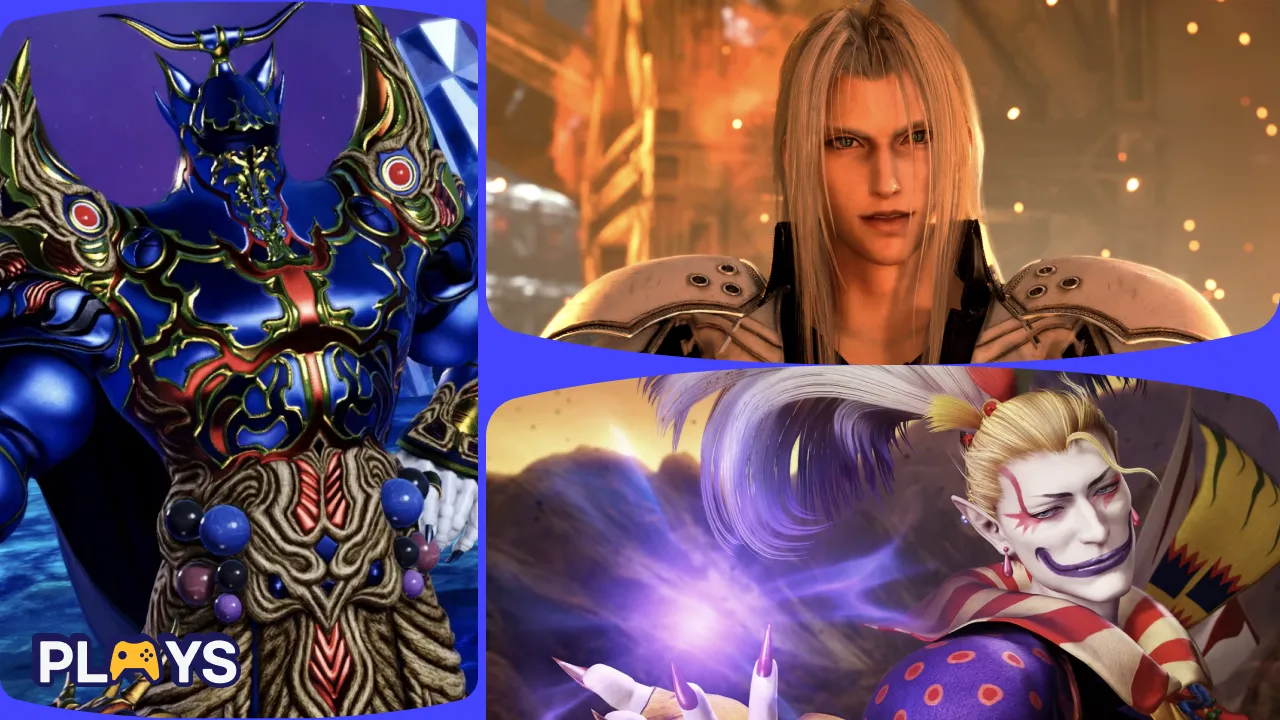
Exdeath has one of the weirdest origin stories in the entire "Final Fantasy" series, and that's really saying something. Rather than being born or created in the usual way, he's the physical form of countless evil spirits that were sealed inside a giant tree until they eventually merged into a single being. Somehow, all of that ends up looking like a fairly standard armoured warlord for most of the game. The real spectacle arrives during the finale, when he transforms into Neo Exdeath. Suddenly, the intimidating knight is replaced by a grotesque mass of twisted flesh, human bodies, and monstrous limbs. It’s body horror, it’s fantasy, it’s on Nintendo systems, it was so original.
Golbez/Zemus
“Final Fantasy IV” (1991)
For most of "Final Fantasy IV," Golbez is the face of everything standing in Cecil's way. He constantly stays one step ahead of the party, stealing the Crystals and carrying out what appears to be his own ruthless plan. As the story unfolds, though, players discover there's far more going on behind the scenes. Golbez was never the true mastermind at all, having spent much of the game under the control of the Lunarian Zemus. That revelation completely changes how you view his actions, turning him from a straightforward villain into another victim of manipulation. It's an interesting twist, but it also means Golbez loses some points as an antagonist, since many of the game's greatest evils weren't truly his own doing. Let’s split this entry between the two .. What a team!
Cid Aulstyne
“Final Fantasy Type-0” (2011)
Compared to the universe-ending gods and reality-breaking monsters that usually headline the series, the main villain of "Final Fantasy Type-0" is surprisingly grounded. At least, he starts that way. Cid Aulstyne is simply the ruthless leader of the Militesi Empire, relying on intelligence, political influence, and anger that he’s the second Cid to be evil in the series. His calm and calculating personality makes him a constant threat, as he's always thinking several steps ahead of the heroes. Of course, this is still "Final Fantasy," so things eventually become far less normal. After his death, Cid is possessed by a powerful deity and transformed into a terrifying monster, blah blah blah BUT his grounded evil was pretty damn epic.
Shadow Lord
“Final Fantasy XI” (2002)
The Shadow Lord from "Final Fantasy XI" certainly understands the importance of making a dramatic first impression. Clad in imposing black armour and surrounded by an intimidating presence, he looks every bit like the kind of villain you'd rather avoid in a dark alley. His backstory, however, is another matter entirely. It's wrapped up in so much lore that explaining it properly could take longer than some RPGs themselves. And, it doesn’t matter because none of you are playing this game anymore. At its core, though, he's a relentless enemy determined to bring destruction on a massive scale. While he isn't the sort of villain who casually wipes out kingdoms with a flick of his wrist, he's a terrifying military leader backed by a powerful army. His climactic two-phase boss battle, mixing crushing melee attacks with dark magic, remains one of "Final Fantasy XI"'s most memorable encounters. Remember? Oh you don’t?? DAMMIT! Can’t get that 30 seconds back.
Vayne Carudus Solidor
“Final Fantasy XII” (2006)
Vayne Solidor spends most of "Final Fantasy XII" proving that you don't need to swing a sword every five minutes to be dangerous. As the heir to the Archadian Empire, he hides ruthless ambition behind polished speeches, expensive-looking armour, and the calm confidence of someone who always has a backup plan. He's even willing to murder his own father if it helps him move one step closer to absolute power. Like many "Final Fantasy" villains, Vayne wants humanity freed from the control of the gods, but he also intends to rule the new world himself. Pick a thing brother.
Solus Zos Galvus/Emet-Selch
“Final Fantasy XIV” (2010)
Although Lahabrea spends much of "Final Fantasy XIV" acting as the face of the Ascians, it's Emet-Selch who ultimately steals the show. Introduced during the "Shadowbringers" expansion, he quickly became one of the franchise's most celebrated villains. Rather than relying purely on brute force, Emet-Selch wins players over through his intelligence, patience, and unsettling ability to manipulate events across countless years. As one of the architects behind the Ascian plan, he's responsible for unimaginable destruction, yet his motivations are driven by a deep longing to restore the world he once knew. That emotional complexity makes him far more than a typical world-ending antagonist. He's powerful, tragic, charismatic, and easily one of the strongest villains the "Final Fantasy" series has ever produced.
Ultima
“Final Fantasy XVI” (2023)
Few names in "Final Fantasy" carry as much significance as Ultima. Long before becoming a character, Ultima was known as one of the series' most devastating spells, capable of wiping out unprepared parties in spectacular fashion. That's why it's so fitting that "Final Fantasy XVI" reveals Ultima as the true force behind the world's suffering. From the shadows, this ancient being manipulates kingdoms into endless conflict, forcing Clive and his companions to confront the source of the chaos if they hope to save Valisthea. Before reaching that final showdown, however, players must survive one of the game's most memorable enemies: Hugo Kupka. As the Dominant of Titan, he's an arrogant and power-hungry ruler who uses his enormous influence for personal gain instead of helping those beneath him. Defeating Hugo feels like an incredible achievement... right until you realise he was only one piece of Ultima's much larger plan all along.
Delita Heiral
“Final Fantasy Tactics” (1997)
Calling Delita the villain of "Final Fantasy Tactics" is guaranteed to start an argument, but it's a position that's easy to defend. While he begins the story alongside Ramza, Delita slowly abandons any sense of idealism in favour of achieving his goals by whatever means necessary. He believes taking control of the kingdom is the only way to end the endless cycle of war and corruption, but his methods become increasingly ruthless as the story unfolds. Manipulation, betrayal, and sacrifice are simply tools to him. His darkest moment comes when Princess Ovelia discovers the truth and stabs him, only for Delita to retaliate and kill her. He later silences historian Orran Durai to keep his secrets buried, proving that winning the throne ultimately mattered more than protecting his own conscience.
Ardyn Izunia
“Final Fantasy XV” (2016)
Ardyn is one of those villains who sounds incredible when you read his backstory on paper. The man was betrayed by his own brother, unknowingly made an enormous sacrifice, and was cursed with immortality, leaving him trapped in an existence where death is never an escape. It's easy to understand why he became so twisted, and his talent for manipulating everyone around him makes him a constant threat throughout "Final Fantasy XV." The problem is that he never quite meshes with the game's laid-back road trip atmosphere. His history mirrors Noctis' in interesting ways, but their rivalry never reaches the iconic heights of heroes and villains like Cloud and Sephiroth. He's memorable, but the story around him never quite lets him become truly legendary.
Seymour Guado
“Final Fantasy X” (2001)
It was tough to pick a villain from this game, because there’s actually a bunch, but my mind always lands on the bluehaired Sephiroth ripoff that is Seymour Guado. Seymour is one of the most tragic villains in the entire "Final Fantasy" series. As a child, his mixed Guado and human heritage meant he never truly belonged anywhere, leaving him isolated and rejected for most of his life. Instead of finding hope, that loneliness slowly twisted into bitterness, convincing him that life itself was nothing more than endless suffering. From Seymour's point of view, becoming Sin and ending everyone's pain is an act of mercy rather than cruelty. It doesn't excuse the horrors he commits, but it does make his warped logic easier to understand. His multiple transformations and relentless pursuit of Yuna also make him one of the most persistent enemies the party faces, refusing to stay down no matter how many times he's defeated, and no matter how creepy he looks. Still, Sin itself is also a real nightmare, a colossal flying monster capable of wiping entire cities off the map, while Yu Yevon serves as the final boss.
Seifer Almasy
“Final Fantasy VIII” (1999)
There’s a HUGE chunk of great villains in this divisive entry. You’ve got Ultimecia, a powerful sorceress from the future, who plans on compressing time in order to become a god. You’ve also got Edea, the main antagonist until it’s revealed she’s being controlled. But none feel as well rounded to me as Seifer. Seifer is one of the most fascinating antagonists in "Final Fantasy VIII" because, unlike most villains in the series, he starts out as someone the player actually knows. Introduced as Squall's arrogant rival at Balamb Garden, Seifer constantly pushes himself to prove he's destined for something greater. His obsession with becoming a heroic knight ultimately blinds him, making him easy for Ultimecia to manipulate through Sorceress Edea. Even after learning the truth, Seifer refuses to abandon the fantasy he's built around himself, believing his actions will finally give his life meaning. That tragic mix of pride, ambition, and delusion makes him far more than a simple bad guy. He's a rival whose own dreams ultimately become the very thing that destroys him.
Kuja
“Final Fantasy IX” (2000)
Kuja might have one of the most divisive looks in the "Final Fantasy" series, but there's far more to him than flashy clothes and dramatic entrances. As a twisted counterpart to Zidane, he's essentially an earlier version of the hero, created for the same purpose but sent down a completely different path. Beneath all the confidence and theatrical flair is someone consumed by rejection, desperate for the approval he never received. When Kuja discovers the truth about his existence, that heartbreak quickly turns into uncontrollable rage, making his actions feel tragically human even as they become increasingly destructive. He's manipulative, charismatic, and emotionally complex, proving that some of the series' best villains aren't driven by pure evil, but by the pain of never feeling wanted. Maybe if Garland had spent a little less time creating living weapons and a little more time being a decent father, things might have turned out very differently.
Kefka Palazzo
“Final Fantasy VI” (1994)
Kefka Palazzo stands out because he does something almost no video game villain ever manages to accomplish: he actually wins. Halfway through "Final Fantasy VI," his plan succeeds, the world is torn apart, and the heroes are left scattered while players wake up on a lonely beach with Celes, wondering how everything went so wrong. From that point on, you're fighting to survive in a world Kefka has already conquered. His unforgettable personality only makes him more compelling. He's loud, theatrical, unpredictable, and completely unhinged, yet every move he makes is surprisingly calculated. Unlike villains driven by revenge or tragedy, Kefka simply revels in destruction for its own sake. He's the perfect embodiment of pure chaos, happily laughing as the world collapses around him, and that's exactly what makes him one of the greatest antagonists in gaming history.
Sephiroth
“Final Fantasy VII” (1997)
Professor Hojo is as evil as a regular human can get. The Turks are interesting, divided, and driven. And the Shinra power company represents big corporations taking advantage of the lower class. But nobody in this game, or the series, will ever compare to the impact and power of our main boy Sephiroth. Sephiroth has become the face of "Final Fantasy" villains for good reason. Before everything falls apart, he's celebrated as a legendary SOLDIER, only to have his entire identity shattered when he learns the truth about his origins. Left with nobody to help him process that revelation, he spirals into madness under Jenova's influence, transforming from hero into one of gaming's most iconic antagonists. His rivalry with Cloud works so well because the two mirror each other in unexpected ways, making every confrontation feel deeply personal. It's easy to understand the pain and isolation that shaped Sephiroth, even if his actions are completely unforgivable.
