10 Ways Modern 3D Platformers FAIL To Capture Classic Magic
10 Ways Modern 3D Platformers FAIL to Capture Classic Magic
Welcome to MojoPlays, and today, we’re looking at the 10 different reasons why modern 3D platformers can’t ever seem to capture the magic. None of the games we’ll be talking about are necessarily bad. However, there is something to be said about why many of these games don’t resonate with as many players as, say, Mario, Spyro, Crash, and the like.
Lacking Proper Balance
For some strange reason, a lot of modern 3D platformers cannot find the perfect balance in difficulty. The majority of them hone in on just being “cozy games” like the multitude of farming sims which result in them being so easy that it becomes boring. As for the few that try to be harder than the rest, they go too hard on the paint (pardon the pun) to the point where it becomes more aggravating to play than it probably needs to be. Is there simply no understanding in difficulty scaling? Or are these developers maybe focusing too much on letting players relive their youth? It’s tough to say either way.
Excessive Genre-Blending & Minigames
Not every modern 3D platformer is guilty of doing this, but this is an issue we’ve seen here and there. Some games will have a few segments where the game completely deviates from the core part of 3D platforming, so much so that you’re forced to play a completely different game. These moments are often delegated to stealth mechanics or even shooting. Eventually, you’re crossing a threshold where you’re not exactly inspired by “Banjo-Kazooie”, but “Banjo-Tooie” instead, which is a game where people felt like the moments that deviated from the core gameplay were a major detriment.
Staying Too Cute
One could say that complaining about a 3D platformer being cute is like complaining that a JRPG has an anime artstyle. A fair point, sure, but even JRPGs can distinguish themselves with unique nuances, combat mechanics, and UI to make themselves stand out. For 3D platformers, almost every one we’ve seen goes for a seemingly cute artstyle in one form or another. They may look different from one another, but the vibes feel the same across every one of them, which ultimately makes them all feel stale. The genre doesn’t need to be gritty and realistic suddenly, mind you. However, there is a point where the genre almost justifies the people that were saying “Nintendo games are for babies” back in the “Call of Duty” hype days.
When New Feels Old
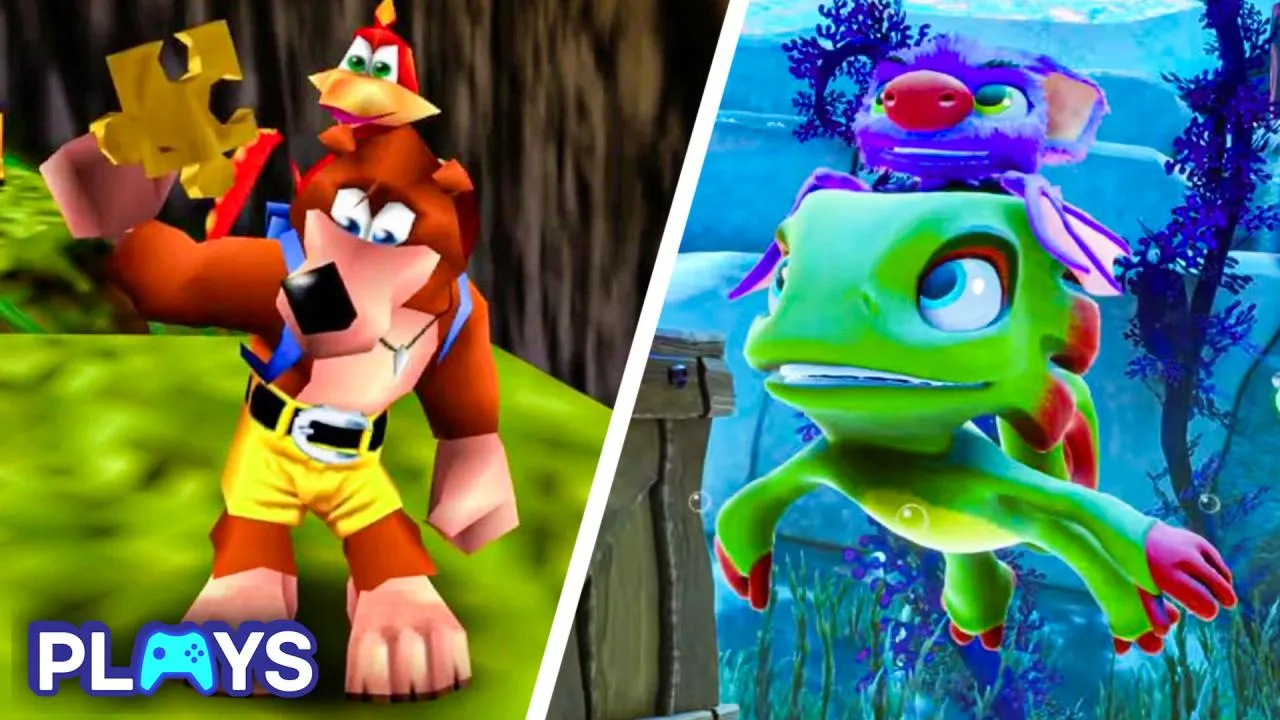
This issue may vary from player to player, but one of the problems with 3D platformers as well as a plethora of other games is the want to overdesign characters. With access to all kinds of technology today, it’s easy for developers to get lost in tiny details the player won’t notice or care about. By adding detail like more texture and more colors, you risk making your characters less memorable and less satisfying to look at. Part of what made Banjo, Crash, and Spyro was that they were characters with basic color schemes and shapes. Nowadays, you have some solid 3D platformers, but characters with too much going on in visual design.
Camera Problems Persist
Camera issues have been a recurring problem with 3D platformers going all the way back to the early days of “Super Mario 64” and a “Jumping Flash”. Regardless of whether you’re in first-person or third-person, just about every 3D platformer ever made has suffered from bad camera placement and controls. These moments can make certain parts of the game incredibly frustrating as not every angle gives the player a good amount of depth perception. Some 3D platformers have tried to alleviate this by adding solidified drop shadows beneath characters like we saw in “Crash Bandicoot 4: It’s About Time” and the “Pac-Man World” remakes. Unfortunately, these are mere band-aid solutions for something that needs to be desperately addressed.
Catering to Speedrunning
Now, this problem hasn’t been as common as camera issues or overly designing characters. However, it’s something we’ve seen in the marketing for some 3D platformers on occasion. Whether it's the fault of marketing or the streamers and YouTubers who get early access, there are some 3D platformers who cater too much to the speedrunning side of the community. That isn’t necessarily a bad thing, but it does make your game intimidating enough for people to jump into. Do I need to pull off crazy maneuvers like this just to progress in the game? It’s like how some FPS streamers play every game like it's a hyperactive version of “Unreal” or “Counter-Strike”, and it can turn a good chunk of 3D platforming players off.
No Style in Music
Obviously, this can be entirely subjective, but it’s worth mentioning here because of how drastically different the old and new eras of 3D platforming are when it comes to music. Go listen to the OSTs of “Super Mario 64”, “Banjo-Kazooie”, or any of the “Spyro” and “Crash” games. The reason the music is so memorable in those games is because each song carries a certain beat to them. Not like a drum beat, but a cadence that matches their respective worlds in tone. Stewart Copeland gave a groove to “Spyro” while Grant Kirkhope matched the whimsy in “Banjo-Kazooie”. Many modern 3D platformers go for orchestral scores or basic chiptunes, but neither of those hold the same kind of flavor as a song composed of three or four instruments.
The DK64 Issue
To some, this is going to sound like a silly problem to have with 3D platformers at all, but many modern 3D platformers fall under the same problem as “Donkey Kong 64”. While many remember the game fondly, the few who have dared to fully complete the game know about how tedious and boring it is collecting every single item in the game. Granted, collectibles are a key part of 3D platformers. But DK64 was egregious as many collectibles required extensive backtracking just to swap characters and unlock other areas. “Yooka-Laylee” and “Crash Bandicoot 4: It’s About Time” are perhaps the biggest offenders of this in recent years as the former required you to collect every Pagie, Quill, Extender, Tonic, and Play Token. The latter was just excessive in locking collectibles behind perfect performance. Why can’t we just keep it to one or two types of collectibles?
Inspired By? Or Wearing Faces?
This is a common flaw we see across several different 3D platformers on the indie side of the market. “Our game is inspired by Major Game A and Major Game B!” Not only does this give off the impression that the game isn’t original, but it also indicates that the game is merely a facelift of the game it’s inspired by. Whether it’s in visuals, music, or gameplay, there are too many 3D platformers trying too hard to replicate the look, feel, and success of the games they’re inspired by. They toe the line so close that it becomes a matter of “why would they play your game then if they can go play the game you’re pulling all the plays from?” It’s a marketing tactic that is just too unreliable and can potentially kill interest, which brings us to our final point…
Little Innovation
By sticking to formulas that worked before, the modern 3D platforming scene has become about as stale as the AAA gaming market many of us fans heavily criticize. To be fair, innovation is hard to come by and is often completely accidental. And in the genre’s defense, 3D platforming is just running, jumping, and collecting things. There’s not much room for anything else to be added in before the game becomes something totally different. We’ve been stuck in this endeavor to be nostalgic for a genre that was quickly becoming stale back in the late 90s and early 2000s. So, will we ever figure out how to move this genre forward? Or are we going to keep doing the same exact thing for another three or four decades?
Are we totally off-base about the 3D platforming scene today? Or are we right on the money? Let us know down in the comments, and don’t forget to subscribe to MojoPlays.

