The 10 LONELIEST Locations in Zelda Games
Lone Peak Shrine
“The Legend of Zelda: Majora’s Mask” (2000)
We’d say the proof is in the name, but the setting also speaks for itself. Just outside Goron Village, floating high above an abyss, is a seemingly unreachable shrine made of ice. The owl, Kaepora Gaebora, leads Link across invisible platforms so that he can earn the Lens of Truth inside. You only spend a short time here, but what makes it lonely is the atmosphere of the area. While every region in “Majora’s Mask” has been warped, the ice of winter brings a unique flavor to the sad tone. Desolation, a land wracked by endless snow, the absence of warmth; these are all visual cues that have been used throughout art to instill a feeling of loneliness in the viewer. Or, in this case, the player. And Darmani, the Goron spirit revealed by the Lens outside, died alone, full of regret and in pain.
Hyrule Field
“The Legend of Zelda: Twilight Princess” (2006)
There have clearly been multiple versions of Hyrule Field throughout the series. Some of which definitely come with a hefty dose of loneliness. However, the one in “Twilight Princess” is the peak of making you feel solitary. This was, by far, the biggest overworld a “Zelda” game had received at the time. And we don’t mean this as a negative, but there are portions of it that are vast and empty. It makes you truly feel the scope of a single person trying to right the world’s wrongs, almost entirely on their own. It isn’t a downcast feeling of loneliness the way that the Lone Peak Shrine is…until the sun goes down. In darkness, and with particular thanks to the eerie music that accompanies it, Hyrule Field transforms, becoming an even lonelier place.
The Depths
“The Legend of Zelda: Tears of the Kingdom” (2023)
From the moment you first descend into the Depths, even though there are NPCs around at the time, it becomes clear that this is an isolated, friendless place. While there are certainly some sky islands up above that make you feel lonely, this bleak underground world takes the cake. Part of the reason why it feels this way is, admittedly, a gameplay fault. The Depths are huge, and arguably devoid of much to do. Loneliness can be a positive thing sometimes. But the Depths are both literally and figuratively dim. This strange, intimidating landscape has none of the bustling villages of the surface, nor the beauty or the Shrines of the sky islands. It embodies the sense of making you feel entirely alone.
Isle of Songs
“The Legend of Zelda: Skyward Sword” (2011)
Before “Tears of the Kingdom,” there were the sky islands of “Skyward Sword.” And trust us, there are plenty of lifeless chunks of rock in the overworld that are fairly lonesome. Yet, you only swing by them to grab some treasure or such. The Isle of Songs, though, that’s a different story. Hidden within the Thunderhead, a mass of swirling clouds, this island was left for Link by the Goddess, Hylia, as part of his test. Sitting in the midst of a huge storm, it’s a place that has been untouched by anyone, waiting for Link for untold years. This blend of atmosphere, the location’s purpose, and its disconnection from everywhere else, fits well with Link’s journey as the lone, chosen hero.
The Royal Valley
“The Legend of Zelda: The Minish Cap” (2005)
‘Eerie’ can often go hand-in-hand with ‘lonely,’ and there are a few spots in the series that mix these two elements well. At a certain point in “Minish Cap,” Link visits a valley with a graveyard for members of Hyrule’s royal family. The area is secluded, dark, and seems purposely opposed to any normal citizens visiting it; there’s even a Lost Woods-style maze to navigate, so dark that Link needs a lantern to see. It doesn’t exactly seem like a warm final resting place, amidst a forest of dead trees and the ghost-like Ghini. Although there is an NPC here, the typical Dampé the gravedigger, his isolation in such a place, further from civilization than other appearances, only adds to the location’s personality.
Tower of the Gods
“The Legend of Zelda: The Wind Waker” (2003)
Most places in “Wind Waker” don’t feel lonely, and that’s partially thanks to the game’s brightly colored style. Even the smallest, “lifeless” islands are so nice to look at. And with a flooded world breeding a society of sailors and explorers, you get the sense that, even if no one’s there now, someone has been before. The Tower of the Gods stands in stark contrast to this. It’s another location that plays into the feeling of loneliness by being untouched by anyone, for an unknown amount of time. It’s also an incredibly atmospheric dungeon. Large, echoing spaces and harmonic vocals with bell chimes heighten the feeling of a solitary task, a test designed solely for the chosen hero.
The Dark Forest
“The Legend of Zelda: Majora’s Mask” (2000)
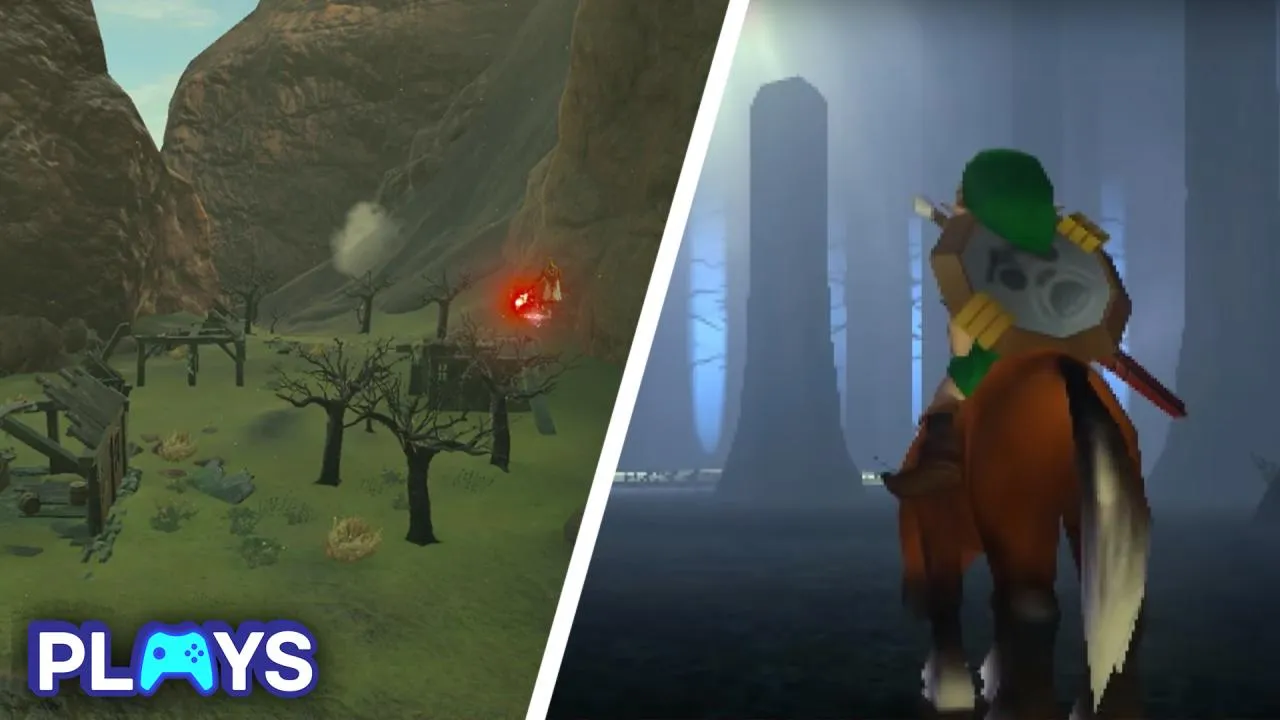
The opening to “Majora’s Mask” immediately sets a forlorn, lonesome mood, before you even take control of Link. It begins with him in a dark forest in search of Navi, his companion who left at the end of “Ocarina of Time.” He’s then attacked and robbed by the Skull Kid; two comforting remnants of home, his ocarina and his horse, ripped away in an instant. Once you do have control, you ‘re meant to feel like you should charge ahead. But if you stop to look around, you’ll find this opening area is a unique and lonely one. Unlike the forest walls in its predecessor, the one here is defined by dead trees with broken, jagged branches. It subtly imparts a more dire tone, one that goes well with Link having all of the warmth of his previous adventure removed. The last bit is his sense of self, when Skull Kid transforms him into a Deku Scrub.
Hidden Village
“The Legend of Zelda: Twilight Princess” (2006)
When Link first visits the Hidden Village, it doesn’t feel like a lonely place. And that’s because it instantly puts you into an Old West-style shootout with a bunch of enemies, complete with some really fun music. But it has some of the key elements as a rundown, nearly abandoned town that’s blocked off from the rest of the kingdom. Plus, once you clear out the enemies, you meet Impaz, the last denizen of the village and member of the Sheikah. She has lived most of her life alone, waiting for a chosen hero to pass her knowledge on to. Along with how kind and gracious she is, her sheltered, reclusive existence makes you feel for her, giving the Hidden Village another, slightly somber layer.
Shadow Hamlet Ruins
“The Legend of Zelda: Breath of the Wild” (2017)
There are obviously a lot of ruins in “Breath of the Wild,” many of which are the result of Calamity Ganon. However, one set of ruins, found on the South Eastern side of Death Mountain, is different from the rest. Part of what makes the Shadow Hamlet Ruins feel lonelier is its location; walled off from most sides by rocky terrain, and a bit far from other settlements. In the Switch 2 version of the game, a voice memory from Zelda sheds some light. The people who once lived here preferred their isolation, being unwelcoming to outsiders. The princess even tried to warn them about the Calamity before Ganon struck, but they turned her away. This knowledge of their ways, and the uncertainty of what, exactly, befell them makes the location feel even more desolate.
The Shadow Temple
“The Legend of Zelda: Ocarina of Time” (1998)
Another example of ‘lonely’ being perfectly paired with ‘eerie,’ the Shadow Temple is an iconically creepy location in the “Zelda” series. Most dungeons in the game usually have a positive connection to the area they’re found in, but have been corrupted. A place of worship, like the Spirit Temple to the Gerudo, or simply a place to forage for the best rocks to eat, like Dodongo’s Cavern to the Gorons. But the Shadow Temple is not positive; it stands as a monument to the war and bloodshed of Hyrule’s past. And that makes you feel far lonelier than anywhere else. Despite hearing about a Civil War, everything up to this point makes you feel that Hyrule and its leaders deserve to be saved. But proof of dark deeds done during wartime, including torture, casts a shadow of a doubt in your mind. And this creates a special kind of loneliness, one that makes you feel less sure of yourself.
What are your favorite lonely spots in the “Zelda” series? Share your thoughts in the comments, and we’ll see you next time!

