10 HARDEST Bosses in Resident Evil Spin-Offs
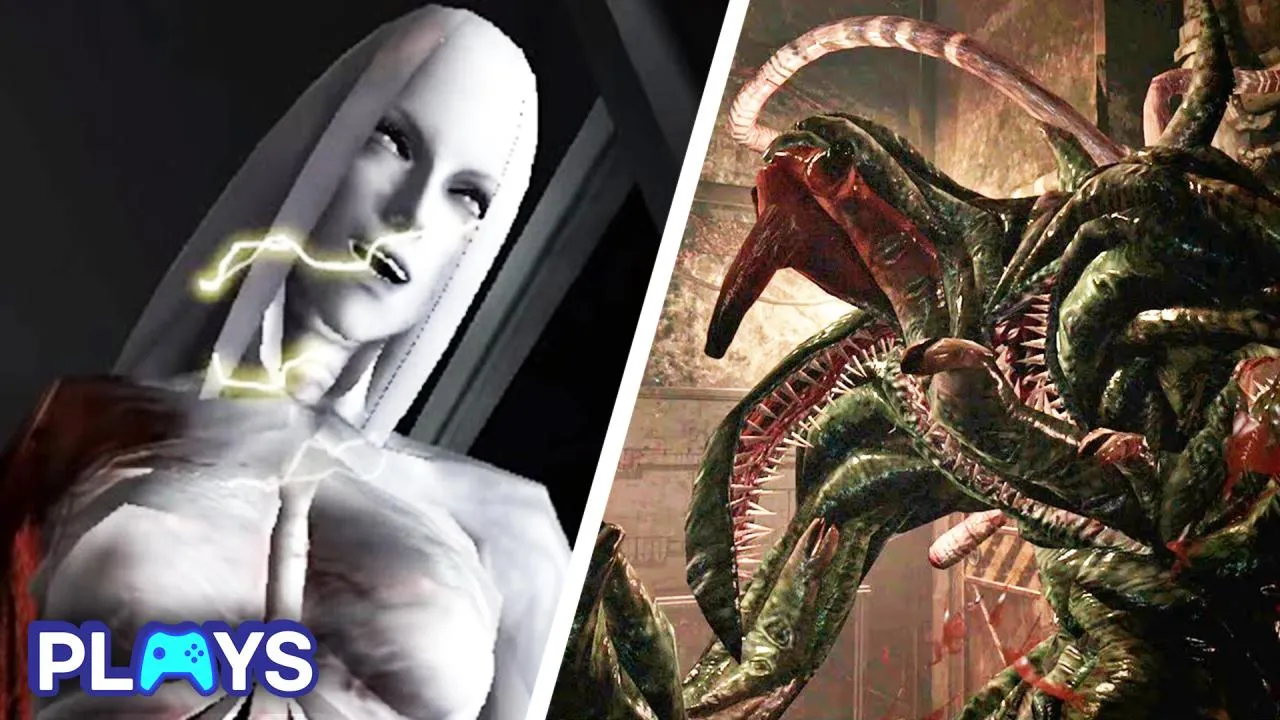
10 Hardest Bosses in Resident Evil Spin-Offs
Welcome to MojoPlays, and today we are looking at the most frustrating bosses in Resident Evil, but not the main entries, the ones that don’t get talked about enough. These are the 10 Hardest Bosses in Resident Evil Spin-Offs. Let’s go!
Scagdead
“Resident Evil: Revelations” (2012)
For a handheld-focused spin-off, “Resident Evil: Revelations” put way more effort into its monsters than anyone probably expected, and the Scagdead is easily one of the best examples. The thing looks like somebody fused a deep-sea nightmare with a butcher shop accident and then gave it a chainsaw just to make everyone’s day worse. What makes the fight so memorable is how aggressive the Scagdead is despite its massive size. Normally in “Resident Evil,” a big arena and explosive barrels would make players feel safer, but here they mostly just create the illusion that you’re in control before the monster starts sprinting at you like an angry refrigerator with legs. The fight constantly forces players to stay moving and take advantage of tiny openings whenever they appear. Let the Scagdead get too close and your health bar basically evaporates on contact thanks to that grotesque chainsaw arm, oh did I not mention it has a chainsaw arm? It has a chainsaw arm.
Ivan Twins
“Resident Evil: The Umbrella Chronicles” (2007)
Unless you’re a full-blown “Resident Evil” historian who willingly spends free time explaining Umbrella timelines to confused friends, there’s a decent chance you skipped “The Umbrella Chronicles” and “The Darkside Chronicles.” These spin-offs traded the normal survival horror gameplay for on-rails shooting while retelling major events from across the series and sneaking in extra lore for longtime fans, a LOT of Ada lore for instance. Hidden inside all that fan service, though, is one of the nastiest boss fights Capcom quietly buried in the franchise: the Ivan Twins. These Tyrant variants only appear in “The Umbrella Chronicles,” but they leave an impression immediately because they fight like absolute lunatics. Unlike the slower Tyrants players were used to, the Ivans are fast, aggressive, and constantly in your face.
Alex Wesker
“Resident Evil Revelations 2” (2015)
The final battle against Alex Wesker (oh yeah Wesker has a sister) in “Resident Evil Revelations 2” feels less like a normal boss fight and more like the game personally deciding it’s tired of seeing you happy. Her mutated final form is unbelievably aggressive from the second the fight begins, constantly charging at the player, swinging wildly, and forcing nonstop movement around the rooftop arena. There’s basically no downtime whatsoever. Reloading even for a second feels dangerous because Alex is always one bad dodge away from turning your health bar into a memory. What makes the fight especially brutal is the placement of her weak points. Landing solid shots often means getting dangerously close to her attacks, so every successful hit feels like you’re gambling with your actual life. Add in limited healing supplies, shrinking ammo reserves, and multiple increasingly chaotic phases, and the whole encounter becomes a marathon that you need to pace yourself through.
Queen Leech
“Resident Evil 0” (2002)
One of the cruelest things about classic “Resident Evil” games is how brutally they punish first playthroughs. Since survival horror is built around resource management, players never really know what’s waiting around the next corner or how much ammo they should actually be saving. I recently played RE0 for the first time, and found it ESPECIALLY brutal when compared to other entries. That becomes especially clear when players run into the Queen Leech fight. By that point, a lot of people have already burned through most of their supplies surviving the train, the mansion, and the endless parade of nightmare creatures the game throws at them. Suddenly they reach this boss and realize they’re carrying about three bullets, half a healing item, and pure regret.
Nosferatu
“Resident Evil: Code Veronica” (2000)
I hate to keep mentioning this (I’m playing all the Resident Evil games chronologically so I have to) but I did this fight LITERALLY this morning, for the first time, and it was tough. The Nosferatu fight in “Resident Evil – Code: Veronica” is one of those boss battles that feels stressful before the monster even starts attacking. The entire encounter takes place on a narrow icy platform hanging above the Antarctic base, which means the arena itself is basically trying to kill you alongside the boss. One badly timed dodge or awkward movement near the edge can instantly send Claire falling to her death. Nosferatu only makes things worse by attacking from long range with giant tentacle swings and poisonous gas clouds that constantly force players to reposition. The problem is repositioning safely is incredibly difficult when the camera angles are fighting you almost as aggressively as the boss itself. On top of all that, players need to carefully target Nosferatu’s weak point while under pressure, which is hard because you can’t see it until you’re close enough to be hit, you can’t aim when you’re standing in poison gas which is everywhere, and you can’t move while you shoot. It honestly feels like it was designed wrong.
Morpheus (Second Form)
“Resident Evil Dead Aim” (2003)
I almost never rage quit games, but “Resident Evil: Dead Aim” absolutely pushed me to that point thanks to its final boss, Morpheus. “Dead Aim” was part of the old Gun Survivor spin-off series, meaning it was designed around using an actual light gun on a CRT television like some kind of arcade cabinet from hell. Technically, you can still play it with a normal controller, but the game clearly resents you for trying. The Morpheus fight becomes a complete nightmare because his weak point constantly moves around while he slowly advances toward the player. Trying to accurately hit that thing using an analog stick feels like attempting surgery during an earthquake. To make things even worse, Morpheus becomes more aggressive the lower his health gets, so the fight slowly transforms into pure panic. The cruelest part comes right near the end when he suddenly launches into a deadly rushing attack that can instantly kill you before you fully process what happened. Dying means starting again from the VERY beginning. Cap-COME ON!
Ultimate Abyss
“Resident Evil: Revelations” (2012)
The Ultimate Abyss fight at the end of “Resident Evil: Revelations” feels like the game looked at players nearing the finish line and decided they hadn’t suffered quite enough yet. After Jack Norman injects himself with the T-Abyss virus, he transforms into this gigantic nightmare creature that basically attacks like pure panic given physical form. The boss is constantly lunging around the arena with huge claw swipes, ranged attacks, and sudden rushes that can erase your health frighteningly fast if you lose focus for even a second. What makes the fight especially exhausting is how aggressive the Ultimate Abyss stays throughout the entire battle. There’s barely any breathing room, and the arena never truly feels safe because the creature can close distance almost instantly. Luckily it has a tiny health pool... Wait, that can’t be right, let me check my notes. Massive health pool. It has a massive health pool.
Alexia Ashford
“Resident Evil - CODE: Veronica” (2000)
“Resident Evil – Code: Veronica” was supposed to push the series forward after the original trilogy, but instead it doubled down on a lot of old-school frustrations, frustrations that earn it SO many spots on this list. Honestly though, one thing almost everyone remembers is Alexia Ashford, who somehow manages to be both ridiculous and terrifying at the same time. At first glance, she just seems like another dramatic aristocrat villain straight out of a gothic soap opera, but her boss fights quickly become absolute chaos. Her humanoid form alone is brutal thanks to the way she traps players with walls of fire while threatening instant death if she lands her horrifying grab attack. Then the game decides that apparently wasn’t stressful enough and transforms her into a giant insect queen nightmare that takes up half the arena. Suddenly poison is raining everywhere, mutant larvae are pouring into the fight, and players are desperately trying not to get overwhelmed. I got overwhelmed, quickly, and easily.
Nemesis T-Type
“Resident Evil Umbrella Corps” (2016)
The Nemesis-T Type encounter in “Resident Evil: Umbrella Corps” feels less like a proper boss fight and more like the game suddenly deciding to throw a brick through its own gameplay loop. “Umbrella Corps” is built around fast multiplayer-style shooting, quick movement, and chaotic PvP encounters, so when Nemesis shows up, everything immediately starts falling apart in the most stressful way possible. Your equipment never really feels suited for handling a gigantic bio-weapon that refuses to stop charging directly at you. Nemesis hits absurdly hard, closes distance almost instantly, and punishes even tiny mistakes with brutal damage. At the same time, the game is constantly throwing zombie swarms into the mix, meaning players also have to maintain their jammer or risk getting torn apart by infected enemies from every direction. It’s a sensory overload nobody is ready for.
The T-078
“Resident Evil - Code: Veronica” (2000)
The infamous Plane Tyrant from “Resident Evil – Code: Veronica” has probably ended more blind playthroughs than almost any other boss in the franchise. Veteran fans still talk about this fight with the kind of exhausted tone usually reserved for surviving natural disasters. What makes the encounter so brutal is how perfectly it combines every stressful part of classic “Resident Evil” design into one miserable package. The battle takes place inside a cramped airplane cabin, meaning Claire has almost no room to maneuver while the Tyrant aggressively stomps toward her like it personally paid for the flight. If players didn’t carefully conserve ammo earlier in the game, things become even worse because this fight appears with almost no warning. Plenty of first-time players arrive carrying barely enough supplies to survive a normal hallway encounter, let alone a giant super-powered monster. The Tyrant hits incredibly hard, constantly pressures the player, and can easily trap Claire in tight spaces if panic starts kicking in. On a blind run, the fight feels almost cruel because there’s a genuine chance the encounter can completely ruin your save file if you’re underprepared enough. If you don’t trust the agony of it, here is real footage of me breaking a controller.
Infected Bat
“Resident Evil 0” (2002)
“Resident Evil” really does have an impressive history of turning ordinary animals into complete nightmares, and the giant bat in “Resident Evil 0” is one of the most annoying examples. After already dealing with giant scorpions and all the other horrors littering the game, players eventually run into this oversized flying menace that somehow manages to make basic movement feel impossible. On paper, the fight doesn’t sound too terrible. In practice, though, it becomes a complete disaster because the boss spends most of the battle airborne in a game released long before aiming at flying enemies felt remotely comfortable. Trying to line up shots while the bat swoops around the room is frustrating enough already, but then the creature starts slamming into Rebecca or Billy with attacks that hit surprisingly hard and can easily chain into stunlocks if players panic. And just to make absolutely sure nobody enjoys themselves, smaller bats constantly swarm the arena too, fun!