10 Video Games That SAVED Their Companies
“Divinity: Original Sin” (2014)
To be fair, “Divinity: Original Sin” is also partially the reason Larian Studios almost went bankrupt in the first place. The studio was already in debt following the release of “Divinity II,” which, according to founder and director Swen Vincke, reviewed and sold poorly due to releasing too soon. To ensure “Original Sin” matched exactly what they envisioned, Larian raised money from outside sources like investors, the Belgian bank, and Kickstarter. It also released a separate entry, 2013’s RTS “Dragon Commander,” earlier than intended to solely focus on this game. The studio delayed tax payments, as well as this game a couple of times, and ended up spending around 4.5 million euros in total. If it had not been a success, that would have been the end of Larian. Thankfully, it was a huge one.
“Nier: Automata” (2017)
After its founding, PlatinumGames quickly became known as a premiere developer of action titles. But the studio hit a rough patch in the mid-2010s. It spent around 4 years working on a large-scale fantasy action RPG known as “Scalebound,” which would have been an Xbox One exclusive before Microsoft canceled it. Games it did release around that time weren’t exactly big hits. The studio faced financial ruin. However, when director Yoko Taro and publisher Square Enix decided to make a follow-up to 2010’s “Nier,” they enlisted Platinum to develop it. “Automata” was a bigger hit than anyone could have imagined, held in high regard as one of the most thoughtful action games ever released. Studio co-founder and frequent director, Hideki Kamiya, credits this game with having saved the company from death.
“The Elder Scrolls III: Morrowind” (2002)
Bethesda is one of the biggest names in gaming, but even it faced down the barrel of bankruptcy. Following the release of “The Elder Scrolls II: Daggerfall,” a commercially successful but highly buggy entry, the studio released two spin-offs using the same code: “Battlespire” and “Redguard,” neither of which sold well. Coupled with the poor sales of the rest of Bethesda’s output in the late 90s, the studio was in dire financial trouble. So, founder Christopher Weaver and lawyer Robert Altman formed Zenimax Media in 1999 as a parent company to Bethesda, overseeing various legal and accounting proceedings. This allowed the publisher to stay afloat, and create its own internal development studio, whose first task was creating a third “Elder Scrolls” game. Of course, “Morrowind” was wildly successful, especially since it launched on Xbox instead of just PC. It introduced a ton of new players to the series, and helped save Bethesda in the process.
“Spyro the Dragon” (1998)
“Spyro the Dragon” was Insomniac’s first big hit, but it wasn’t the developer’s first game. That was 1996’s “Disruptor,” a “Doom” clone for PlayStation that got decent reviews, but abysmal sales. They were so bad that the studio faced bankruptcy, with only a single game under its belt. Luckily, the game was published by Universal Interactive, which had signed the studio for a four-game contract. The contract was retained, since Universal, namely producer Mark Cerny, believed in the studio’s talent. Cerny recommended creating something that had a wider appeal to compete with Nintendo’s more family friendly titles. And the team came up with Spyro. Sony took over publishing duties while Universal remained a producer. The next two games in the contract were Spyro sequels, since the first was a slam dunk, and the studio has been a heavy hitter ever since.
“The Witcher 2: Assassins of Kings” (2011)
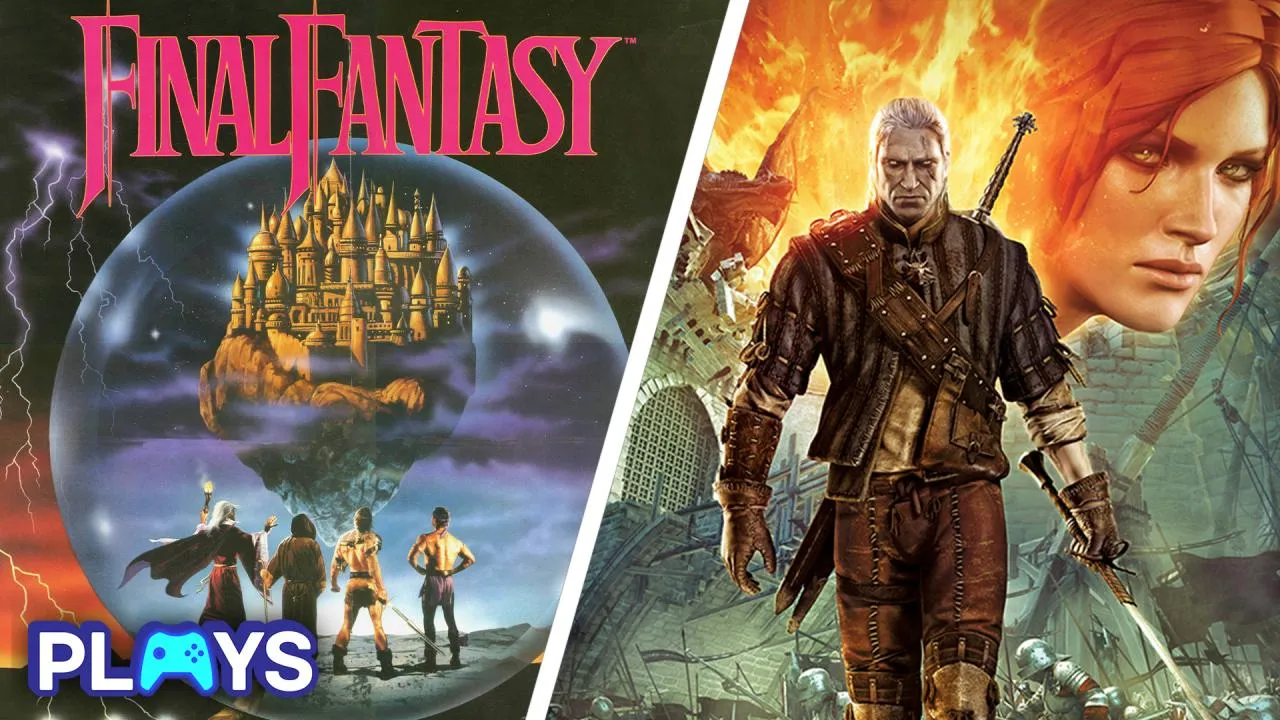
CD Projekt Red became a big name thanks to its adaptations of “The Witcher,” the second of which saved it from death. After releasing the first game in 2007, publisher Atari instructed them to port the PC title to consoles. This turned out to be troublesome to say the least; the team had no experience with consoles, and so enlisted a French studio, Widescreen Games, to develop the port. That deal turned sour over financial disputes, eventually leading to the port’s cancellation. It was all a mess, and an expensive one. In addition to the costs CD Projekt had sunk into the port, the global financial crisis of 2008 hit the studio hard, enough to be close to bankruptcy. As we know, that didn’t happen. “The Witcher 2” was released with a new, custom game engine, and was a sizable hit. Small compared the gigantic third entry, but big enough to save the company.
“Final Fantasy” (1990)
Released in 1987 in Japan and 1990 in North America, “Final Fantasy” was a major hit for Square. Before that, though, the studio was definitely in trouble, so much so that it was on the brink of bankruptcy. The game’s name actually has two meanings. Hironobu Sakaguchi had directed multiple games under Square, but planned to go back to college if his next proved to be another financial dud. Meanwhile, according to composer Nobuo Uematsu, the studio’s poor financial state meant that this could theoretically have been its last release. Of course, today “Final Fantasy” is one of the most recognizable and cherished video game IPs of all time. So it’s a good thing players gravitated towards the first game all those years ago.
“Dead or Alive” (1996)
“Final Fantasy” isn’t the only game whose name references the financial troubles of the studio who produced it. In the mid-90s, publisher Tecmo was going through its own ordeal, and was close to bankruptcy. It decided to take a page out of Sega’s book, whose “Virtua Fighter” was big in Japan at the time. Tecmo created an internal development studio with designer Tomonobu Itagaki as its head, which would eventually become Team Ninja. To set it apart from other fighters, Itagaki and his team made it more fast-paced and featured more sensually dressed characters. And he chose “Dead or Alive” as its name due to how it would make or break Tecmo. The game was a huge hit in both Japan and America, and the Tecmo brand was rescued from certain doom.
“Mahjong Gakuen” (1988)
You may not know the name, but we have a strip mahjong game to thank for the continued existence of Capcom. Despite already having several hits to its name, Capcom faced bankruptcy during the late 80s. At the time, producer Yoshiki Okamoto began programming “Mahjong Gakuen” in secrecy. But when it was finished, Capcom’s then-president, Kenzo Tsujimoto, refused to release it under the company’s name due to its explicitness, which is admittedly incredibly tame by today’s standards. Yuga published the game instead, which was a smash hit in arcades. In fact, it performed better than the big Capcom game released that year, “Ghouls 'n Ghosts.” Although Capcom didn’t publish it, the money it brought in for Okamoto, as well as others who worked on the game, helped save the company.
“Pillars of Eternity” (2015)
Before the release of “Pillars of Eternity,” beloved RPG developer Obsidian Entertainment was close to shutting its doors. It had faced several cancellations prior to 2012, and didn’t receive bonuses for its work on “Fallout: New Vegas” due to missing Bethesda’s required Metacritic score by a single point. There wasn’t enough money to fund its next project, and like many others, it faced bankruptcy. Thankfully, around this time, Kickstarter was blowing up as a practical way to gain funds. “Pillars of Eternity” was promoted as a spiritual successor to “Baldur’s Gate,” which many employees were familiar with, having been a part of original publisher Black Isle Studios before it shut down. The Kickstarter campaign broke records. The game sold and reviewed well, earned expansions and a sequel, and saved Obsidian.
“Persona 3” (2007)
To certain players, Atlus has been a major publisher and developer since the late 80s. But there’s no denying that, prior to the release of “Persona 3,” the studio’s output was much more niche. We know this is true because, according to director Katsura Hashino, he was told during development that the game could be Atlus’ last. So, in order to keep the studio alive, he set out to make “Persona 3” the very best it could be. Although he received some pushback from his team, he sought to implement features that would bring in more players. This obviously worked out; “Persona 3” sold well, reviewed well, and earned multiple awards. Not only is Atlus thriving today, but so is the series. Both the fourth and fifth game, also directed by Hashino, were major hits, helping “Persona” become one of the most famous JRPG franchises around.
Is there a game you’re grateful saved a certain studio? Share some positivity in the comments. And if you haven’t already, be sure to subscribe to MojoPlays for more great gaming videos every day!
