Top 30 Definitive Scenes That Changed TV Forever
#30: Ross Says “Rachel”
“Friends” (1994-2004)
Obviously, this beloved 90s sitcom wasn’t the first to do a will-they-won’t-they romance. But it seems like every show since “Friends” has shades of Ross and Rachel’s arc in it. Would there even be a Jim and Pam or a Janine and Gregory without them? These two had a rocky road, but for many, they didn’t really become an endgame pairing until after Ross got married to another woman. Once Ross said his ex-girlfriend’s name at the altar instead of his soon-to-be wife, the writing was on the wall. It was a screw-up so big, we had to wait an entire summer to see its conclusion in the season five premiere.
#29: Roll Call
“Hill Street Blues” (1981-87)
One thing you could always count on with this cop show was the daily roll call. It was a clever way to introduce different storylines and bring in an ensemble of characters, some who’d just pop up for the episode and others who kept coming back. Up until then, crime dramas usually started and ended with a brand-new case every week. But this setup made things feel more authentic and gave the characters some real depth beyond their badges. Sergeant Phil Esterhaus always signed off the same way, reminding everyone about the risks of the job. It became the show’s signature moment and to this day sums up its legacy.
#28: Sam & Diane’s First Kiss
“Cheers” (1982-9)
Would there even be a Ross and Rachel without Sam and Diane? There’s technically no official record saying they were the first will-they-won’t-they couple, but that’s exactly how they felt to modern audiences. It was a chance meeting and a jilted bride-to-be that brought these two into each other’s lives. Really, it was a classic case of opposites attracting, even if they didn’t know it yet. Throughout season one, viewers loved watching them butt heads, mostly because of all the tension bubbling underneath. It was only in the season one finale that they finally surrendered to their real feelings. If you ask us, Sam & Diane walked, so all future will-they-won’t-they couples could run.
#27: Mr. Hooper's Death
“Sesame Street” (1969-)
You wouldn’t necessarily expect it from a kids’ show, but “Sesame Street” has always been ahead of the curve, from making diversity a priority with its cast and crew early on to the way it didn't talk down to its young viewers. One that stuck with us is how the show addressed the passing of one of its actors, Will Lee, who played Mr. Hooper. Instead of side-stepping the subject or quietly recasting the role, they decided to teach children about death and grieving. Apparently, they consulted with child psychologists, development experts, and even weighed up the religious side. After it aired, feedback showed kids understood the message without being left emotionally scarred.
#26: The Doctor Regenerates
“Doctor Who” (1963-89; 1996; 2005-)
Just a few years into its original run, actor William Hartnell stepped away from the series due to ill health. This left the showrunners in a real bind. How do you keep “Doctor Who” going without a Doctor? And if they recast him, how would they explain it to the audience? We would’ve loved to be a fly on the wall when they came up with their ingenious solution. The Doctor would simply regenerate. Meaning, whenever he was fatally hurt, his body could renew itself and take on a new look. Fun fact: the word regeneration wasn’t actually used until the third doctor. Since then, they’ve kept expanding that lore and even revisited the twelve-regeneration rule.
#25: “Maude's Dilemma”
“Maude” (1972-78)
During the landmark Roe v. Wade case in the 1970s, “Maude” made history as the first show where the lead considers having an abortion. In this two-part storyline, 47-year-old Maude learns she’s pregnant. She then has to figure out if having a baby now fits into her life. The storyline brilliantly and sensitively addresses the wider conversations surrounding abortion. In the end, she decides to have one, and what’s powerful is that there’s basically no judgment. Well, not on screen anyway. Norman Lear reportedly had to fight to get it to air, and, of course, protests followed. Still, it was an authentic portrayal and a huge step in bringing the subject to primetime.
#24: “Flash-Foward”
“Lost” (2004-10)
The flash-forward in the “Six Feet Under” epilogue still gives us chills to this day. But it was the use of that device in the season three finale of “Lost” that left us completely shook. Viewers were so used to “Lost” using flashbacks to flesh out the characters’ lives beyond the island. So why would we expect things to be any different now, right? Well, in one final flash we see Jack and Kate meet. Wait, what? How is that possible? Then the penny dropped: we weren’t in the past, we were in the future. It really showed how far writers could bend plot devices and timelines, not to mention instantly cementing its place in pop culture with five words.
#23: Meeting Archie Bunker
“All in the Family” (1971-79)
Explosive, vulgar, and gut-bustingly funny, the Bunker family patriarch crashed onto TV screens for the first time in 1971. Right away, the irascible Archie Bunker gets into a heated discussion with his daughter and son-in-law about religion, a discussion that was probably happening in millions of American households. But at that time, primetime network TV was not exactly known for being that controversial, especially in sitcoms. Creator Norman Lear faced pushback right away. Everyone, from viewers to critics to the show’s network, seemed scared of Archie Bunker’s frank observations. It didn’t matter. The show eventually earned a devoted audience and became a cultural institution.
#22: Murphy Brown's Single Motherhood Speech
“Murphy Brown” (1988-98; 2018)
It was already groundbreaking when Murphy decided to become a single mother. Yet this storyline drew plenty of backlash from conservatives. It even went so far that Vice President Dan Quayle gave a speech claiming characters like Murphy Brown were mocking traditional family values—never mind that the father in question had no desire to raise a child. Thanks to Brown’s platform on the show, she was able to respond to Quayle’s remarks in a way that still feels timely today. Many credit the character with opening the door for single mothers to be shown more often on TV. And when Candice Bergen won another Emmy, she made sure to mention Quayle in her speech.
#21: The Candy Factory
“I Love Lucy” (1951-57)
Lucille Ball’s influence still looms large over TV comedy. To watch an episode of “I Love Lucy” is to see the origins of gags and set-ups that we’ve seen hundreds of times since. But few have left as lasting an impact as Lucy Ricardo trying different careers and hysterically failing. Whether it’s accidentally getting drunk during a spokeswoman gig or stomping grapes in Italy, nobody could mess up a job like her. This scene sees her and Ethel Mertz wrapping candies on a conveyor belt. They lose control almost immediately, shoving the candies into their mouths, leaving the studio audience dying with laughter. Its impact is a testament to the show’s enduring popularity and the legendary status of its star.
#20: Jumping the Shark
“Happy Days” (1974-84)
Many “Happy Days” fans would argue that introducing Arthur Fonzarelli, aka Fonzie, completely transformed the show. And while that’s hard to dispute, the writers “jumped the shark” when they literally had him do just that. That moment became a cultural benchmark and gave us a term for when a once-loved show goes overboard to chase ratings. The phrase is thought to have been coined by Jon Hein and his roommate Sean Connolly, inspired by the ridiculous plot where Fonzie actually jumps over a shark, a stunt apparently meant to show off Henry Winkler’s real waterskiing skills. In 1997, Hein even launched a website cataloging other shows that “jumped the shark,” and invited others to contribute, too.
#19: The Kiss
“Star Trek” (1966-69)
The original Gene Roddenberry science fiction series broke ground in more ways than one. But among its most important and memorable moments was this scene in the season 3 episode “Plato’s Stepchildren.” Captain James Kirk and Lieutenant Uhura shared a kiss under the powerful influence of a nefarious group of aliens called Platonians. Their embrace made a lot of network executives nervous. There was a reason. William Shatner was white and Nichelle Nichols was black, and this was 1968, only one year after interracial marriage became legal in the United States. Although for years it was incorrectly identified as the first interracial kiss on network television, it was probably the most famous instance on American network television up to that point.
#18: “Time Enough at Last”
“The Twilight Zone” (1959-64)
From the moment it premiered in 1959, Rod Serling’s twisted, bizarre, and allegorical anthology series was pushing buttons and broadening the scope of television storytelling. “The Twilight Zone” soon became famous for its twist endings. One of its most enduring conclusions came at the expense of voracious reader Henry Bemis, a bookish man who is the lone survivor of a nuclear blast and manages to see the bright side. He finally has time to read. Then he breaks his glasses. Left completely alone and unable to see, his post-apocalyptic dream becomes a nightmare. This unforgettable climax has been referenced and parodied ever since.
#17: Don Pitches the Carousel
“Mad Men” (2007-15)
This AMC period drama examines midcentury America through the eyes of the men and, eventually, women who shaped the culture through advertising. In the first season finale, genius ad man Don Draper manages to break our hearts and beautifully expose the show’s entire thesis in one achingly brilliant scene. His pitch for the Kodak Carousel, a photo projector, includes his own family photos. It simultaneously illuminates Don’s failing marriage and exposes the great lie his career is based on. Even as it pulls at your heartstrings, it’s making us face the reality that nostalgia, like advertising, is something that’s only been constructed and made to seem real.
#16: Luke & Laura’s Wedding
“General Hospital” (1963-)
From their summer on the run to their legendary marriage, Luke and Laura Spencer were a worldwide sensation. In November 1981, 30 million people tuned in to watch them tie the knot in front of all the citizens of Port Charles, New York. The episode still holds the record for most-watched episode of a soap opera. Not only was it huge for daytime drama fans, but the event was credited with lending legitimacy to the entire genre. Actors Genie Francis and Anthony Geary became bonafide superstars. Luke and Laura’s wedding was the culmination of a new era of daytime serials, one that revolved around the supercouple.
#15: The One Who Knocks
“Breaking Bad” (2008-14)
At first, Walter White just seems like a desperate guy driven to desperate measures. What starts out as an illegal side hustle to offset the cost of cancer treatments gives way to something else entirely, and this season 4 sequence makes us realize how far gone he is. Delivered brilliantly by Bryan Cranston, the monologue sees Walter spelling out who the real villain is here. He was never the mild-mannered chemistry teacher we thought we knew. He’s proven himself from the beginning to be cruel, manipulative, and full of rage. He is the danger. He’s shameless, almost boastful, perfectly encapsulating the TV antihero of the age.
#14: Bob Newhart Gets Meta
“Newhart” (1982-90)
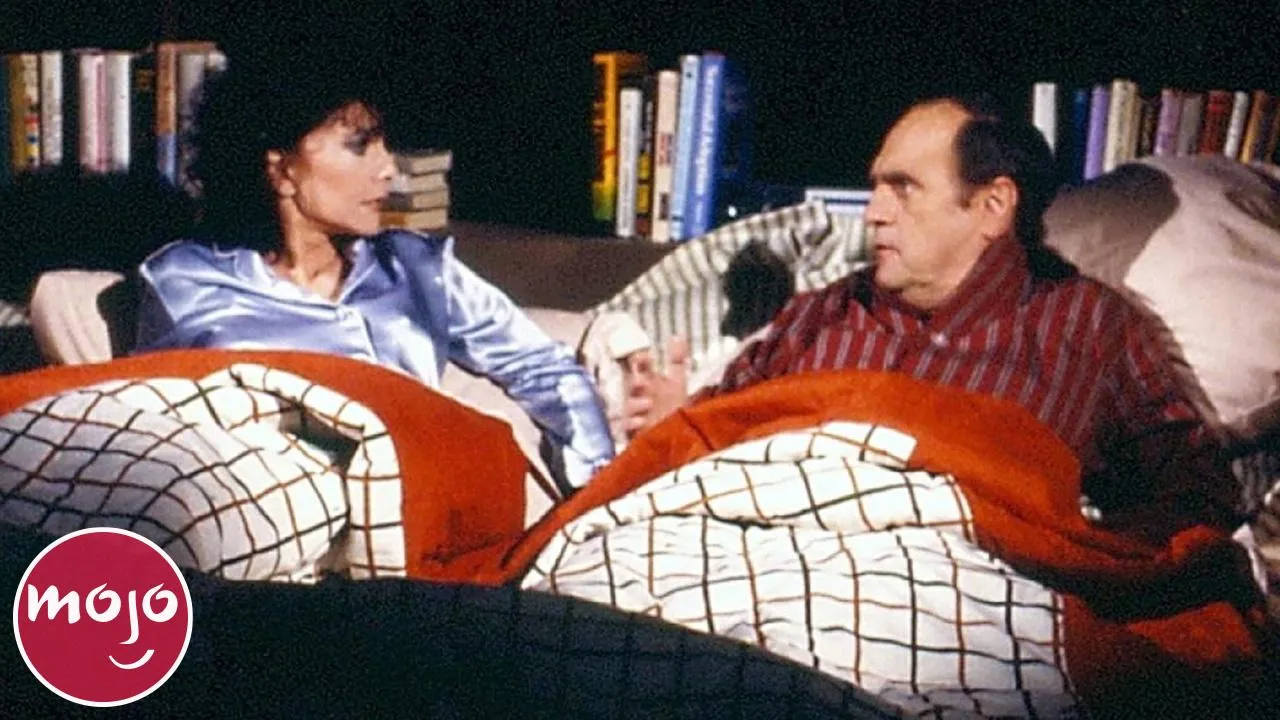
In the series finale of Bob Newhart’s second sitcom, his character is knocked unconscious by a golf ball. He then wakes up in the bedroom from his previous sitcom, in bed next to his former co-star, Suzanne Pleshette. The scene was filmed under complete secrecy, with fake endings leaked to the press to keep them from spoiling the surprise. While “St. Elsewhere” had shocked audiences with its “it was all just a dream” ending a couple years before, “Newhart” took that conceit and pushed it even further. This wraparound, universal wormhole ending was insane for the time.
#13: The Contest
“Seinfeld” (1989-98)
Several episodes of this “show about nothing” changed the way TV comedies functioned. “Seinfeld” could spin comedy gold from situations as mundane as waiting for a table at a Chinese restaurant. But perhaps its most audacious feat is a scene from a classic episode, “The Contest,” where the core four characters have an entire discussion about self-pleasure without ever saying the word. In fact, that’s what makes it devastatingly funny. Instead, they resort to euphemism and innuendo that just gets more unhinged as the scene goes on. It presented a fresh, innovative way to broach offensive topics without aggravating the censors.
#12: The Red Room
“Twin Peaks” (1990-91; 2017)
Even with all its quirks, the first episode or two of David Lynch and Mark Frost’s surrealist soap opera whodunit isn’t completely off the rails yet. It’s only when FBI Agent Dale Cooper first dreams of the Red Room, a sort of dimensional nexus between worlds, that the show really announces itself as one of a kind. While there, Cooper finds himself with a person who speaks cryptically and Laura Palmer, the high schooler whose murder he’s come to Twin Peaks to solve. The whole scene is packed with eerie and unforgettable images. Creators of shows like “The X-Files,” “Riverdale,” “Atlanta,” and even “The Sopranos” were all influenced by the series’ use of dreams and surreal imagery to illuminate the story.
#11: Chuckles’ Funeral
“The Mary Tyler Moore Show” (1970-77)
Recurring character Chuckles the Clown was the butt of all kinds of jokes by the madcap news crew of WJM-TV. This trend continues even after his death, and at his own funeral no less. The writers of “The Mary Tyler Moore Show” won a well-deserved Emmy for this classic episode that finds an equally hilarious and profound way to deal with death and grieving. Given how absurd it all is, it’s hard not to crack up right alongside Mary Richards as she tries to keep it cute out of respect for poor, dead Chuckles. But that’s what makes this scene so great. It’s hilarious, but it’s also human.
#10: Bill & Frank’s Last Dinner
“The Last of Us” (2023-)
One episode of this HBO adaptation of a celebrated video game had everyone talking. In a post-apocalyptic America, survivalist Bill takes in a traveler named Frank, and the two share many blissful years together. But as Frank becomes weaker due to a progressive illness, Bill decides to spend one last day with him before Frank ends his own suffering. As they share their last meal and glass of wine, Bill reveals that they’ll be dying together. And then we all wept. The episode won several awards and was lauded for presenting a story about a mature gay couple.
#9: Kimble Catches the One-Armed Man
“The Fugitive” (1963-67)
For four seasons, TV viewers watched as Dr. Richard Kimble was wrongfully convicted of murdering his wife and evaded police to find the killer for himself. Then, after four seasons, the unthinkable happened. He actually caught the one-armed man, the shadowy figure truly responsible for her death. After years of running, Kimble can finally walk free. This was so huge for the era because this was a time when TV storytelling just wasn’t taken seriously. It was almost unheard of for a show to have a proper conclusion in its series finale. “The Fugitive” paved the way for episodic stories that had a complete arc.
#8: “Sammy’s Visit”
“All in the Family” (1971-79)
We’ve already talked about Archie Bunker’s impact, but now let's talk about the episode “Sammy’s Visit.” In it, Sammy Davis Jr. stops by after leaving his briefcase in Archie’s cab. Archie’s thrilled to have him over, but that doesn’t stop him from making his usual off-color remarks. Apparently, Davis actually asked for this guest appearance, and the writers built a realistic setup around it. Their back-and-forth is funny and sharp. Davis handles Archie’s comments with humor and grace. But the moment that steals the show comes at the end: when Davis totally disarms Archie with a kiss. It’s a perfect, funny, and quietly powerful moment that turned into a classic piece of TV history.
#7: Who Shot J.R.?
“Dallas” (1978-91)
Does your favorite show always end a season on a cliffhanger? Thank “Dallas” for that one. The third season finale of this primetime soap ended on a mysterious note. Megalomaniacal oil baron J.R. Ewing sits alone in his office late at night. He hears a noise, goes to investigate, and is gunned down by an unseen assailant. Viewers had two questions. Would J.R. survive, and who shot him? Was it his ambitious younger brother Bobby? Could it have been his long-suffering wife Sue Ellen? Or, how about her lover Dusty? The cliffhanger ending had audiences speculating all through the summer of 1980. When the show returned in the fall, the season premiere scored an unbelievable 76% of that night’s TV-viewing audience.
#6: Ellen Comes Out
“Ellen” (1994-98)
It was big enough news when Ellen DeGeneres came out in real life. But the scandal that occurred once her sitcom avatar made that big leap was a completely different animal. The two-part “Puppy Episode” from 1997 was an auspicious event. Not only did it include guest stars Laura Dern and Oprah Winfrey, it was the very first time a main character on a series came out as gay midway through its run. When Ellen’s character made her announcement over the airport intercom, it was to the cheers of a studio audience. Public reaction was not as joyous. Advertisers and special interest groups trashed the show. “Ellen” only lasted one more season, and DeGeneres and Dern both faced career repercussions as a result.
#5: Kunta Kinte’s Name
“Roots” (1977)
Based on the 1976 novel by Alex Haley, this ABC miniseries was the first mainstream American TV project to delve into the horrors of slavery. The miniseries made the brilliant decision to cast familiar white actors in the roles of slave owners and antebellum racists to draw its audience in. Over 30 million people watched the second episode, which comes to a climax with Kunta Kinte refusing to answer to the name Toby, given to him by the slave owner who’s purchased him. He is whipped until he does so. The scene is relentless even by today’s standards, and pushed the boundaries of what could be shown on network TV.
#4: The Final Scene
“The Sopranos” (1999-2007)
In the 2000s, there may have been more viewing options than ever before, but HBO’s mob-centered masterpiece was appointment television. Over 11 million people tuned in to see how Tony Soprano’s story would end. Facing unprecedented threats to his underworld empire, the crime kingpin of New Jersey sits down to dinner with his family as Journey’s “Don’t Stop Believin’” plays on the jukebox. A feeling of unease creeps in. After six seasons, we realize that any person in this restaurant could be an assassin. Then the screen cuts to black. Allegedly, the abrupt ending had people thinking their cable had gone out. The amount of speculation and downright anger this ambiguous ending caused is still unprecedented to this day.
#3: The Red Wedding
“Game of Thrones” (2011-19)
If this fantasy epic taught us anything, it’s that you can’t get too attached to anyone. Even the show’s main characters aren’t safe. Two seasons after Ned Stark was beheaded for treason, his widow and eldest son and heir befell one of the most violent fates in all of TV history. In a flash, Catelyn Stark, Robb Stark, his pregnant wife, Talisa, and their retinue of partisans are slaughtered by Walder Frey’s party. Visceral doesn’t begin to cover it. In one fell swoop, three pivotal characters are gone and in the most brutal way possible. The reaction was incredible. On top of being a near-peerless episode of television, it still generates conversation more than a decade later.
#2: Goodbye
“M*A*S*H” (1972-83)
Despite lasting literal years longer than the Korean War, this war dramedy was insanely popular. While it began as a straight comedy, it changed tone and direction, as exemplified by the death of Lt. Col. Henry Blake in its third season. There was room for the horrors of war between punchlines. This was doubly true in the series finale, which still holds the record for most-watched episode of TV. Filled with incredible and powerful moments, the most memorable scene is its very last, where Hawkeye Pierce leaves the 4077th Mobile Army Surgical Hospital for good. His helicopter rises to reveal B.J. Hunnicutt’s goodbye message spelled out using stones. It’s a majestic and elegant end to “M*A*S*H’s” legendary 11 season run.
Before we unveil our top pick, here are a few honorable mentions.
The Snowglobe, “St. Elsewhere” (1982-88)
A New Twist on the ‘It Was All a Dream’ Trope
“The Body,” “Buffy the Vampire Slayer” (1997-2001)
A Touching & Real Exploration of Grief
Monica & Chandler’s Relationship, “Friends”
This Was a Relationship for the Fans Created by the Fans
Kunta Kinte's Birth, “Roots” (1977)
A Powerful Image for a Hopeful Future
The Moldavian Wedding Massacre, “Dynasty” (1981-89)
It Became the Series’s Highest-Rated Cliffhanger Season Finale
#1: “Lucy Is Enceinte”
“I Love Lucy” (1951-57)
It might be hard to imagine now, but there was a time when showing a pregnant woman on TV, or even saying the word “pregnant,” was a big no-no. Lucy wasn’t the first pregnant character on screen (that was Mary Kay Stearns back in the 40s), but when Lucille Ball became pregnant in real life, CBS agreed to include it… just not say it. That’s why the episode’s called “Lucy Is Enceinte.” Funnily enough, the next episode does use “pregnant” in the title. Anyway, the writers found clever ways around it, and it actually turned out really sweet. Fun fact: Lucy’s on-screen birth aired the same day as her real-life one and brought in 44 million viewers.
What do you think is the biggest landmark scene in TV history? Let us know in the comments
