Top 20 Jobs That Don't Exist Anymore
#20: Coffee Sniffer
Due to the country's involvement in the Seven Years' War, Prussia was broke. After becoming king, Frederick the Great needed to raise money. One way was to increase the tax on black gold by 150%, following his father's classification of it as a luxury. Frederick told people to drink beer instead for health reasons. This was followed by only the government being allowed to roast coffee. So, commonfolk turned to smuggling and roasting beans themselves to get their caffeine fix. To combat this, Frederick employed soldiers who were injured in the war to literally sniff out people drinking coffee or roasting it, resulting in fines. However, the coffee sniffer role was removed in 1787 after Frederick’s death.
#19: Hog Reeve
Also known as a “hog constable,” which gives the adorable image of a pig wearing a police uniform, a hog reeve played a vital role in Colonial New England during the 1600s. As the name suggests, this job dealt with keeping pigs in line in communities, both domestic and stray. If the swine had an owner, the human would be fined if the animal wreaked havoc in the area. Sometimes, they would even need to pay the hog reeves an impound fee if they captured the wandering pig. Even old England had hog reeves, who would stop swine from entering cathedrals, as they apparently liked doing back then. Nowadays, the job of Hog Reeve is obsolete, beyond being an honorary title.
#18: Radio Actors
In 1921, the first radio drama aired, leading to an increase in actors performing on the wireless. Famously, Orson Welles’s 1938 adaptation of “The War of the Worlds” caused mass confusion as listeners believed aliens were attacking the Earth. However, with television becoming a household essential in the 1960s, the golden age of radio acting ended. Albeit with a smaller audience, radio plays and soap operas continued as performers went into the recording studio. However, 2003’s “Not from Space” changed that, as the first radio drama to be recorded on the internet. In the modern age, while the radio still exists and is regularly used, radio dramas were overtaken by audiobooks, which generated $1 billion in US sales in 2018 alone.
#17: Phrenologist
Over the centuries, humans have had many medical and health professional specialties that were deemed life-changing until more research turned them into pseudoscience. One of which was phrenology. This method held the belief that a practitioner could feel and measure a person’s skull to uncover different mental traits the person had through “mental organs.” Franz Joseph Gall is credited as the pioneer of phrenology in the late 1700s. As such, it began sweeping Europe and North America in the 1800s. However, the method also became a vehicle for racism and misogyny. Fortunately, by 1840, an increase in research against phrenology turned most of the scientific world against the practice, causing phrenologists to decline in popularity.
#16: Lector
No, this doesn’t involve Hannibal. Long before factory workers had Tannoy systems, earphones, or radios, a lector was their source of news and entertainment. Created around 1865 and primarily featured in cigar factories in the US and Cuba, the lector was elected by fellow workers, who also contributed their own wages to pay their chosen one. The lector would then read from newspapers or books, often with left-wing ideologies, out loud as the employees worked. The person who held the role was essentially an actor performing one-person shows. However, when Florida had the Ybor City cigar makers' strike in 1931, the factory owners blamed lectors for seemingly radicalizing the workers. So, they were banned, leading to the role’s demise in the US.
#15: Plague Doctor
With long cloaks, a beaked mask, and a jaunty hat, plague doctors are often used for Halloween costumes nowadays. After all, their role was taken over by modern specialty doctors and other medical professionals as research progressed. Plague doctors were hired by cities to combat the effects of a disease outbreak, most famously during the Black Death from 1346 to 1353. However, the iconic costume wasn’t developed until around the 1600s. The reason for the unique masks was due to the belief that disease was spread by bad smells. The pointy beak part would be filled with pleasant herbs or flowers for the doctors to inhale, rather than the scent of sick people, as they treated them with leeches and other outdated methods.
#14: Sluggard Waker
Have you ever gone to a service at a Christian church and found yourself nodding off? Well, if so, rather than getting disapproving glances from other partitioners and the priest, in the olden days, you’d have experienced a lot worse. In the 1700 and 1800s, usually in England, a parishioner would be given the task of being the sluggard waker. If they spotted someone asleep, they would pick up their speciality stick and approach. Typically, depending on the sleeping person’s gender, they’d get different sides of the stick. If they’re male, they get struck with the brass knocker or forked end, which sounds traumatic. If female, they get tickled awake with a fox tail, which is disturbing in another way.
#13: Ninja
While Hollywood likes to depict Japan as having ninjas hiding around every corner, in reality, it’s a very different story. Primarily used as spies and saboteurs against their employer’s enemies, the legacy of ninjas has blended with fiction. As such, many believe that ninjas also operated as assassins, which is disputed by some historians. It’s claimed that the earliest written factual account of the profession was in the 1100s. Yet there are earlier tales, including some from the first century, that also feature the spies. However, the stories’ factual accuracy is unclear. In Japan’s Edo period, from around 1603 to 1868, with the lack of conflicts, the work vanished for ninjas. Instead, they found employment as bodyguards, while others transitioned to other professions or crime.
#12: Computer
Before computer technology took over society, if a task required a lot of calculations, there was nothing else than the human brain. In the 1600s, human computers aided astronomers in calculating the positions of planets. They also played a key role in mapping as they worked on the first Nautical Almanac in 1767. Usually, men were employed as computers. Yet by the mid-1800s, women began being hired more, most famously with the astronomy team at the Harvard College Observatory known as the “Harvard Computers.” World Wars I and II saw a sharp increase in human computers as a lot of data required collecting and processing. The job also played a big role in sending people to space, as seen in the 2016 film “Hidden Figures.”
#11: Elevator Operator
Nowadays, getting into an elevator is an independent affair, as you press the button to the floor you need. Yet back in the day, it was far more of an experience. After all, upon entering, an elevator operator would be waiting to serve. On top of a friendly greeting and information about the business or attraction you’re in, the worker would be in charge of safety by closing the door manually. If the elevator broke down, the operator would keep everyone calm. Yet their most vital role was controlling the lever that moved the elevator. Even when button-operated elevators were invented, users preferred an operator. However, following an operator strike in 1945, this led to the downfall of their profession beyond novelty.
#10: Knocker-Upper
These days it’s pretty easy to set an alarm on your phone, a smart speaker or even a clock. Before you know it, an annoying beeping has you crawling out of bed. But did you know that at one time, you could get a job as a “knocker-upper” which was essentially a human alarm clock. Found mainly overseas, especially in Britain, the name describes someone who would literally knock on your window to try and wake you up. They could be seen on the street with long sticks tapping on windows, or in some cases, even use pea shooters on the glass.
#9: Ice Cutter
Have you ever heard of a refrigerator referred to as an “ice box”? Wonder where the name came from? In the days before freezers and fridges that could keep themselves cool, believe it or not, they relied on large blocks of ice to be loaded into them to keep the contents cold. “Ice Cutters” were the folks employed to cut the large blocks of ice. The “ice man” would then deliver it to your home and you’d have frozen goods for a few days before having to replace it. Modern technology has essentially eliminated these jobs aside from the need to carve ice for sculptures, and unique hotels.
#8: Milkman
Hop on down to your corner store and you’re likely to find a few different varieties of milk. It’s taken for granted you will find it at the grocery, a convenience store, and even gas stations. Yet there was an era where people didn’t get all of their groceries in one place. Milk was generally only available from one company within an area, and it was always brought courtesy of the milkman. Glass bottles of milk would be delivered to your home, and the empties returned. Once a week or so, the milkman would return and the cycle continued. Aside from jokes about infidelity, not much is heard about the milkman anymore.
#7: Dispatch Rider
A common news story today is hearing about how some hacker was able to intercept communications and use it for nefarious purposes. So it’s no surprise that even back as far as World War I, the military was concerned about secure communication. To thwart would-be eavesdroppers, the forces would send urgent orders and messages by motorcycle courier instead of using radio transmissions that could be intercepted. A little more advanced than the “Pony Express” but certainly secure. With no means to capture a radio transmission, the riders became very popular over both WWI and WWII.
#6: Soda Jerk
Is it a weird dance that we all forgot about? Was it a slang term for when you take your glass off the fountain pop machine? None of the above folks. In fact, a soda jerk was someone who operated the soda fountain machine in various stores back in the 1940s. Along with filling drink and ice cream beverages, the “jerks” were expected to socialize and entertain any of the patrons within the store. Despite having the word “jerk” in the name, it was actually a coveted position aimed at men with outgoing personalities and qualities that would keep the customers coming back for more.
#5: Video Store Employee
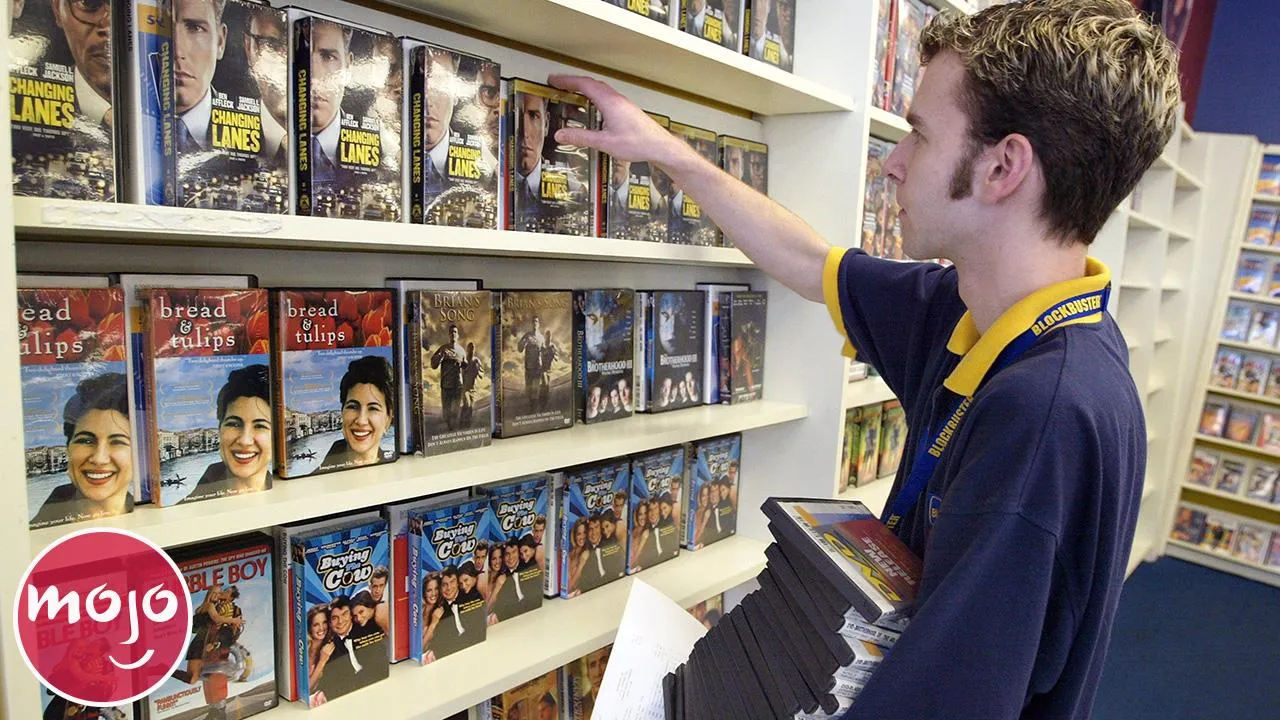
So yes, we know that a few of these may still exist. But by and large, most full video rental places have gone out of business and been replaced by streaming services. Video store employees would be the ones responsible for renting you your movies, games, and sometimes equipment from the store. They were also the ones that would cringe every time someone wasn’t kind and didn’t rewind a VHS tape. But of all things we hated, it was returning that movie just a little past the return time and having to pay that employee the dreaded “late charge.” Can’t say we miss these folks!
#4: Typesetter
Anyone who worked in the print industry years ago would be blown away by how the hardcopy process has changed over the years. At one time, a “typesetter” was responsible for lining up all of the letters, numbers, and spaces in a special typeset machine. Different fonts and sizes had unique blocks which had the character or symbol printed backwards on them so they would “print” correctly. The setter would line all of these up in correct order and load them into the machine to be used to “print” a line, or paragraph of text. They would then be removed, cleaned, and stored for their next use. Thank you digital revolution!
#3: Lamplighter
This entry is one that shows how even the simplest of technology has changed how people work. Most common streetlights today are connected to the power grid, and turn on and off as the sun sets and rises. How exactly would you get similar ones up and running if they were oil or candle based? Cue the lamplighter. Just as the name implies, a lamplighter was responsible for manually lighting each lamppost as the sun went down. When morning arose, they would then again make the same trip and butt out any lights still running. This job became unnecessary once electric lamps were introduced.
#2: Pinsetters
Make one mention of a bowling alley and immediately the sounds of crashing pins fill the air, along with the smell of shoe disinfectant. You roll the ball down the lane and jump for joy when the strike comes. Magically, the pins get swept under and mysteriously set themselves back up. It’s not really magic but more ingenuity. There was a time where “pin boys” were responsible for collecting the fallen pins, and putting them back on the lane for the next turn. You could spot them behind the pins at the end of the lane just waiting for their next job. Sadly, once the auto-pinsetting machine was invented, these little jobs went away.
#1: Switchboard Operator
Today, no one even gives a second thought about placing a call on their phone. Through advanced telecommunication technology, there’s a box somewhere that knows how to connect you to whomever you are calling. That wasn’t always the case. At one time, you had to pick up the phone and ask an operator to connect you to someone else. Seated at a “switchboard,” the operator would connect you directly to the other person. For long distance calls, they would have to connect with an operator from another area, and would actually log how much time was spent on the line.
If you could work any obsolete job in history, even for just one day, what would you choose? Let us know below!

