The 10 Most INNOVATIVE 3D Platforming Mechanics Ever
Parkour Platforming
“Mirror’s Edge” (2008) and “Assassin’s Creed” Franchise (2007-)
While we know that “Mirror’s Edge” and the “Assassin’s Creed” franchise aren’t pure 3D platformers, there’s simply no denying that the parkour platforming and traversal both series pioneered have helped shape the way we enjoy many platformers today – games such as “Donkey Kong Bananza” and “Prince of Persia: The Lost Crown” specifically coming to mind. The parkour-based platforming in both “Mirror’s Edge” and the “Assassin’s Creed” games transformed movement itself into a core gameplay system rather than a simple means of just getting around an environment. In “Mirror’s Edge,” parkour is presented from a first-person perspective, emphasizing momentum, flow, and physicality as players chain wall-runs, vaults, slides, and precision jumps into smooth, uninterrupted motion that feels almost athletic in nature. This design encourages speed, spatial awareness, and mastery of the environment, making movement both a challenge and a reward. “Assassin’s Creed” games, especially the older titles, similarly revolutionized traversal by allowing players to fluidly climb, leap, and scale entire cities with minimal interruption, turning historical landscapes into vertical playgrounds, always encouraging experimentation and fun. The franchise’s ‘free-running’ system prioritizes accessibility and cinematic spectacle, enabling complex parkour actions through intuitive controls while maintaining a sense of realism and character agility. In both series, parkour is not merely a stylistic flourish but a defining mechanic that reshapes level design, player agency, and immersion, proving that how a player moves through a world can be just as innovative and impactful as combat or narrative.
Dual Analog Platforming and Gadget Usage
“Ape Escape” (1999)
“Ape Escape’s” dual analog mechanic was groundbreaking in 1999 (and really can’t be understated) because it redefined how players interacted with characters and tools in a 3D space at a time when most platformers still relied on a single control stick and face buttons. By mapping character movement to the left analog stick and assigning gadget actions to the right stick, the game made physical motion and tool usage feel distinct, simultaneous, and spatially intuitive. Players didn’t just press a button to use a gadget, they swung, aimed, or spun it with analog precision, enhancing the monkey-catching shenanigans with a finer degree of control. This design allowed for more expressive and context-sensitive interactions, such as subtly angling a net, rotating a stun club, or controlling a propeller with variable speed, which added depth without overcomplicating inputs. Additionally, “Ape Escape” was the first major 3D platformer to require the PlayStation DualShock controller, effectively demonstrating why dual analog sticks mattered, specifically in a genre that is all about freeform movement and character expression. For 3D platformers in general, this approach expanded the genre’s vocabulary, showing that platforming, camera movement, and actions could be decoupled and layered in more sophisticated ways, paving the way for more complex control schemes in later action and adventure games.
Exploration-First Open Level Design
“Super Mario 64” (1996)
“Super Mario 64’s” exploration-first open level design was groundbreaking because it redefined how players interacted with 3D spaces in platformers. Instead of guiding players through linear stages with a singular objective, each course functioned as a small, open environment where experimentation and curiosity were central to progress, both of which enhanced the game’s charm and playfulness. Players could freely roam around each painting world, discover multiple goals within the same level, including scooping up oodles of coins, uncovering hidden nooks and crannies and solving environmental puzzles. They could even choose the order in which they tackled challenges, namely, getting the coveted Power Stars, making movement itself a form of play rather than just a means to an end. This was especially innovative in a 3D context, where understanding depth, camera control (more on that later), and spatial relationships was still new territory for most players, especially when platformers were primarily set on a 2D plane. By emphasizing exploration first and foremost, and weaving Power Stars into the exploration, “Super Mario 64” taught players how to navigate 3D worlds intuitively and with a greater sense of freedom of player expression, setting a foundation for future 3D platformers and influencing countless games that embraced nonlinearity, player choice, and environmental discovery as core design principles.
Time Manipulation
“Blinx: The Time Sweeper” (2002)
While your mind might first conjure “Prince of Persia: The Sands of Time” (more on that great game later) when it comes to time manipulation in 3D platforming-adjacent games, it’s actually “Blinx: The Time Sweeper” for the OG Xbox that truly pioneered this innovative mechanic in the 3D platforming space. The time manipulation mechanic was (and still is) remarkably innovative because it made control over time the core mechanic of the 3D platforming gameplay rather than a situational gimmick. By giving players the Time Sweeper vacuum that could hoover up time crystals that could then record, rewind, pause, fast-forward, and selectively replay actions, the game allowed time itself to function as a malleable resource, effectively turning mistakes into strategic opportunities and turning forward-thinking planning into a solid tool as you navigate each whimsical and colorful stage. This was especially novel in an era when most 3D platformers emphasized precise movement and trial-and-error design, often punishing failure with restarts rather than encouraging fun experimentation. Blinx’s mechanic enabled players to solve environmental puzzles, navigate enemies, and refine platforming sequences by actively editing the flow of gameplay, which blurred the line between player performance and system manipulation. This mechanic is still quite novel in gaming as a whole. In toying with time itself, the game treats time as an interactive system and demonstrates how temporal control could deepen player agency, reduce frustration through creative experimentation and environmental interaction, and expand the expressive possibilities of 3D platformers as a genre. Good job Blinx, you earned yourself some catnip!
Gravity Shifting
“Super Mario Galaxy” (2007)
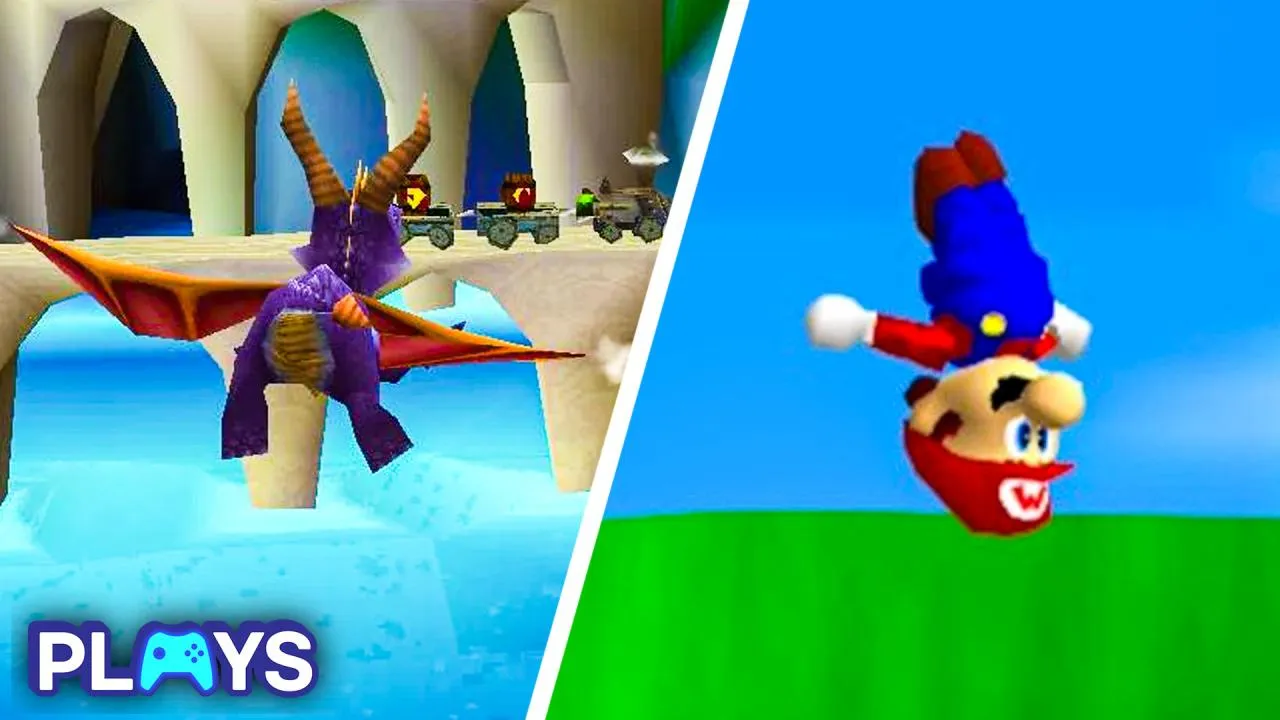
What goes up must come down, right? Well, not in the case of “Super Mario Galaxy.” The gravity shifting mechanic in this game was innovative because it fundamentally rethought how players navigate 3D spaces, turning gravity itself (a common denominator in any 3D platformer) from a static, by-the-books rule into a dynamic and highly intuitive gameplay system, while keeping in line with the narrative throughline. By allowing Mario to run seamlessly around various-sized planets with their own gravitational pull, and in some areas to experience shifts tied to movement or perspective (like walking upside down), the game replaced traditional flat levels with fully spherical environments that players had to understand spatially rather than directionally, which often broke our brains at times if we’re honest. This design encouraged constant reorientation, forcing players to think in terms of momentum, camera control, and spatial awareness in ways that earlier 3D platformers rarely demanded, but it never made the game ‘harder’ in the traditional sense. Importantly, the mechanic was intuitive despite its initial sense of complexity. We say complex because you really did have to retrain your brain to move differently when walking on the underside of a planet, for example. Nintendo’s careful camera behavior and visual cues made radical gravity changes feel natural rather than spatially confounding. For “Super Mario Galaxy,” this mechanic enabled highly imaginative level design that supported the game’s cosmic, out-of-this-world theme while keeping Mario’s controls precise and familiar. For 3D platformers as a whole, it demonstrated that the genre could move beyond linear planes and fixed gravity without sacrificing accessibility, opening the door for more experimental uses of space, physics, and player perspective in future games, which was expanded upon in “Super Mario Galaxy 2.”
Gliding + Airborne Traversal “Spyro the Dragon” (1998)
While “Super Mario 64” did indeed have moments where you could soar through the skies for a brief period of time, it wasn’t intrinsically tied to the entire platforming experience and level design as it was in 1998’s “Spyro the Dragon” for PS1. In “Spyro,” gliding and airborne traversal were quietly revolutionary mechanics that helped redefine how 3D platformers could use space, especially vertically speaking. Spyro’s ability to leap from high points (or low points if you wanted to get spicy) and smoothly glide forward transformed verticality from a simple obstacle and platforming challenge into a core part of exploration, encouraging players to think in terms of height, distance, and momentum rather than just linear jumps. This, of course, led to highly creative platforming maneuvers for our favorite purple dragon. Unlike many early 3D platformers that struggled with imprecise camera controls and awkward midair movement, Spyro’s glide was predictable (well…mostly), it was readable and telegraphed, and it was tightly integrated with level design, allowing wide chasms, layered vistas, and sweeping pathways to feel intentional rather than intimidating, especially in a level like ‘Tree Tops.’ This mechanic reduced frustration, and increased immersion into the vibrant world, by giving players a sense of control after leaving the ground (instead of just flailing around like a goofball), while simultaneously inviting risk-taking and experimentation—missed jumps often became alternate routes rather than outright failures. In doing so, Spyro demonstrated that 3D platforming could be fluid and expressive, using airspace as a navigable environment instead of a brief transitional state (yes, I know…we are getting quite esoteric here), and helped set a strong template for other games to come down the line.
Physics-Driven Momentum
“Crash Bandicoot” (1996)
This one is honestly a lot harder to decipher and pin down since, by its very nature, it’s a lot more about the feeling of moving a character through a 3D space, thus it’s harder to define in words. But, we shall do our very best here. “Crash Bandicoot” distinguished itself through a physics-driven sense of momentum that felt unusually and enjoyable tangible for an early 3D platformer. Rather than treating movement as purely static or grid-like, the game gave Crash a real sense of weight, inertia, and acceleration, so jumps carried forward velocity, slides preserved speed, and landings demanded anticipation rather than instant correction. This meant players had to think about how fast they were moving and how their motion would carry through space, creating a rhythm closer to real physical motion than to the rigid stop-and-go controls common in other 3D platformers. Of course, this meant a major retraining of our brains as we navigated Crash’s tricky first outing on PS1. At a time when many 3D platformers struggled with wonky and unclear movements and awkward camera perspectives, Crash’s momentum-based physics provided a deeper sense of clarity and overall consistency, as well as a boatload of challenge. Once players learned how speed and direction interacted, the game felt a heck of a lot more fair, readable, and purely skill-based. This approach was innovative not only because it made “Crash’s” levels feel fast, fluid, and satisfying, but because it demonstrated that 3D platformers could embrace momentum as a core design principle instead of a random, throwaway gimmick, influencing later games to treat movement physics as a source of depth and mastery rather than a technical obstacle to overcome.
Wall Jumping and Wall Running
“Super Mario 64” (1996) and “Prince of Persia: The Sands of Time” (2003)
We are giving you a nice two-for-one deal here since both of these mechanics are innovative and intrinsically tied to their respective gameplay experiences. In the case of wall jumping, by allowing Mario to rebound off vertical surfaces with well-timed jumps, the game gave players a powerful tool for vertical exploration that was not tied to rigid ladders or scripted paths, reinforcing the sense of freedom that defined its open level design. Plus, it just made you feel uber-cool whenever you pulled it off, kinda like you were ready to compete in the Olympics. This mechanic encouraged experimentation and mastery of movement, as skilled players could chain wall jumps to reach areas that felt daring or even slightly beyond the intended route, enhancing player agency. Moving over to the wall running side of this entry, “Prince of Persia: The Sands of Time” excelled in many areas of gameplay innovation, including, but not limited to, time manipulation for platforming and puzzle solving (much like Blinx), and, in the case of this entry, the excellent wall running mechanic. By allowing the Prince to run along walls at a precise angle, the game gave players a dynamic way to navigate horizontal and vertical spaces alike, bridging gaps and reaching ledges in ways that were previously impossible in most 3D environments, apart from just hoping your jump would make it that far. This mechanic emphasized timing, spatial awareness, and momentum, rewarding players for mastering the physics of movement rather than merely memorizing platform locations. This also ties in to the parkour platforming we mentioned in a previous entry. It made you feel superpowered as you chained wall runs, jumps, flips, and time powers. For 3D platformers more broadly, it was innovative because it redefined environmental interaction: walls were no longer just static boundaries or set dressing but active surfaces to engage with.
Double Jump + Vertical Acrobatics
“Jumping Flash!” (1995)
Ah yes, the humble double jump. It’s the fantastic tool in any 3D platformer protagonist’s arsenal that takes them to the next level in terms of moving through a 3D space. I can’t tell you how happy it makes me when a double jump is available right from the outset in a platforming game. But, did you know that the first real double jump in a 3D game was actually pioneered by 1995’s Jumping Flash! For PS1? Unlike most games of the era, which confined movement largely to horizontal planes, Jumping Flash! gave players unprecedented vertical freedom, allowing them to chain numerous jumps to reach high platforms, cross wide gaps, or survey the environment from crazy heights, all from a first-person point-of-view. The double jump wasn’t just a simple extra hop; it became a core tool for exploration and strategy, emphasizing timing, spatial awareness, and risk-reward gameplay. Plus, it’s just a heck of a lot of fun to use in this game and in platforming games, in general. This mechanic stood out because it leveraged the PlayStation 1’s 3D capabilities to create a feeling of true aerial agility and responsiveness, influencing almost every later 3D platformer that sought to combine expansive verticality with fluid player control. The double jump in this game was an absolute necessity if you wanted to progress and explore every inch of a level. It helped that the game’s drop shadow, sense of predictable physics, and general layout was all woven directly into the core game design.
Free-Roaming 3D Movement + Player-Controlled Camera
“Super Mario 64” (1996)
Saving the absolute best and most innovative for last, “Super Mario 64” once again shines brightly as a beacon for all other 3D platformers of the time, and heck, even to this very day when it comes to freely navigating 3D worlds with the camera in your control (at least most of the time when it wants to cooperate). Unlike the fixed or side-scrolling perspectives common in earlier platformers, Mario could move fluidly in all directions across expansive 3D environments, allowing players to approach challenges from multiple angles. The game’s camera, controlled by the player via the Nintendo 64’s C-buttons, provided unprecedented control over perspective (even though it was sometimes a bit wonky), enabling players to explore levels strategically, at their own pace, avoid hazards, take on baddies, and plan jumps with precision. And crucially, this helped with obtaining every single coin and Power Star since you, as the player, always felt in control of Mario, something immediately connecting you to the game world like no other game before it. This combination of unrestricted movement and dynamism when it came to the player-directed camera not only gave a sense of spatial expression in a 3D space that felt truly three-dimensional but also set a standard for almost all 3D platformers that followed, influencing titles for decades and demonstrating that 3D environments could be navigated intuitively without disorienting the player. It was an elegant, innovative, and highly enjoyable solution to the new challenges of 3D platforming gameplay, and helped establish the blueprint for modern 3D game design as a whole, not just 3D platformers.
So, what did you think of this list? Are there any innovative 3D platforming mechanics that we forgot to mention? Be sure to let us know in the comments.
