50 Disturbing Interviews With Killers
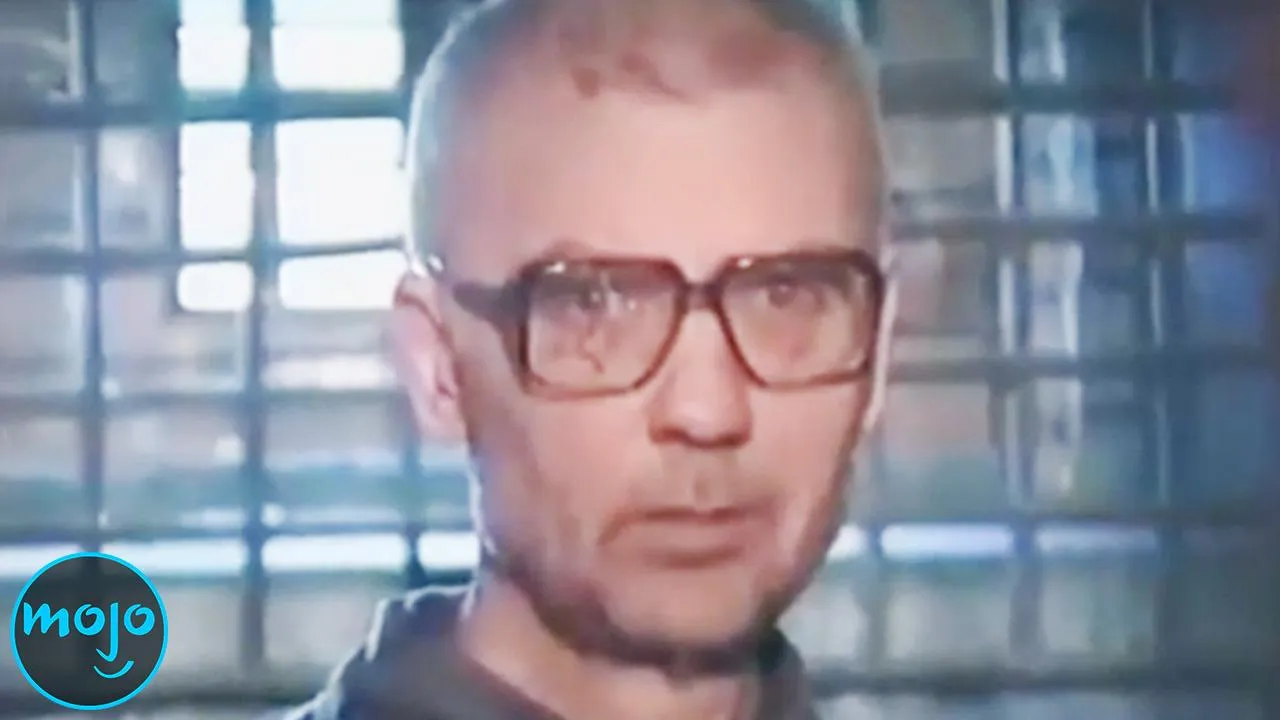
50 Disturbing Interviews with Killers
Welcome to WatchMojo, and today we’re looking at interviews with confirmed murderers that haunted viewers.
Ron Sanford
One of the youngest people convicted of murder in Indiana history was just 13 years old when he and a friend killed two elderly women. Twenty-five years into his 170-year sentence, Ron Sanford talked with Indianapolis news about life behind and before bars. He spoke about growing up amid poverty and violence, with trauma and lack of supervision purportedly explaining his actions. He also expressed deep remorse for the mistakes of his youth. Sanford’s story received wide media attention as an incident of the socioeconomic tragedy and excessive punishment that disproportionately affect Black men in the U.S. That's unsettling enough without the news story’s reflection on a level of violence that is ultimately inexcusable.
Bobby Joe Long
At least ten women were assaulted and murdered in the Tampa Bay area in 1984. Bobby Joe Long targeted victims regularly through newspaper classified ads, and was ultimately brought down after the escape of Lisa McVey. He got very candid with CBS News in an interview before the 1986 trial for two murders besides the eight he confessed to. The soundbite of Long calmly expressing that he’s not proud of what he did, and doesn't know why he did it, became infamous. This claim of cognitive dissonance with such a mannerly tone supported this violent misogynist as a prime figure in psychopathological studies. Long was executed on May 23, 2019.
Devon Arthurs
In a bizarre case of radicalization, 18-year-old Devon Arthurs of Tampa abandoned neo-Nazism in favor of Salafi Islam in 2017. He later murdered two friends from the Atomwaffen Division, supposedly for disrespecting his newfound faith and plotting a terrorist attack. His guilty plea earned him 45 years. David Scott took the story deeper with a prison interview for a 2025 episode of Court TV’s “Interview with a Killer.” Arthurs shows unsettling clarity throughout this lengthy discussion about the online and social activity that led to his lethal extremism. He expressed remorse while still rationalizing the defense of his ideology, in a terrifying look at the consequences of the modern echo chamber.
Tommy Lynn Sells
The “Coast to Coast Killer” was a drifter who claimed to have committed up to 70 murders across the U.S. After his apprehension in Texas in 2000, Tommy Lynn Sells did several interviews in the 14 years leading up to his execution. Perhaps the most sobering was with Dan Abrams of ABC’s “Nightline” for a 2010 story on psychopathy. The way he almost nostalgically reflects on his murders perfectly demonstrates an expert interview regarding emotional suppression. But Sells couldn't bring himself to discuss one of his most horrific sprees, and offers no comment for survivor Krystal Surles. Whether Sells was manipulating Abrams or really had a limit to his evil, he was a chillingly ideal subject for this study.
Dorothea Puente
On November 11, 1988, a seemingly sweet woman sat down with Sacramento Police Detective John Cabrera to discuss the boarding house she ran for the elderly and disabled. Specifically, the focus of Dorothea Puente’s police interview was on the human remains that were just found on her property. It would be determined that she poisoned at least nine tenants in order to steal their Social Security checks. Footage of the so-called “Killer Landlady’s” post-arrest interview was used at her trial and later circulated for its novel juxtaposition. She maintained her innocence and a calm, maternal demeanor while struggling to explain herself. Puente was convicted of three murders in 1993, and died in prison of natural causes 18 years later.
Joel Rifkin
One of New York’s most prolific serial killers, convicted of murdering nine women, though he confessed to killing 17 between 1989 and 1993. Nearly 30 years later, A&E’s “Cold Case Files” dedicated their first two-part special to an on-camera prison interview with Joel ‘the Ripper' Rifkin. He keeps a flat affect as he walks producers through his troubled backstory and his methodology, including victim selection and the actual murders and mutilations. He also offers clues to identify two unnamed victims. But even with the old man's friendly disposition and 203-year sentence, he remains cryptic. This televised investigation is mostly just a haunting reminder of the destruction Rifkin left in his wake.
Jodi Arias
From total denial to a ninja attack, Jodi Arias of Arizona offered many stories about the 2008 death of ex-boyfriend Travis Alexander before settling on self-defense. She was ultimately convicted of his gruesome murder in 2013. CBS’s “48 Hours” then interviewed her for a special dedicated to scrutinizing Arias’s sometimes absurd lies. There was in fact nothing amusing about her cold expression as she continued to manipulate and misdirect throughout the conversation. Clips of interrogation and trial footage suggested that she used more emotional outbursts to serve a façade of grief that the jury ultimately didn't buy. This material and testimony from others are now just evidence that Arias is deeply disturbed.
Wayne Williams
Between 1979 and ‘81, Atlanta was paralyzed by the murders of nearly 30 children and young adults. Wayne Williams’s conviction for two led to many of the cases being closed, though many believe he was a scapegoat in a more complicated crisis. There was still no doubting his instability after his interview with Soledad O’Brien for CNN’s 2014 documentary “Atlanta Child Murders.” Williams is cold and muted, deflecting accusations along with questions about his own claims that he was trained in lethal combat by the CIA. O’Brien seems willing to get a nuanced perspective from an alleged serial killer, but he responds with manipulation. Whether Williams had the ability to take so many lives, he has the disposition of someone dangerous.
Drew Peterson
Once a police sergeant in Bolingbrook, Illinois, Drew Peterson became the center of a media circus following the 2007 disappearance of his wife Stacy. The intense scrutiny helped secure his 2012 conviction for the murder of previous wife Kathleen Savio. The tragedy became the subject of dramatizations and interviews with Peterson himself, including for a local Fox affiliate’s coverage of the ten-year anniversary of his 2009 arrest. He was in good spirits during the phone conversation, as an attempted murder-for-hire against his prosecutor resulted in his transfer to a less squalid prison. This interview epitomized his flippancy about his crimes and the missing person case that facilitated the downfall of a clearly callous man. Stacy Ann Peterson was never found.
Dennis Nilsen
The Muswell Hill Murderer took at least 12 lives in London between 1978 and ‘83. A habit of keeping his victims’ remains in his apartment for weeks eventually led to Dennis Nilsen’s discovery. A decade into his life sentence, his interview for Central Television’s “Murder in Mind” was met with controversy due to the sensitive nature of the subject. Nilsen’s clinically toned description of his methods is indeed difficult to hear. No less chilling, however, is how he justified killing and preserving people out of a desperation for company. The documentary became an important exploration of the tragic humanity within many of the monsters among us. The fact remains that no degree of loneliness could excuse Nilsen’s twisted actions.
Brian Steven Smith
An SD card found on the streets of Anchorage, Alaska featured evidence of Brian Steven Smith murdering Kathleen Jo Henry. He confessed to also killing Veronica Abouchuk, though authorities suspect his crimes run deeper. David Scott probed for more information in the debut episode of Court TV’s “Interview with a Killer” shortly after Smith’s conviction in 2024. The combative conversation mostly just exposed the killer’s apathy for human life and defensive lying. One of the lies he most glaringly fails to sell is that he doesn’t like doing what he filmed himself doing. It was a fitting proof of concept for “Interview with a Killer” as an in-depth look at the cruelty and equally upsetting desperation of evil.
Angela Simpson
In 2009 in Phoenix, Arizona, Terry Neely was lured out of an assisted living facility by sex worker Angela Simpson after allegedly telling her that he was a police informant. He was then tortured over the next three days before being murdered. A local news interview suggested that she was morally resolute in both her actions and their consequences. But the Investigation Discovery show “Signs of a Psychopath” told a different story through footage of Simpson’s confessional interview with police. She boasts about the murder as a source of immense pride, a tone she would maintain in other prison interviews with the media. The footage following her arrest still says plenty about the reality of her twisted principles.
Scott Peterson
The pregnant Laci Peterson of Modesto, California was reported missing on Christmas Eve 2002. Two years later, her husband Scott was convicted of her and their unborn son’s murder. He stayed silent to a horrified public for two decades before he was approached about the Peacock docuseries “Face to Face with Scott Peterson.” Video calls with the prison inmate lead this in-depth portrait of the adultery and burden of family responsibility that preceded a tragedy. And yet, Peterson vehemently maintains his innocence while crafting a burglary scenario. This doesn’t hold up under scrutiny of Peterson’s detached demeanor alone. His chillingly persistent façade of an ordinary, falsely accused man makes the story of his terrible crimes all the more harrowing.
Lee Boyd Malvo
In 2002, 17-year-old Lee Boyd Malvo and his mentor John Allen Muhammad terrorized the Washington, D.C. area with a three-week sniper spree that claimed 10 lives. A decade later, Malvo called Matt Lauer from prison in an exclusive interview for NBC’s “The Today Show.” He reflects with unsettling clarity on the crimes of his youth and how Muhammed abused and indoctrinated him into devaluing human life. He nonetheless takes personal responsibility for being “a monster.” Malvo seems to show the genuine remorse of someone fully rehabilitated, and has since made multiple appeals for his release from prison. Whether he deserves it, listening to the process of someone going from victim to victimizer is utterly devastating.
Paris Bennett
In Abilene, Texas, 2007, 13-year-old Paris Bennett murdered his little sister Ella. His motive was to spitefully take away something precious to their troubled mother Charity. He was sentenced to 40 years in prison with a diagnosis of psychopathic traits, hence the title of the 2019 special “Psychopath with Piers Morgan.” Charity watched from a separate room as the British journalist engaged Bennett in a callous and explicit account of his crime. He shows no signs of remorse for sacrificing at least half of his life to destroy his family. Charity still maintained communication with her son until 2021, when she supposedly discovered that Paris was contacting a woman who was plotting a mass shooting.
Lori Vallow Daybell
In 2019, Charles Vallow was killed in Arizona, and his two children in Idaho. Matriarch Lori murdered her estranged family with brother Alex Cox and boyfriend Chad Daybell, reportedly to serve an apocalyptic mission. It’s also believed that the couple aimed to kill their respective spouses for financial gain. The so-called “Doomsday Mom” surely had much to say to Keith Morrison for a 2025 episode of “Dateline NBC.” The prisoner claimed innocence and the prospect of reuniting with her children in the afterlife, while evidence and police testimony painted her as a skilled manipulator. She has, after all, made several appeals to overturn her life sentence. To one extent or another, it’s a surreal study in dangerous delusion.
Paul Bernardo
The torture and murder of two Ontario teens led to Paul Bernardo being sentenced to life in prison in 1995. He was also implicated in a string of prior sexual assaults. Two Toronto detectives thus suspected Bernardo of being involved in the 1990 disappearance of Elizabeth Bain when they talked with him in Kingston Penitentiary in ‘07. Published footage of the lengthy interview shows Barnardo not only denying any involvement, but accusing the justice system of dehumanizing him. He also downplays his proven crimes as past “mistakes.” It’s a quintessential example of extreme narcissism beyond rehabilitation. Bain’s case remains open, but Barnado’s rambling, self-pitying monologue proved to be an asset in studies of antisocial behavior.
Charles Cullen
In 2003, one of the most prolific serial killers in American history confessed to euthanizing as many as 40 patients as a critical care nurse in New Jersey and Pennsylvania. Charles Cullen was convicted on 29 counts of murders, but research implicates him in hundreds more. His first televised interview in prison would be with Steve Kroft for an episode of “60 Minute” in 2013. Questions about the hospitals’ systemic failure to prevent this horror are supported by Cullen calling his killings an act of mercy. When pressed about the improving conditions of many of his patients, he admitted that there was no real justification. Cullen is clearly a deeply disturbed individual, whose interviews are always a dark indictment of institutional failures.
Israel Keyes
This American serial killer funded his cross-country spree with bank robberies until his arrest in Alaska in 2012. Israel Keyes then confessed to committing 11 murders in 11 years, in a filmed FBI interview that became widely circulated. So too did later interviews of him meticulously negotiating his legal options and confession to three specific murders. He wound up taking his own life in his cell toward the end of the year. Although Keyes never made it to trial, the unique nature of his crimes and how candidly he owned up to them has made him an academic curiosity. This haunting calculation is epitomized in his infamous chats with the FBI.
Chris Watts
From the small Colorado town of Frederick came the horrifying scandal of Chris Watts killing his pregnant wife and two young daughters in 2018. After initially playing the role of a concerned husband on television, he eventually pleaded guilty. Shortly thereafter, investigators from the Colorado Bureau of Investigation visited Watts in prison for a five-hour interview. The audio recording was nonetheless widely heard for Watts’s casual, conversational tone in his detailed confession. He even describes the final moments of his children’s lives with a bizarre calmness, as well as keeping a family photo in his cell. It’s a heavy odyssey through the cognitive dissonance in a phenomenon known as a family annihilator.
Andrei Chikatilo
Considered one of the most depraved serial killers in Russian history, Andrei Chikatilo boasts a macabre history. Known by names like “The Rostov Ripper” and “The Butcher of Rostov,” Chikatilo was convicted of murdering 52 people between 1978 and 1990. He was known to lure his victims into secluded areas, and his murders were often sexually motivated and extremely brutal. He’s a monster, and seemed to harbor a chilling detachment to his crimes. A number of interviews were conducted with Chikatilo while he was on death row awaiting execution, and he recounts his horrific crimes with a calm voice and a creepy, dispassionate method. They’re the key hallmarks of a true psychopath.
David Parker Ray
While he was never officially convicted of murder, authorities believe that David Parker Ray may have killed up to 60 women between the late ‘50s and the late ‘90s. Ray lived for decades as a free and unassuming man, working maintenance with the New Mexico Parks Department. But in secret, Ray was abducting, assaulting, and likely killing dozens of women. He later became known as the Toy Box Killer, named for the soundproofed semi-trailer in which he kept his victims. Just one week after he was convicted of kidnapping, KOB 4 landed a short interview with Ray, his friendly, almost grandpaly demeanor clashing heavily with the disgusting things that he says. That smile is enough to chill your blood.
Ward Weaver
Back in 2003, Portland’s KATU were granted an interview with Ward Weaver. Weaver followed in the depraved footsteps of his father, who was convicted of a double-murder back in 1984. In January 2002, Weaver kidnapped Ashley Pond as she was walking to her school bus stop. Two months later, Pond’s classmate, Miranda Gaddis, also disappeared. The remains of both girls were found on Weaver’s property the following August, resulting in a life sentence. During the interview with KATU, Weaver is constantly spitting out lies, maintaining his innocence throughout, and even callously laughing as if he didn’t have a care in the world. He even seems to show disdain towards his victims, a bizarre trait which many viewers have noticed – much to their annoyance.
Kenneth Bianchi
The Hillside Strangler terrorized the Los Angeles area between October 1977 and February 1978, killing ten people and often leaving their bodies in public. Following an investigation, it was discovered that the Hillside Strangler was actually two people: cousins Angelo Buono Jr. and Kenneth Bianchi. Aside from the ten Hillside Strangler victims, Bianchi also murdered at least two more people by himself in the state of Washington. Bianchi later became one of the subjects of the documentary “Death Diploma.” And what’s most scary is just how normal he appears. He doesn’t look frightening, he is friendly and well-spoken, and he constantly denies his many atrocious crimes. This is the work of a master manipulator.
Bernard Giles
In 2018 and 2019, Piers Morgan sat down with a number of serial killers, delving into their crimes, motives and psychologies. The creepiest interview was with Bernard Giles, a man who murdered four teenage girls and one woman throughout 1973. Giles would pick up his young victims as they were hitchhiking, murder them, and ditch their bodies in the wooded areas around Brevard County, Florida. He was finally caught when two potential victims escaped and called the police, and he was given life in prison. Unlike the others so far, Giles’s interview is surprisingly candid and open, with the killer outwardly admitting his crimes and recounting them in extensive, albeit highly disturbing, detail. We don’t know what’s creepier – the lying and manipulation, or the truth.
Arthur Shawcross
Known as the Genesee River Killer, Arthur Shawcross killed two people in Watertown, New York in 1972. But under the terms of a controversial plea bargain, he only served fourteen years in prison. He was considered no longer dangerous and released in 1987. Unfortunately, Shawcross almost immediately began killing again; and throughout ‘88 and ‘89, he murdered at least 11 more victims. He served his life sentence in New York’s Sullivan Correctional Facility, which is where this interview was conducted. Shawcross looks like a lovable grandfather, but his appearance betrays his nightmarish speech, in which he recounts his crimes in a clinical manner, without a single ounce of passion or remorse. He appears normal, but there is nothing behind those eyes.
Gary Hilton
A two-part episode of Court TV’s “Interview with a Killer” puts David Scott face-to-face with Gary Hilton, one of the oldest serial killers in America. Hilton murdered at least four people between 2007 and 2008, when he was in his early 60s. Hilton comes across as annoyingly boastful, showing a huge degree of pride and amusement in his murders. It’s truly sickening watching his eyes glint every time he recounts taking a life. However, Scott proves a commendable interviewer and often pushes back on Hilton’s warped stories, resulting in a fantastic and highly entertaining game of mental cat and mouse.
Christopher Porco
On November 15, 2004, Christopher Porco entered the home of his parents Peter and Joan in Delmar, New York. He then attacked his parents with a fireman’s ax as they slept. Joan suffered extensive injuries to her head, but somehow managed to survive. Peter was also bludgeoned, but he got up in the morning and went about his daily routine before collapsing and dying in the foyer. While Porco was found guilty, some ambiguity still surrounds the case. And Porco pounces on it in this interview with Piers Morgan. In fact, Porco is so manipulative and believable that Morgan himself seems to fall for it. It’s scenes like this that remind us of how persuasive and likable the average psychopath can be.
Ian Huntley
On August 4, 2002, two school children, Holly Wells and Jessica Chapman, disappeared from Soham, Cambridgeshire. An extensive search effort was undertaken to find the missing girls, and news crews came out to Soham to interview locals and follow the search. Jeremy Thompson of Sky News found the school caretaker, Ian Huntley. Huntley reports that the girls walked by his house and that they briefly shared words about his girlfriend, Maxine Carr, who was the girls teaching assistant. On August 17, their bodies were found in a ditch in nearby Suffolk. Following an investigation, it was discovered that the perpetrator was Ian Huntley, who lured the girls into his house – the same house he's standing in front of throughout the interview.
Mark David Chapman
When someone kills a major celebrity, they themselves become something of a celebrity. Such is the case with Mark David Chapman, one of the most famous killers in American history. On the night of December 8, 1980, Chapman shot John Lennon as he was entering his apartment complex, then calmly sat and waited for the police to arrive. It must have been a very surreal sight. Perhaps even more surreal was seeing Chapman on primetime TV, interviewed by none other than Larry King. Chapman comes across as both calm and articulate, a killer hiding in plain sight. He almost sounds bored recalling one of the most pivotal moments in modern history.
Richard Kunklinski
Richard Kuklinski, aka The Iceman, has been the subject of multiple documentaries over the years, and even a feature film. The validity of his claims has been questioned, specifically the large number of contract killings in which Kuklinski had reportedly taken part. Still, this doesn’t change the fact that Kuklinski was a startling interview, one that gave credence to his chilling namesake. Kuklinski does indeed come across as icy and detached within both “The Iceman Tapes” and “The Iceman Confesses,” describing his double life as a devoted family man and cold-hearted killer. Although the Iceman passed away in 2006, his reputation lives on within this disturbing footage.
Stephen McDaniel
Like the interview with Ian Huntley, this one depicts a killer feigning ignorance and giving an interview to a local news station while posing as an innocent bystander. McDaniel’s demeanor seems busy and energetic, as the wheels appear set in motion within his head. He attempts to set up an alibi for himself, although he's soon caught off-guard when he learns, on-camera, that part of his victim’s remains have been recovered. At this point, McDaniel stops dead in his tracks, his eyes glaze over, and his reactions say it all: he knows he's been caught. It's surreal to see it all play out in real time.
Dennis Rader
It’s the brazen and nonchalant attitude emanating from Dennis Rader that makes this interview with the BTK Killer so disturbing. The piece was conducted by Massachusetts psychologist Robert Mendoza, and it took place almost immediately after Rader pleaded guilty to ten counts of first-degree murder. To hear Rader describe his methodology in such laissez-faire terms is chilling, as BTK details how he would stalk and learn about his potential victims before striking. He even describes a kit of tools that he would use during the proceedings. Rader also tells Mendoza that he couldn't help but commit these crimes, and he muses as to whether or not being dropped on his head as a child resulted in some form of demonic possession.
David Berkowitz
Full disclosure: the purpose behind this interview with the Son of Sam, David Berkowitz, is a vehicle to showcase the killers born-again beliefs. Still, the source details are there. Berkowitz is interviewed with soft, acoustic guitar music in the background and flattering lighting, the exact opposite of what we normally expect from these sorts of interviews. It's still a bit unsettling, this humanizing of the .44 Caliber Killer who held New York City in the grip of fear back in the 1970s. Around the time of this interview, Berkowitz also tried to insinuate that a Satanic cult had used him as a pawn in these killings, but a new investigation could not corroborate these claims.
Peter Sutcliffe
Jack wasn't the only Ripper in England. Peter Sutcliffe, the Yorkshire Ripper, terrorized the areas of Manchester and West Yorkshire between 1975 and 1980. Sutcliffe targeted sex workers or women that he perceived as being involved in such business, although his criteria for such assumptions could be something as innocuous as a woman being out in the early morning. Sutcliffe's various phone interviews with officials and the media lean into the Rippers violent and misogynist views, to the point where he callously labels one of his victims as being in the wrong place at the wrong time. Sutcliffe even went as far as referring to his victims as filth during his confession to police.
Peter Kürten
Peter Kürten was dubbed “The Vampire of Düsseldorf,” due to the killer's reputation for savagery, as well as his fixation on blood. Although this interview report dates all the way back to Kürten's execution on July 1, 1931, and has admittedly fallen into the realm of nebulous urban legend, the legacy is no less chilling. Kürten was speaking with a prison psychologist while awaiting the guillotine when he asked whether or not he would shortly afterwards be able to hear the sound of his own blood. His head currently resides at Ripley's Believe It or Not! museum in Wisconsin as an exhibit attraction.
Samuel Little
It's infuriating to think that a serial killer can go on killing for so long that they can eventually just slow down due to old age. Samuel Little possessed the largest confirmed victims list in U.S. history, beginning way back in 1970, if not sooner. Little continued his murderous ways for over 30 years until he was finally apprehended, thanks to advances in modern forensic pathology. This career criminal never showed remorse for his behavior, either. The official FBI YouTube account has a wealth of confessions from Little, all of which possess the killers relaxed, almost self-satisfied attitude.
Sammy Gravano
So many true crime aficionados study the interviews of serial killers, but the stories from the underworld of organized crime can be equally chilling. Take, for example, the story of Sammy “The Bull” Gravano. The Bull was a notorious Gambino Family underboss who broke the organization's code of silence by speaking to officials and testifying as a government witness against mob boss John Gotti. Gravano's own demeanor during this 1997 interview with Diane Sawyer is a mixture of frankness and arrogance as he describes a life of contract killing. The Bull’s story feels just as cinematic as “The Godfather,” a stranger-than-fiction story of true, organized crime.
Diane Downs
The case of Diane Downs is one steeped in trauma and violence, a situation of loss for everyone involved. Downs was convicted for killing one of her children and making an attempt on the other two on May 19, 1983. Downs has claimed in interviews, such as this 1984 piece from KEZI Eyewitness News, that she was herself the victim of abuse as a child. However, Downs also attempted to play off her attack as a random crime perpetrated by a carjacker. Additionally, her demeanor in this interview exudes this sense of calm, with plenty of smiles and very specific recollections about the incident. It's chilling stuff.
Westley Allan Dodd
There is a shocking matter-of-factness within almost every interview containing soundbites from Westley Allan Dodd. The convicted killer and predator was known for saying, point-blank, that he would kill again, if set free. Dodd was so intent on underlying his crimes and behavior that he even stressed, on multiple occasions, that he deserved the death penalty. Dodd never shied away from detailing his criminal past, recounting how hed been committing horrible crimes of violence since he was very young. Eventually, Dodd got his wish, as he was executed on January 5, 1993.
John Wayne Gacy
The Netflix documentary “The John Wayne Gacy Tapes” did a lot to point out the notorious serial killer's sociopathic tendencies when it came to shifting blame for his accused crimes. This wasn't the first time evidence to that end has come out, however, as documented by this piece from CBS News 2 Chicago, back in 1992. Interviewer Walter Jacobson doesn't need to do much talking in his encounter with Gacy, as it quickly becomes clear that the former Pogo the Clown is trying his best to present alibi after alibi for his innocence. Gacy himself is composed for the most part, although there is a moment where he demonstrates his infamous rope trick with a shoelace that echoes the methodology of his horrible crimes.
Ted Bundy
Time can change many things about a person, including how they behave while being interviewed. The Ted Bundy featured in a 1977 jailhouse interview from KUTV News appears more in line with the suave-yet-cold-blooded reputation Bundy had amongst other notorious serial killers. He smiles a lot during the piece, and possesses body language that appears relaxed and almost happy. Bundy keeps eye contact with his interviewer throughout most of their conversation, and it's easy to become lulled into a false sense of security which was exactly Ted's intention. Fast-forward to the night before his execution, and we see a fearful and pensive Ted Bundy, a man seeking to shift blame for his crimes during his interview with Christian conservative evangelist James Dobson.
Richard Ramirez
The Night Stalker, Richard Ramirez, may be one of the most frightening serial killers of all time, not only due to the brutality of his crimes, but also the projected aura of what many perceive to be pure evil. It's easy to see why during some of Ramirez's more notable interviews over the years, including one conducted with author Mike Watkiss. Richard's somewhat tense responses to Watkiss's questioning imply a coiled rage, an anger that's also exemplified by the Night Stalker's breathing as he seems to become annoyed with Watkiss. Ramirez is comparatively more relaxed during a piece with “Inside Edition,” although that interview also hammers home the Night Stalker's obsession with Satanism, evil and the occult.
Edmund Kemper
There's something truly bone-chilling about the matter-of-fact way in which the Co-Ed Killer, Edmund Kemper, describes his past in the 1981 documentary, “The Killing of America.” Kemper's impressive intellect and well-spoken nature belie the brutality of a life that committed its first murder at the age of 15. The killer even makes a self-referential joke to his modus operandi of picking up hitchhikers by putting on a pair of glasses, and asking the camera whether they would get into a car with him. Kemper's mental state comes across as perpetually active, like a bubbling pot of water about to boil over, while the documentary's exploitative narration pushes the creep factor of this one over the top.
Jeffrey Dahmer
There's no barely-repressed rage within the demeanor of Jeffrey Dahmer as he discusses his history with interviewer Stone Phillips. Nor are there any wild, headline-grabbing theatrics. Instead, Dahmer's quiet and soft-spoken recounting of his horrible crimes lends the piece that much more power. There's the power of shock as he discusses the failed attempts at creating living zombies with the remains of his victims. There's also the power of how Dahmer's moments of shocking violence are undercut by the killer's regret for the decisions he made, and the futility of what seemed to be a date with infamy and destiny.
Gary Ridgway
Gary Ridgway, aka The Green River Killer, was one of the most prolific of all American serial murderers. Ridgway was also perhaps one of the most unrepentant, a sentiment that's placed front and center during any of his interviews. Take, for example, one he did with FBI psychopathy profiler Mary Ellen O'Toole, where he very calmly describes how he would gain the trust of his victims. O'Toole manages to get Ridgway talking in-depth about his past, his upbringing, and the dozens of victims attributed to the Green River Killer's rampage.
Charles Manson
There's been a wealth of interview footage of Charles Manson released over the years, much of which can be used as evidence for the man's often-unhinged persona. And there's a lot of that here from this 1987 interview with “Today” correspondent Heidi Schulman. However, there's also this intent to shatter the myth of Manson as a leader, and this is aided by the visual of Manson's scattershot presence during the interview. Although the occasionally violent outbursts by Manson have been well-documented in this piece, it's the more soft-spoken soundbites that reveal more about the man's own admitted failures and shortcomings.
Ottis Toole
This interview with Ottis Toole is the stuff of nightmares. There are a lot of reasons for this, too, not the least of which is Toole's explosive bursts of laughter and absolutely chilling smile. Additionally, there's the explicit nature of how Toole describes his past crimes, and how the former associate of fellow killer Henry Lee Lucas seems to easily disassociate the value of human life. The grainy and blown-out AV quality of this interview footage only seems to add to the feeling of grime and filth left over by Toole's gleeful accounts and delivery.
Issei Sagawa
It's not often that a known cannibal is allowed to walk the streets, but that was the case with Issei Sagawa. Sagawa's history of murder is detailed in a Vice documentary, while Issei himself describes the premeditated shooting of his classmate while living and studying in France. Sagawa's obsessions are also detailed in the piece, as well as the legal loopholes that allowed the killer to escape prison time for his actions. Sagawa's quiet and fragile demeanor undercuts his words, all spoken in equally hushed and inoffensive tones. It's a frankly horrifying and unbelievable story.
Aileen Wuornos
This interview with Aileen Wuornos on the eve of her execution is disturbing for a number of reasons. For starters, there are the crimes for which Wuornos was convicted, but there are also the stories Aileen tells about her treatment in prison. Her accusations of sonic torment and food tampering speak to her paranoia and mental state during this time, a state that gradually reaches a fever pitch during the interview. Wuornos's face as she directly addresses the camera is chilling. And the audience can only stare back into her eyes as the condemned killer accuses society of railroading and sabotage.
What are some other chilling sit-downs with killers? Give your assessment in the comments.

