The 20 Most OVERLOOKED PS5 Single Player Games
- "Granblue Fantasy: Relink" (2024)
- "The Alters" (2025)
- "Somerville" (2022)
- "Absolum" (2025)
- "I Am Your Beast" (2024)
- "Ball x Pit" (2025)
- "Bionic Bay" (2025)
- "The Entropy Centre" (2022)
- "Crow Country" (2024)
- "Rise of the Ronin" (2024)
- "Marvel's Midnight Suns" (2022)
- "Trepang2" (2023)
- "Pacific Drive" (2024)
- "Still Wakes the Deep" (2024)
- Robocop: Rogue City (2023)
- "Evil West" (2022)
- "A Plague Tale: Requiem" (2022)
- "Returnal" (2021)
“Granblue Fantasy: Relink” (2024)
Outside of Japan, the Granblue Fantasy series might not be as well known as the Final Fantasy franchise, but with Relink, the fantasy RPG epic makes the jump from handheld to console and the transition is a surprisingly solid JRPG adventure. With a story that doesn’t waste the player’s time with unnecessary bloat, and a cast of interesting and charming characters, the game’s short length compared to its contemporaries is actually one of the game’s strengths. However, where the game truly shines is in its action heavy combat. The series mobile roots make combat reminiscent of Genshin Impact, with each character having their own special skill sets and abilities, and enough strategy in character rosters to cater to nearly anyone’s playstyle. With multiple playstyles and game mechanics with a brisk but rewarding story and surprisingly deep endgame content, Relink is a solid all around RPG experience that was missed by far too many at release.
“The Alters” (2025)
Proving critical acclaim doesn’t always lead to recognition, The Alters disappeared almost immediately after release, despite the near universal acclaim by everyone who played it. Taking the familiar survival sim style gameplay and filling out the many roles needed for your station to survive with clones of yourself, each with their own personality and alternate backstory depending on which task they’re specifically created for. However, being trapped in a singular location with clones of yourself often leads to interpersonal drama you need to contend with alongside the hazards outside. The game also forces the player to deal with moral decisions on how to handle their clones and how much you’ll push them to accomplish your mission and survive. The clever script is brought to life brilliantly by Alex Jordan playing all fourteen versions of himself, each with their own accent and personality, and is an incredible sci-fi experience that shouldn’t be missed.
“Labyrinth of the Demon King” (2025)
Labyrinth of the Demon King is the kind of experience we as gamers haven’t had since the days of the PS1, and not just because of the graphical aesthetic. It combines elements of Elder Scrolls style combat with Silent Hill’s atmosphere and a PS1 retro inspired graphical style to create the most authentic PS1 experience that was never released on the PS1. The surprisingly varied polygonal enemies can be truly unsettling thanks to the game’s brilliant art design but the most truly impressive aspect of the game is the titular Labyrinth itself, filled with winding corridors that circle back on themselves, full of shortcuts, hidden paths and countless secrets to uncover. Labyrinth of the Demon King was woefully undermarketed at release but is one of the most impressive solo indie dev titles on the PS5.
“Somerville” (2022)
Whereas most games about alien invasions focus on either the invasion or the aftermath, Somerville offers players a much more somber and cinematic version of an alien encounter. With the simple premise of finding your family, the world you explore has long since been conquered by the aliens with their strange tech is everywhere and all new dangers to contend with. The camera work and the presentation are top notch and perfectly convey exactly what the devs want the player to experience and we’d expect nothing less from one of the co-founders of Playdead, the creators of Inside. Somerville feels like an A24 version of an alien invasion, focusing less on the destruction and more the human cost and navigating the many puzzles before you in this familiarly unfamiliar world. Fans of Playdead’s previous games owe it to themselves to take a trip to Somerville.
“Absolum” (2025)
A true genre mashup, Absolum is a beat ‘em up roguelike set within a wonderfully detailed and vibrant fantasy world. The game’s combat is as solid as you’d expect from some of the former developers of the equally brilliant Streets of Rage 4, and the roguelike systems of Hades, utilizing permanent progression buffs and allowing you to build your ultimate fighter to take on the game’s many tricky and challenging enemies and bosses. Something commonly overlooked within the genre is the narrative and world building, but Absolum excels here as well. The world feels lived in, and the environments are filled with hidden details to uncover while punching and kicking your way through the game’s gorgeous levels. With four playable characters, each with their own skillsets rather than simple weapons swaps, Absolum improves on the familiar formula much the way Hades did before it, but somehow hasn’t received the same recognition as that genre defining title.
“I Am Your Beast” (2024)
Fans of Superhot, Neon White, or Ghostrunner are truly missing out on something special by not playing I Am Your Beast. Insanely violent and insanely fast, I Am Your Beast tasks players on their quest for revenge to kill all the enemies within the level as quickly, creatively and stylishly as possible all without taking a single ounce of damage. With some runs lasting only a minute, the game challenges you to beat your best time by replaying levels and uncovering the best route and methods of execution for the many nameless soldiers interrupting your retirement. With each level including challenge multipliers, gleefully slaughtering your way through the endless waves of enemies scattered through every level is a far more rewarding experience that deserves to be played by not only fans of speed running or those wanting a challenge, but for anyone wanting a bloody good time.
“Ball x Pit” (2025)
It’s not often someone is able to take the tried-and-true roguelike formula and put their own spin on it. Pun intended. Dropping players into the depths of the pit to face off against near endless waves of enemies and bosses is already a good time, but the addition of run changing powerups and fusions that can send so many balls and powerups flying across the screen is a zen-like experience. While not overly complex, the town building mechanic has its perks such as additional permanent stat boosts as well as unlocking new characters, all with unique ways to play and shoot their balls. The gameplay loop is incredibly addicting and before you know it, you’ll have lost countless hours on “just one more run” to unlock a new bonus or character, and then of course you must try them out in the pit, and that’s how the game gets you. Just pure unadulterated fun and it’s perfection.
“Bionic Bay” (2025)
These days it’s difficult to innovate on the 2D platformer genre, and on the surface Bionic Bay looks like a standard 2D pixel art platformer. However, once you start playing, the game’s innovative use of physics quickly differentiates it from other platformers in the same genre. Bionic Bay is incredibly gorgeous with the camera shifting perspectives giving scale to just how massive its environments can be and swapping between objects within the environments or narrowly diving to narrowly miss a stray laser shot and catch the edge of a platform keeps gameplay consistently intense. The level of detail is staggering, and the world is incredibly reactive to the player’s actions, offering puzzles that make you feel clever for finally solving them rather than walking you through them. Blending physics puzzles with its frenetic platforming sections, Bionic Bay is a challenging and rewarding throwback to old school platformers that got lost amongst a busy release window.
“The Entropy Centre” (2022)
Portal 2 released over a decade ago and despite numerous imitators, The Entropy Centre is about as close to a spiritual successor to the Portal games fans could ask for. Although puzzles are still the core of the gameplay, here replacing portals with a time manipulation gun, the story and especially the quirky AI Astra make exploring the lunar station and preventing Earth’s destruction a journey you care about outside of the gameplay. The writing is almost on par with that of the Portal series and the numerous environments you explore are filled with environmental details to flesh out the world and backstory, and the game introduces new game mechanics at a steady pace, allowing you to grow accustomed to the new changes in mechanics instead of overwhelming you early on. We might never get another Portal game, but The Entropy Centre more than fills that void left by Valve’s inability to count to three.
“Crow Country” (2024)
Retro horror games are essentially their own genre at this point, but few have managed to recapture the unsettling magic of PS1 horror the way Crow Country does. Everything about the game recreates the best the survival horror genre had to offer back in the early days of Resident Evil and Silent Hill. The environments are appropriately unsettling, the enemy designs are the perfect blend of creepy and polygonal, the puzzles are creative without being obtuse, inventory management is streamlined, and ammo supplies are reserved just enough to keep up the tension. Crow Country isn’t just a brilliant homage to horror games of the 90s, it subverts players’ expectations of genre tropes and constantly keeps players on the edge with its unexpected twists and turns. Don’t let the cutesy art style fool you, Crow Country is an unsettling homage and a scary good time for those nostalgic for the bygone era of survival horror.
“Rise of the Ronin” (2024)
Upon its first reveal, many wrote Rise of the Ronin off as a Ghost of Tsushima clone, but in truth, the game has much more in common with Assassin’s Creed than Sucker Punch’s masterpiece. Set during the early 1900s in Japan, players are given a massive open world to explore, and their choices can affect the outcome of the narrative and their relationships with the many real-life historical figures they meet. The game’s combat is where the game truly shines, offering players various weapons to suit their playstyle and a plethora of satisfying finishing moves. The game does suffer from the traditional Ubisoft formula with an excess of map icons, but the world itself is fun to explore full of varied traversal mechanics. Assassin’s Creed fans who have been longing for the series to finally go to Japan or those anxiously awaiting the next Ghost game from Sucker Punch shouldn’t ignore Rise of the Ronin.
“Marvel’s Midnight Suns” (2022)
We’ll be the first to admit we were a little skeptical about this one when it was first announced. A card-battle-game set in the Marvel universe from the developers of X-Com? Seemed like a stretch. The use of randomized cards in turn-based battles was also a major hangup for us and seemingly quite a few others given the game’s lukewarm sales. However, what easily could have been a microtransaction heavy gacha game turned out to be surprisingly fleshed out and added additional strategic depth to battles. Getting to know the many familiar heroes in between combat encounters and using the growth of those relationships to unlock further combat abilities makes the time between battles just as important and thankfully all our favorite heroes are well written and fleshed out. Would we have preferred an X-Com style Marvel adventure? Absolutely. But if Midnight Suns clicks with you, it's one of the best superhero outings in years.
“Trepang2” (2023)
We’ll be featuring a lot of throwback games to scratch that nostalgic itch on this list so just be prepared for that. Not every first-person shooter wants to be the next Call of Duty, and Trepang2 takes more inspiration from the F.E.A.R series than anything else and honestly, we’re here for it. The use of slo-mo during gunfights is top notch with all the classic bullets and blood exploding in gloriously gratuitous fashion that fills us with childish glee for the days before everything was hyper-realistic. The plot is as forgettable as you could imagine but that's not what you’re playing this game for. The real draw is the ballet of bullets and the devs clearly had fun creating every single enemy encounter and given the game’s lightning-fast pace and the enemy’s surprisingly competent AI, each playthrough can end up feeling like a brand-new experience.
“Pacific Drive” (2024)
There is no greater bond than between a driver, the road, and their vehicle, and no game embodies this idea more than Pacific Drive. Set against the backdrop of supernatural shenanigans in the pacific northwest, players need to traverse the many dangers of the “Exclusion Zone” and gather resources to upgrade their station wagon to go further into the Zone for even better equipment and gear. The survival mechanics are deeply woven into the gameplay and with your home base on wheels needing constant maintenance in addition to experiencing supernatural events that give the car a mind of its own, every trip into the Zone is a new experience turning this extraction survival sim into more of a rogue like. The background narrative revolving around the events that led to Zone are wonderfully incorporated into the world itself and the deeper players go, the more they learn about the world.
“Still Wakes the Deep” (2024)
There is truly no shortage of horror exploration games out there but few if any are as immersive as Still Wakes the Deep. Set on an oil rig in the 1970s, everything about the rig is recreated with such impressive detail, you’d swear the developers had lived this life themselves. Full of interesting side characters, simply exploring the rig and getting to know your crew members is an experience itself. However, once the horror kicks in, it really kicks in. Drawing inspiration from Lovecraftian lore, the creatures the player attempts to escape from are truly spawned from the deepest nightmares. The isolation and claustrophobia of being trapped in the middle of the ocean is palpable and is arguably a terrifying experience all on its own. It’s rare when all the elements of a horror experience come together this perfectly, and the game’s relatively short length makes surviving this nightmare easily digestible in a single playthrough.
Robocop: Rogue City” (2023)
Robocop has been around long enough that much of its “future” technology are now modern-day conveniences, but Robocop remains a timeless icon much like the Terminator and has finally received a game deserving of his status. Putting players in the cybernetic boots of the one-man police squad, players will need to clean up the streets of Old Detroit and the decisions they make during the game’s many missions can affect the overall outcome of the story, giving players far more agency over what easily could have been a traditional licensed shooter experience. Rogue City perfectly nails the aesthetic of the classic Robocop films and even got many series regulars to reprise their roles including Robocop himself Peter Wellers. Fans of the films or even just a good old first-person shooter experience owe it themselves to give this one a shot.
“Evil West” (2022)
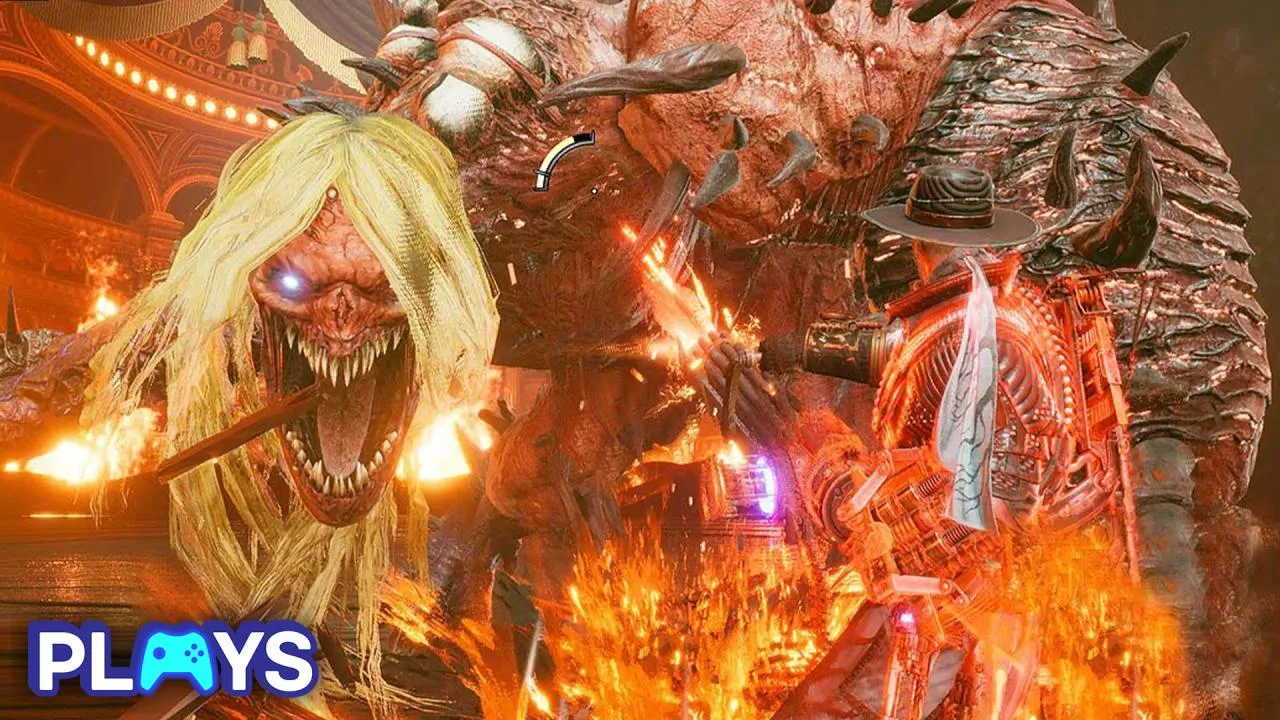
With every game these days chasing the uncanny valley, sometimes you just want a game focused on nothing more than the power fantasy of letting you loose to have a good time. A throwback to the PS2 era of 3rd person shooters, Evil West sets players on a quest to quell a supernatural uprising and gives you an obscene amount of steampunk and Tesla inspired equipment to do it. A ridiculous premise, full of clunky dialogue, (in the best ways), solid, impactful and bloody combat, and some truly grotesque monster designs, Evil West knows exactly what it wants to be and wants nothing more than its players to have fun. Full of old school combos and finishing moves and a nice lean and linear campaign, Evil West is Blockbuster weekend rental of video games and the perfect nostalgic binge for players longing for the old school days of gaming.
“A Plague Tale: Requiem” (2022)
A Plague Tale Innocence enraptured players in the emotional journey of Amicia and her brother Hugo as they navigated the black plague and the endless streams of highly infected and deadly rats. The sequel managed to build on this premise in every way imaginable. The stakes and the world were much bigger, the number of rats and dangers the pair encounter are somehow even more insurmountable, and the emotional bond between brother and sister remains core to the journey as Amecia learns to deal not only with Hugo’s condition but the rage building inside her. The gorgeous world remains both tragically beautiful and horrific as they travel the French countryside running from both the rats and the Inquisition and combat has been greatly improved providing players with more options during encounters as well as more options to approach the game stealthily. The entire series deserves far more recognition than it has received.
“Prince of Persia: The Lost Crown” (2024)
The Prince of Persia franchise has been dormant for the better part of a decade now and the planned remake of The Sands of Time’s future ended up needing a rewind itself, but in the meantime, Ubisoft took a break from the Assassin’s Creed machine to give players probably one of the best and most innovative Metroidvanias of the generation. While the game might be Prince of Persia in name alone, the puzzles, combat and world are all wonderfully designed and crafted with their own unique visual style and aesthetic. Over the course of the game, the player will acquire numerous time bending abilities that are well implemented into the gameplay and combat encounters along with some truly impressive boss encounters. The game arguably should have been a major hit with Metroidvania fans, but for whatever reason, the game disappeared from most players’ radar as the year of major releases carried on.
“Returnal” (2021)
It’s not often a critically acclaimed Sony first party game gets lost in the shuffle but barely a year into the PS5, and Returnal kind of just came and went. Developed by bullet hell maestros Housemarque, the team adapted their perfected style of gameplay to the 3D space and wrapped it all together in a twisting mind-bending time loop narrative that would have had Christopher Nolan checking the game’s Wiki for answers. Admittedly the game’s difficulty as well as the fact there was no way to save mid-run at launch was a strict barrier for entry, but that’s honestly also the game’s biggest draw. Not completing the game in a single playthrough, that was ridiculous. The Souls-Like difficulty mixed with rogue-like elements keeps those dedicated enough coming back for just one more run and the game’s surprisingly deep and emotional narrative is more than enough for the rest to push through the game’s difficulty spikes.
Which PS5 game do you feel deserves more attention from gamers? Share your picks in the comments.
