10 Predictions The Running Man Got Right
10 Predictions The Running Man Got Right
Welcome to WatchMojo, and today we’re looking at predictions from the 1987 “Running Man” film, as well as Stephen King’s source material, that were eerily accurate.
The Timing
King’s 1982 novel and the 1987 film adaptation take place in different years. The book sets itself in 2025, while the film’s opening text states that it’s 2017. It’s funny to think that this futuristic sci-fi film is now technically a period picture. It’s not as humorous, though, once you consider how well the film’s dystopian version of 2017 lined up with the real 2017. It’s worth noting that after the first scene, the film jumps ahead eighteen months. So really, the film takes place closer to 2018 or possibly 2019, ie, when COVID-19 first surfaced and things really started going downhill. Now that we’re living through 2025, can we honestly say it’s that different than King’s book or either film adaptation?
Pollution & Climate Change
The 1987 film’s opening crawl mentions that “the world economy has collapsed,” and “food, natural resources, and oil are in short supply.” While the global economy hasn’t collapsed, it’s come alarmingly close over the years, and essential resources aren’t as accessible to the masses as one would hope. “The Running Man” also signified how humanity’s neglect of the environment would slowly but surely make this planet almost uninhabitable. Although phrases like “climate change” and “global warming” don’t come up in King’s book, pollution does. It’s noted in the novel that the Network is knowingly killing millions every year with air pollution. There are nose filters, but only the rich can afford them, while the poor are largely unaware of how toxic their world is becoming.
Smart Homes
In the 1987 movie, Ben Richards breaks into Amber’s apartment. While her home isn’t without some dated technology like cassette tapes, Amber lives in a smart house. To get through the front door, you have to use a numeric keypad. That might’ve seemed like a luxury back then, although it feels in line with modern home security systems. The lights, kitchen appliances, and television are all voice-activated. Richards also swipes her travel pass to log into her account and book a flight to Honolulu. It’s essentially online booking, except Richards does it on a television instead of a laptop or phone. While the film’s small, bulky home TVs are retro now, the film did predict giant flatscreens becoming more prominent in urban areas.
People Living in Poverty
Although the economy has collapsed in “The Running Man,” not everyone lives in poverty. The rich keep getting richer while the poor attempt to scrape by with what little is accessible to them. A key plot point from the novel that the 1987 film omitted was Richards’ motivations for joining “The Running Man.” In the book, Richards has a family, most notably a young daughter who has fallen gravely ill. Richards can’t afford the medicine needed to treat her, thus seeking funds through reality TV. Edgar Wright’s version restored this plot point, which reflects our current healthcare system, where even basic over-the-counter medications can ironically cost someone an arm and a leg. The cramped housing and limited job opportunities also echo today’s world.
Desensitized to Violence
The audience for “The Running Man” cheers on the bloodshed, viewing a person’s death as entertainment. Now more than ever, reality shows rely on somebody suffering to keep audiences engaged. Granted, you could argue that none are nearly as fatal as “The Running Man.” Fair enough, but the film and book reflect how desensitized people have become to violence in media. Whether it’s a fictional story like “Squid Game” or a true crime story like “Monster,” carnage is commonplace in some of our most popular shows. In real life, we don’t want to see other people get hurt. Yet, when we hear about another mass killing or natural disaster on the news, most of us go about our days, basically accepting violence as routine.
Constant Surveillance
To film a show like “The Running Man,” the Network has cameras everywhere, some better hidden than others. This not only reflects the lack of privacy in reality TV, but our day-to-day lives with the rise of Big Brother. Mass surveillance has been taken to the next level with the advancement of drone technology. Sometimes, such surveillance is used for entertainment, other times it’s used for control, and in various cases, it’s a combination of both. To an extent, you could also argue that the story’s commentary on surveillance mirrors the rise of social media, with more people willingly broadcasting their lives for the world to see. Whether you like it or not, it seems like there’s always a camera in your face now.
Arnold Schwarzenegger, Action Star Turned Political Leader
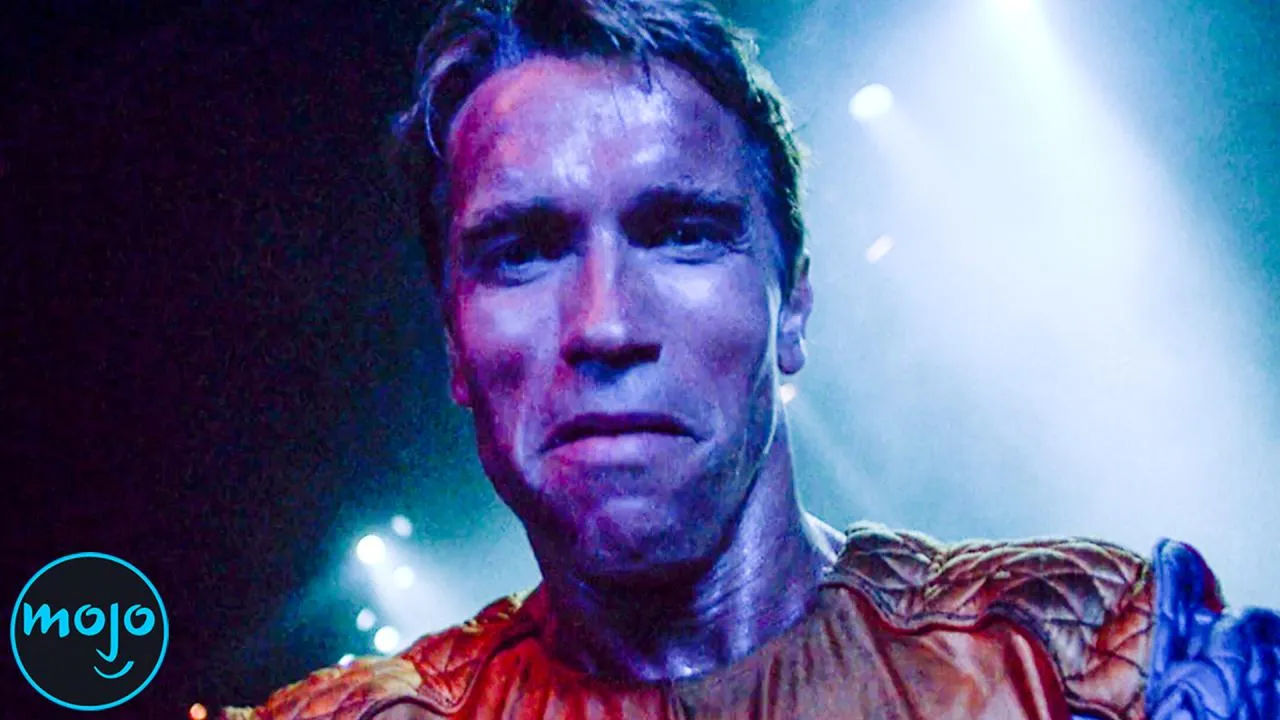
This prediction is specific to the 1987 movie, in which Arnold Schwarzenegger plays Richards. It takes an action star to survive “The Running Man,” and fortunately, there wasn’t a bigger one in the '80s than Arnold. Although Richards says he isn’t interested in politics, he ultimately brings power back to the people. Richards doesn’t just enthrall viewers with his death-defying escapades. He emerges as a symbol of rebellion. To a degree, this is reminiscent of Schwarzenegger’s real-life journey from action hero to politician. Okay, it’s not a perfect comparison, but Schwarzenegger did become an unexpected political figure like Richards. It’s also something of a coincidence that Captain Freedom, another politicized idol in the film, was played by Jesse Ventura, who became a governor as well.
Deepfakes
The film opens with Richards trying to save a crowd of innocent people, but his fellow officers turn against him. Despite his noble efforts, the footage is altered to make it look like Richards went rogue on the unarmed individuals, being labeled as The Butcher of Bakersfield in the press. Aside from tapping into the increase of fake news stories that many accept as fact, the hauntingly realistic footage predicted deepfakes. While the genesis of deepfakes can be traced back to the 90s, the technology has reached unprecedented levels of sophistication today, especially with generative AI available to people at a fingertip. Users can have digital versions of people do and say whatever they want, making it harder than ever to determine the truth.
The Rise of Reality TV
While the idea of reality TV wasn’t nonexistent in the 80s, it had yet to take over airwaves (or the world). You could argue that the source material was inspired more by game shows. Even then, the idea of an entire network dedicated to game shows seemed like a stretch until we eventually got one. The stalkers in the 1987 film resemble the costumed athletes in “American Gladiators,” which wouldn’t premiere until two years later. What’s more, “The Running Man” foreshadowed how reality TV could turn average people into celebrities, albeit at a price. Watching Richard Dawson as Damon Killian, it’s also hard not to think about another reality TV show host who used his platform to weaponize audiences and rise to power.
September 11th
Richards gets his revenge on Killian in every version of “The Running Man,” although the book differs from the movies in a major way. Upon finding out his family is dead, Richards hijacks a plane and flies it into the Games Network building. Richards takes his life along with Killian’s as the tower is destroyed. The book’s final line reads, “The explosion was tremendous, lighting up the night like the wrath of God, and it rained fire twenty blocks away.” The 1987 movie went in another direction, which was wise in ways that the filmmakers never could’ve predicted. After September 11, 2001, even King viewed the ending of his novel differently. As such, he had no qualms about Edgar Wright changing it for his film.
Can you think of any other ways “The Running Man” predicted the future? Let us know in the comments.
