Top 20 Nostalgic Websites That Don't Exist Anymore
#20: Nupedia
Before Wikipedia cemented itself as the internet’s go-to information source, there was Nupedia. Actually, both sites had creators in common: Jimmy Wales and Larry Sanger. In 2000, the two launched Nupedia as a free-content online encyclopedia driven by volunteer contributors. Although Nupedia shared many similarities with Wikipedia, there was one notable difference. Nupedia required articles to be peer-reviewed, with a seven-step approval process. The following year, Wales and Sanger created Wikipedia as a side project. Unlike Nupedia, Wikipedia didn’t require a meticulous peer review, leading to faster growth. Within a month, Wikipedia had almost 200 articles, ten times more than Nupedia. While Sanger preferred Nupedia, Wales found Wikipedia more convenient and user-friendly. After Sanger exited in 2002, Nupedia only lasted another year, eclipsed by Wikipedia.
#19: Boo.com
Boo.com was founded in March 1999, a year before the dot-com bubble peaked and ultimately popped. Specializing in trendy sportswear and fashion, this e-retailer was among the earliest casualties of the dot-com crash, although there were once high hopes for Boo.com. So much so that backers invested millions, wanting in on the dot-com boom. The vision for the site was overly ambitious given this era’s technological limits, leading to a series of high-profile delays. Upon finally launching, many users struggled to navigate the site, finding it complicated and slow. Sales were low, but spending was excessive, with the companying go through $135 million in a year-and-a-half. Boo’s employees and investors were in for a scare by May 2000, as the company faced liquidation.
#18: Blip.tv
Blip.tv was founded in May 2005, just three months after YouTube launched. Where YouTube was initially associated more with viral videos, Blip.tv provided a platform for content creators to share and monetize their web series. Channel Awesome, Rooster Teeth, and Red Letter Media were just some of the production companies that teamed with Blip, which accumulated 100 million video views by 2010. Even so, it was hard to compete with YouTube’s growing dominance. In 2013, shortly after many of its founders left, Blip fell under the ownership of Maker Studios, now known as Disney Digital Network. The writing was pretty much on the wall when Blip was shut down in 2015, driving many of its creators to YouTube.
#17: At the Movies TV
Is film criticism an art in itself? Roger Ebert, Gene Siskel, and Richard Roeper made a case for this through the show, “At the Movies.” In 2007, several years after Siskel died and shortly after Ebert had to leave for health reasons, Atthemoviestv.com introduced the “Balcony Archive,” complete with video reviews going back to the mid-80s. Although it appeared the show’s legacy would be preserved online, “At the Movies” endured some creative changes over the coming years, leading to its decline. Following its cancellation in 2010, the site disappeared along with its vast video library. Clips and episodes have since resurfaced online through third parties, often of lower video quality. “At the Movies” deserves an official, curated site with these reviews restored.
#16: Nick Reboot
If you want to rewatch your favorite Nickelodeon shows from the 90s and 2000s, you’ll need a subscription to Paramount+ or another streaming service. During the early 2010s, though, there was Nick Reboot, an unauthorized service that streamed Nickelodeon reruns 24/7. Nick Reboot not only streamed classic shows, but also nostalgic bumpers and commercials, fully recreating the experience. While its mysterious creators argued this was fair use, it was only a matter of time until Viacom took legal action, bringing about the site’s inevitable end in 2015. Recently, the domain Nickreboot.tv surfaced, although it’s apparently invite-only. Nevertheless, this gave Reddit users hope that Nick Reboot might make a comeback, but it’s unlikely the original site will ever return in its former glory.
#15: Ogrish
If Ogrish were a YouTube channel, all of its content would get demonitized! As such, we’ll avoid showing any of the graphic, unedited videos that drove curious viewers to Ogrish in the early 2000s. Containing uncensored gore and even death, Ogrish was not only controversial for releasing disturbing imagery, but doing so without consent. In one case, the FBI instructed Ogrish to remove a video containing the killing of Daniel Pearl, a Wall Street Journal reporter. Despite the site’s shocking and, to some, unethical nature, Hayden Hewitt argued that Orgish was “tremendously serious” and its community was “remarkably reserved.” By Halloween 2006, Orgish was phased out to make way for LiveLeak, another video-sharing site containing extreme violence. Since 2021, LiveLeak redirects users to ItemFix.com.
#14: GameTrailers
The late 90s and early aughts saw the rise of several gaming sites, many of which sadly no longer exist. Perhaps the one we miss the most is GameTrailers, which Geoffrey Grotz and Brandon Jones founded in 2002. In addition to sharing game trailers, as its name implied, the site gained a following with its reviews, countdowns, and video podcasts like “Invisible Walls.” Under Viacom’s ownership, GameTrailers had a presence beyond cyberspace, with Geoff Keighley hosting “GT.TV” on Spike. Everything started to collapse after Defy Media acquired GameTrailers, leading to its closure in 2016. IGN bought GameTrailers, keeping its brand and video library alive through YouTube. For those still nostalgic for the original site, though, it’s sadly game over.
#13: Flashplayer.com
Between the dawn of the 21st century and the rise of YouTube was a golden age of flash animation. Many videos were shared on Newgrounds, which is still active despite the loss of Adobe Flash Player in 2020. There were also alternative animation-sharing sites like Flashplayer.com. 2000s kids surely have fond memories of watching videos from creators like Knox, LegendaryFrog, and Super-Flash-Bros. Some ongoing series even inspired merchandise, such as “Neurotically Yours” starring Foamy the Squirrel. It was also one of the sites that hosted “Potter Puppet Pals,” back when the series used Flash. If you look up Flashplayer.com now, it’ll direct you to IGN, with the original site long gone. Yet, many videos resurfaced on YouTube, now with much shorter loading times.
#12: Fractal Cow
Fractal Cow is primarily remembered for one area dedicated to the most evil character on television: Bert from “Sesame Street.” Allow us to explain. Dino Ignacio, a student from the University of the Philippines, was looking to polish his digital art expertise. He decided to have some fun with it, launching Bert is Evil in 1997. The parody site linked Ernie’s roommate to the JFK assassination, O.J. Simpson’s defense team, and a pre-9/11 Osama bin Laden. The dark parody site gained a following and even won a Webby for Best Weird Website. The site now only exists in archive form, but it remains a reminder of just how strange early internet culture was and how things would only get more bizarre from there.
#11: The Spot
Imagine “Melrose Place,” but in mid-90s website form. That’s how many described The Spot, which commercial director Scott Zakarin helped launch in 1995. Inspired by Zakarin’s experiences in chat rooms, the Spot chronicled an episodic online story, often being cited as the first web series of its kind. Actors portrayed “Spotmates,” who appeared in videos and photos that accompanied diary entries. The site also made visitors part of the narrative, encouraging “Spotfans” to send messages, occasionally influencing the writing staff. Users could even communicate with characters as if they were real. The Spot won a Webby, although the series ended in 1997 amid financial difficulties, Zakarin’s exit, and similar sites drawing traffic away. There were multiple attempts to relaunch the Spot, but Zakarin wasn’t attached.
#10: ChaCha
Before everyone had smartphones with internet access, you often had to wait until you got to your home computer or to a library to research your burning questions. ChaCha provided a pretty ingenious solution, allowing users to call or text a number with questions and receive answers from human researchers, known as guides. There was also a desktop version, which was useful if you weren’t getting a straight answer from Google. But, while ChaCha might’ve been useful in 2006, when it was first launched, it became less relevant as time went on. Eventually, the company started losing money and shedding employees until finally closing for good in December of 2016.
#9: SixDegrees
The term “social media'' wasn't widespread until the 2000s, but SixDegrees.com showed the power of this concept back in 1997. This site was based on the idea of growing your personal network via the internet, a forecast of just how blurred the line between "real life" and "internet life" would eventually become. Based on the concept of all people being connected by six degrees of separation, the site invited users to list everyone they knew and foster those same connections online. Its features were mainly limited to messaging and bulletin boards, and just three years after its launch, it shut shown. Still, SixDegrees was still an important precursor to some of today’s biggest social media platforms. So, what’s the verdict? Do we think Kevin Bacon ever joined?
#8: JenniCam
With social media, it feels like we know far more about people and their personal lives than we ever wanted to. But, in the 90s, the idea of getting to know a complete stranger was an intriguing novelty. Enter JenniCam, a website run by Jennifer Ringley, who started this “lifecast” when she was a 19-year-old college student. Millions tuned into Ringley's broadcasts, which included some explicit material, and she became something of a celebrity, appearing on talk shows like the "Late Show with David Letterman." A change in PayPal policy ultimately caused Ridgley to shut down JenniCam at the end of 2003. She's since avoided the public eye, which includes no social media profiles. But, she kept working with computers, and would later became a programmer.
#7: Pets.com
If you watched TV in the late 90s, you undoubtedly saw commercials for Pets.com with their sock puppet mascot. While this enterprised specialized in pet supplies, their management quickly went to the dogs. Pets.com's revenue lagged far behind their spending, and they became one of the biggest cautionary tales of the dot-com bubble. The company was liquidated in November 2000, just two years after its launch. Or, in dog years, 14 years after its launch. Chewy.com would later demonstrate that pet supply sites like this can be profitable and long-lasting. They just need to be properly managed.
#6: Grooveshark
Before Spotify, Apple Music, and other services showed the profitability of music streaming, there was Grooveshark. This was a website that allowed users to upload and listen to their favorite songs. There was just one, massive issue: songs were being uploaded without the consent of their owners, meaning Grooveshark was named in numerous copyright infringement lawsuits. Apple, Android, and Facebook all removed the Grooveshark app in response, and it soon became apparent that Grooveshark would eventually have to stop swimming. A legal settlement in 2015 forced the site to close down for good. After just over nine years, the grooves were sadly over.
#5: Google Answers
The primary function of Google is to provide answers. So, it seems a little redundant to have another site where users submit questions. But, search engine technology wasn't quite as sophisticated as it is now back when Google Answers first launched in 2002. Contractors, known as "Google Answers Researchers" or GARs for short, would answer questions, and they didn't necessarily come cheap. Some answers could cost as much as $200, which is a high price to pay for information. The answers tended to be extensive, but the site’s lifespan wasn’t. The knowledge market shut down in 2006, but you can still comb through its archives.
#4: Megaupload
A website dedicated to uploading and sharing files is a great idea. But it’s one that can easily fall into iffy copyright territory. That’s what happened with Megaupload, a file hosting service founded by entrepreneur Kim Dotcom. For just under seven years, Megaupload let users share all types of files and became one of the web's most popular sites, even inspiring a song. While the site claimed to take action against copyright infringement, it was ultimately a haven for digital piracy. In 2012, the U.S. Department of Justice shut it all down, and Dotcom and other Megaupload executives were arrested. Talk about a Mega problem.
#3: Friendster
It might be lost to the sands of internet history, but there was a time when Friendster was the top social media site around. Granted, there wasn’t a lot of competition when it started, but credit where credit is due. The site drew more than 115 million registered users after its 2003 launch, and, realizing the potential in social media, Google offered to buy the site for $30 million. Friendster’s owners turned this down, which was viewed as a colossal miscalculation. As Facebook grew in popularity, Friendster found itself in a bind, switching its status to "social gaming site." The site went defunct in 2015, and the company ended for good three years later. Friends forever, but not “Friendster forever.”
#2: GeoCities
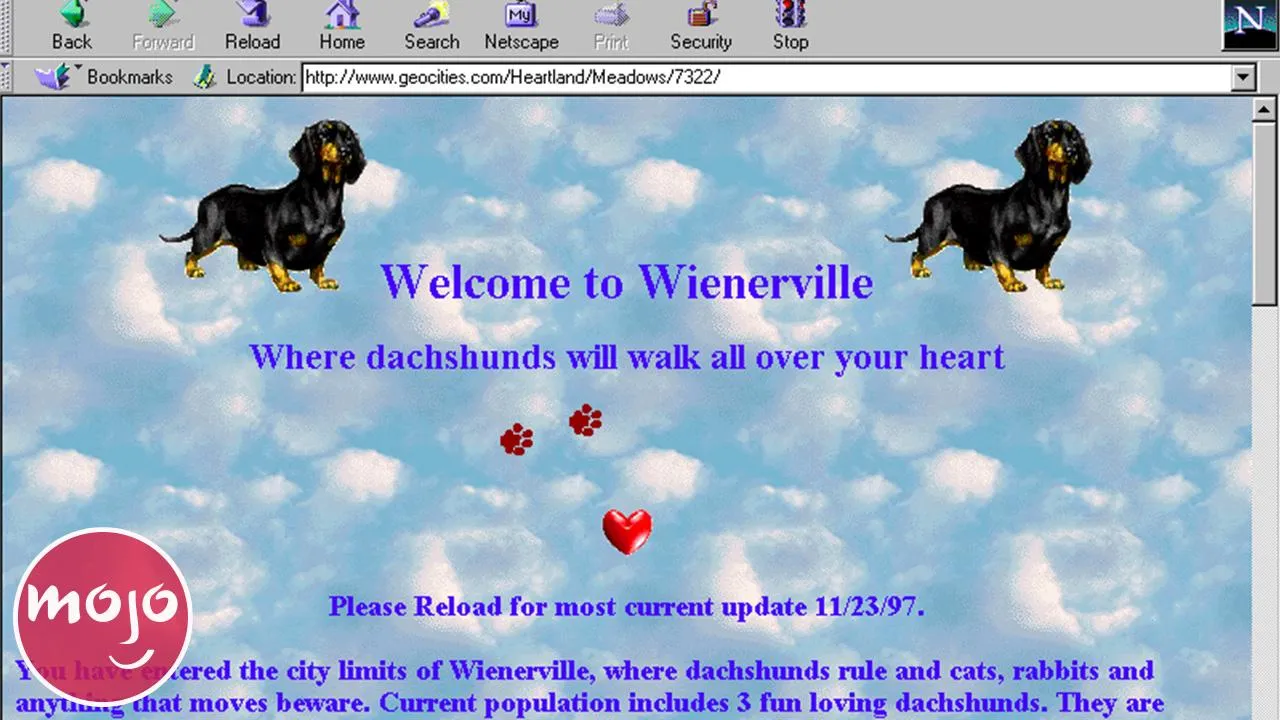
If you used the internet in the 90s, you probably visited at least one GeoCities site. Heck, you probably made one yourself. GeoCities was web hosting for people who didn't know a thing about coding but who wanted to make sites of their own. Webpages were categorized based on "cities," such as Hollywood and SiliconValley, which were dedicated to movies and acting. They didn't look great, and certainly not by today’s standards, but they gave users a way to express themselves, as well as practice web design. In 1999, Yahoo! took ownership, and brought about some unpopular changes. GeoCities’s end came about in 2009, which many blamed on Yahoo!'s management.
#1: Club Penguin
It might sound like a social spot for flightless birds, but Club Penguin was actually one of the most popular internet communities around. A massively multiplayer online game, or MMO, Club Penguin gave users and their penguin avatars a world of games and other activities to enjoy. The site proved so popular, Disney purchased it for $350 million in 2007. However, it wasn't without its critics. While the site was geared towards children, there were numerous complaints that not enough was done to keep its young users protected. Interest gradually declined, with many users getting their gaming fixes on smartphones. A Club Penguin app was released in 2013, but it wasn't enough and, in 2017, we waved a very sad flipper goodbye to the virtual world.
Which defunct website did you regularly visit back in the day?

