Top 20 Surprisingly Expensive Antiques Roadshow Items
- Moorcroft Vases
- Porcelain Painting
- YZ Bird
- Painting Collection
- Dog Collar
- Replica Chalice
- Ten Pound Lamp
- Engraved Horns
- TT Collection
- Chinese Censer
- Cup & Saucer
- Guanyin
- William Conor Sketch
- RAF Medals
- Soapstone Statue
- Animal Pipes
- Family Portraits
- Walnut Boxes
- Edward Lear Watercolour
- An Old Schoolbook
#20: Moorcroft Vases
This woman had no idea her late mother’s two vases would be worth anything when she brought them on. They don’t, at first glance, look particularly unique, and certainly you’ll need to know your art history to know what they are. Of course, the Roadshow’s expert, Catherine Wright, does, lifting the vases to show artist William Moorcroft’s coveted signature on the base. The vases turn out to be an early example of Moorcroft’s work, dating to the very beginning of the twentieth century. As a pair, they turn out to be worth thousands at auction. The owner was stunned as, indeed, were we; she’ll probably keep them locked up from now on – that is, if she doesn’t sell them.
#19: Porcelain Painting
Lee Young had an exceptional painting to look at this week, this one done on porcelain. It’s the porcelain that gives it its extraordinary, vibrant quality, with the candlelight practically glowing. Though it was made by a German company rather than a specific artist, the painting is signed by a generic surname, which Lee says means the manufacturers thought it was one of their better pieces. Despite it being made by a company, it’s still worth a pretty penny. Lee says it might be worth as much as £1800, though it’s easy to imagine someone paying more than that given that it’s in such beautiful condition.
#18: YZ Bird
Mark Hill was thrilled to be presented with this novelty clock by a woman who’d inherited it years ago from her grandmother. These little wooden birds were manufactured and widely sold in department stores in the 1920s and 1930s, but it’s rare to find one with an included clock. They’re now widely collected curiosities, each one with its own distinct character. Much to Mark’s horror, the current owner says that her father at one point tried to replace the clock, but luckily, kept the original broken timepiece intact when it didn’t fit. That was a narrow escape, and it turns out to be worth hundreds of pounds – which shocks the owner, who’d previously had it valued at just £75.
“YZ” = “Why Zed”
#17: Painting Collection
This couple brought on a group of paintings by an artist called Frank Dicksee, one of expert Rupert Maas’s favourites. Amazingly, Dicksee was the current owner’s great-great uncle, so these paintings were family heirlooms. Interestingly, though, many of the paintings weren’t signed, which led Rupert to speculate that they were done by other members of the family – all artists in their own right. The provenance remained clear through the family connection, and the lack of signatures didn’t dent the values too much. They were surprised when they ended up being worth thousands of pounds EACH, getting them over ten grand in total if they sold them.
#16: Dog Collar
This couple and their dog brought on an unusual item that had been in the family for generations. The current owner wasn’t entirely sure what it even was, but suspected a dog collar – something quickly confirmed by the Roadshow experts. It dates back to the mid-18th century and is still intact, which is apparently rare for these things. It’s actually worth about six hundred quid, which is nothing to sneeze at given that it probably wasn’t intended to stand the test of time. The dog present, however, remains unimpressed. It’s hard to imagine any of today’s dog collars being worth anywhere near that much one day, though.
#15: Replica Chalice
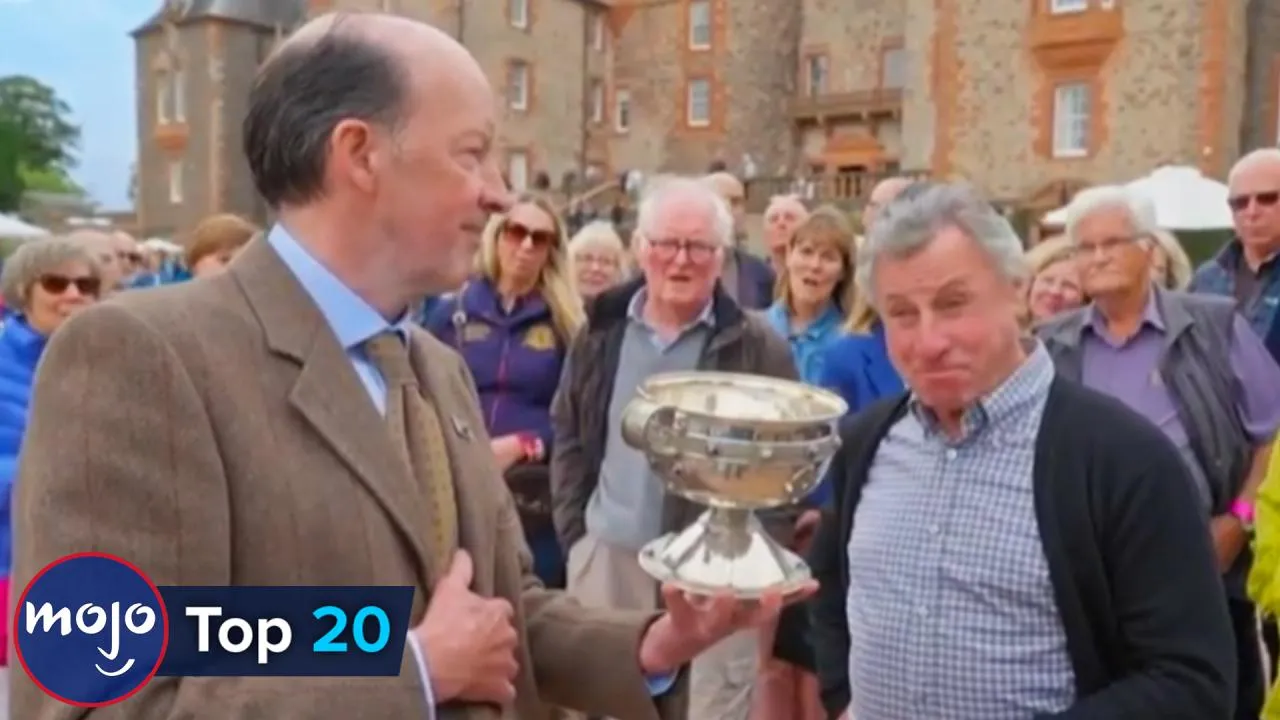
Gordon Foster was fascinated by this strange object brought on by a man who knew nothing about it. He was bringing it to the Roadshow on somebody else’s behalf, but all he knew was that it was supposedly unearthed in a potato field in Ireland. Gordon is thrilled to reveal it’s a replica of the Ardagh Chalice, a well-known 8th century Celtic chalice currently on display in the National Museum of Ireland. Despite being a replica, it’s still made of silver and still extremely beautiful, meaning it’s not cheap – though, certainly not as priceless as the original. Gordon says it’s worth thousands.
#14: Ten Pound Lamp
This woman saw this strange, lonely lamp standing outside someone’s house in a yard sale for three days until she decided to put it out of its misery. She picked it up for a tenner just because she liked it, and later brought it onto the Roadshow to see if anybody could explain what it was. Will Farmer knew exactly what it was and who’d made it, an artist called Bernard Rooke, a renowned potter. It was only a few decades old, but was extremely complex for a lamp, with rotating, heavy pieces. When Will announces that he’d expect the lamp today to go for a grand at auction, the audience’s excitement is palpable.
#13: Engraved Horns
This was certainly one of the weirdest items we’ve ever seen brought on, and a near miracle that anybody knew what to value it in the first place. The horns had been inherited by the current owner much to her husband’s annoyance. She says he hates them so much he won’t let her put them up. They end up being over 150 years old and likely made by a Prussian artist who travelled the world. Despite hanging up in the owner’s ancestor’s pub for years, they’re in such good condition that they’re worth about a grand. Whether she sells them to get her husband to stop complaining is anyone’s guess, but who knew these weird relics were worth so much.
#12: TT Collection
This unique collection of motorbike memorabilia was brought on by the grandson of the man in all the photographs, who raced motorbikes on the Isle of Man in the interwar period. He did well racing in the earliest TT races in the 1920s, even getting second place in one race. It’s a fascinating piece of forgotten history, and Marc Allum was thrilled to be able to provide some valuations for the collection. It turns out to be worth a few grand in total, but the real worth is the sentimental value to the family. Now, they’ve had the chance to share this piece of history with the public.
#11: Chinese Censer
Most people wouldn’t have even known what this mysterious object was in the first place, let alone been able to put a value on it. Expert Lee Young knows exactly what it is, however, identifying it immediately as a “censer”, something used to burn incense. The owner’s parents were collectors of East Asian art and ephemera and brought this back from the Far East sixty years ago, but the current owner has no idea what it might be worth. It ends up being almost three hundred years old and in remarkably good condition, with a decades-old collection sticker inside proving it came from a reputable source. After all that, it’s worth as much as eight grand.
#10: Cup & Saucer
This unassuming set of crockery was brought on and presented to Chris Yeo, who knew exactly what it was, even though many would have written off these items as almost worthless. As he explains, the items were made by the famous twentieth century potter Lucie Rie, who became one of Britain’s most celebrated artists after she moved to London from Austria to escape the Nazis. She’s a well-known figure to those aware of the art world and the history of pottery, but not to a layperson. If you, like many, don’t know Rie’s name or understand the provenance of the pottery, you’d have been amazed to hear a valuation of hundreds of pounds.
#9: Guanyin
Porcelain figures are always a challenge for the average person to know the value of, but luckily, there was an expert on hand to provide detailed information. The statue was brought to the UK by the current owner’s grandmother after a trip to the Malay Peninsula back when it was still British Malaya. The figure of Guanyin is made of coveted Chinese porcelain and has an inscription wishing luck to fishermen. It’s good news for the owner, however, as Rosa values it at around five thousand pounds at a minimum, anticipating that she could sell for even more than that if the right buyer is found.
#8: William Conor Sketch
Despite knowing the artist, these owners still had no idea what this sketch was worth. Expert Grant Ford was excited to see a piece come in from one of Belfast’s most famous artists while the Roadshow was in the city. Conor was one of many artists commissioned by the British government during the First World War to sketch soldiers for official records, so he was extremely prolific. The owner, who bought it decades ago for a pittance, only thirty quid, thought it was actually worth a few hundred pounds. It wasn’t. Grant puts the value between three and five thousand, shocking the audience.
#7: RAF Medals
Medals are always challenging to value, with the owners almost never knowing exactly what they’re worth – in fact, sometimes they don’t even know what they are or why their ancestors got them. What’s particularly remarkable about this collection, though, is that the man who earnt them didn’t go into combat during the war, but instead was a test pilot. You may think that that would reduce the value of the medals, but actually, it makes them rarer; remember, there were even fewer test pilots than combat pilots, and flying experimental aeroplanes isn’t exactly a risk-free endeavour. The Air Force cross alone, with its two extra bars, ends up being worth at least ten grand.
#6: Soapstone Statue
The owner picked up this trinket for just a fiver years ago, and brought it onto the Roadshow out of curiosity, not expecting it to be worth very much at all. Lee Young was thrilled to have a look at the little figurine, though, despite all the scrapes and bumps it’s taken over the years. He’s missing a hand, missing some pieces of his base, and even lost his head at one point – though the current owner carefully glued it back on. Despite all of that, the carving is still so desirable that Lee puts a value of at least a thousand pounds on it, shocking the assembled crowd.
#5: Animal Pipes
This man has spent years collecting novelty smoking pipes shaped like animals, and now has more than a hundred of them. Cristian Beadman was trusted to provide the valuation, examining the pipes. They’re all extremely beautiful, but not the kind of thing that would be easy to value without a lot of knowledge. The owner collects them because he likes animals rather than having a particular passion for antique tobacco pipes, so it was probably a surprise when Cristian revealed he could get up to five grand for his entire collection. Whether he sells them or hands them down as heirlooms remains to be seen, but they ARE very charming.
#4: Family Portraits
You probably wouldn’t look twice at these pictures if you saw them in a stately home, because as Rupert Maas freely admits, they’re not particularly eye-catching. But they’re invaluable to the owner, as the man in the picture on the left is a direct ancestor of hers, her great-great-great grandfather, a drum major. She also has the long mace her ancestor is wielding in the portrait, which Rupert enjoys holding onto throughout the valuation. Despite not really knowing who the artist was and despite the subjects not being famous, Rupert gives the two pictures an astonishing valuation of up to eight grand. We doubt the family will ever sell them, though.
#3: Walnut Boxes
One of the strangest items we’ve ever seen on the Roadshow were these four walnuts, that had been hollowed out and used to store small objects used in sewing and other handcrafts. The current owner has been collecting them when she sees them and has no real idea what they’re worth, only knowing that they were probably made in France. She says she paid “quite a lot” of money for them, but the valuation eventually comes in at two thousand pounds for the collection of all four – presumably more if she manages to pick up any others. As always, she insists she won’t sell them.
#2: Edward Lear Watercolour
Another showing from Rupert Maas, this time he was given a unique watercolour from Victorian artist Edward Lear to value. Lear is best known today for his writing, largely poetry and limericks, but he was also an artist, and this watercolour was done by him. The owner has it because one of her ancestors enjoyed antiquing, and apparently didn’t know quite how much it was worth. Even though the watercolour is small and has degraded because of the way the paint was mixed, Rupert still thinks it could go for thousands at auction. Not bad for something bought decades ago with minimal knowledge of the artist.
#1: An Old Schoolbook
Of all the heirlooms that might end up being worth something one day, you wouldn’t have thought an old schoolbook would be at the top of this list. This book was given to the current owner’s great-great-great grandfather, Edward Allen, and was given to him in 1777 when he was just sixteen. It began as a way to learn arithmetic, then became an invaluable account book at the dawn of the industrial revolution. It was this that gave it its extraordinary value, as a window into Derbyshire’s weaving industry at the turn of the nineteenth century. Though it’s doubtful the owner would ever sell it, as a historical artefact, it could be worth as much as six thousand pounds.
Let us know in the comments which of these items surprised you the most.
