Top 20 Iconic David Attenborough Moments
- The Brine Lake
- Whales vs Whales
- Turtles Nesting
- Tiger Cub Wrangling
- Kung Fu Mantis
- Dolphins Go Hunting
- Horse Battle
- Shell Swapping
- The Moray Eel Strikes
- Polar Bears Playing
- Christmas Island
- Slug Love
- Pallas's Cat
- Leopard Seal Attacks
- Boulder Cam
- Antarctica's Greatest Thieves
- Sea Toad
- An Impala Escapes
- The Fangtooth
- Lions vs Hyenas
#20: The Brine Lake
Far underwater, around some submerged volcanoes, a lake of brine has managed to form at the bottom of the sea. The briny pools are home to their own ecosystem, providing a fertile breeding ground for giant mussels, which are about ten times larger than the mussels we usually eat. The mussels are also home to various deep water crustaceans. The most bizarre thing of all, though, is what happens when an eel ventures too close. As Attenborough explains, if an eel stays in the brine for too long, it proves toxic, and it can even die from the concentrated salt. Luckily, this eel manages to escape, but its struggle makes for uncomfortable viewing.
#19: Whales vs Whales
Does the blue whale, the largest animal that’s ever existed – yes, including all the currently known dinosaurs – have any natural predators? Well, that depends on whether you define this orca behaviour as “natural”. Attenborough makes it clear that this disturbing adaptation has come about because of orcas’ needing to find new prey, but it was still remarkable to see it caught on camera. The killer whales – which are actually the world’s largest species of dolphin – conduct a test run where they gang up on another and attempt to drown it. But all of this is practice for downing a blue whale, which orcas have been known to do since the early 2000s.
#18: Turtles Nesting
Each year, giant river turtles converge on an enormous sand bar that’s only accessible for a few months, after which point it will be submerged in the river again. We follow one particular turtle as she searches for somewhere to make her nest that isn’t already occupied by another expectant mother, and then observe as the eggs are laid and left behind to hatch on their own. Not the most maternal species, the adults simply leave and the hatchlings just have to get on with it. The hatchlings dig themselves out of the sand eventually and all take to the river, where one day, they’ll repeat the cycle themselves.
#17: Tiger Cub Wrangling
In this groundbreaking documentary, Indian elephants, one of the few animals not to be afraid of tigers, were equipped with subtle cameras. The footage captured was extraordinary, as the elephants managed to follow the lives of a mother tiger and her four cubs as they grew up. But the tigress had a lot of work on her hands – or, paws – because the cubs kept trying to escape. Over and over again, we see them tumble over the rocks as the mother comes to retrieve them, only to find that, behind her, another is already trying to make its way to freedom. But don’t worry: none of the cubs were any worse for wear, all making it to adulthood.
#16: Kung Fu Mantis
There are over 2000 species of mantis, varying in size and colour, but these fearsome bugs do have predators of their own. This minuscule mantis is forced away from its original leaf by its brash siblings, and finds itself being stalked by a tiny jumping spider. On these cameras, though, the jumping spider appears as a formidable threat. The mantis escapes the spider after engaging in a spot of martial arts, but comes face-to-face with something even more dangerous: another, much larger mantis. It’s snatched up and eaten, revealing just how ruthless the natural world is even for the tiniest creatures.
#15: Dolphins Go Hunting
Dolphins hunting for fish along coastlines sometimes exhibit this bold but bizarre behaviour. They’re able to glide in the shallow water right where the tide comes in and snatch up those fish, putting themselves in serious danger of getting beached. Sometimes, they also lie in wait right at the edge, until a fish gets near enough that the dolphin can snatch it. There’s a reason dolphins are known as some of the most intelligent animals in the world, and adaptive behaviours like this are just one part of it. The dolphins also teach the technique to other, younger dolphins watching.
#14: Horse Battle
Did you know that wild horses sometimes fight each other? Though we usually think of wild horses as skittish and easy to scare, in the rugged ecosystem of Nevada, mustang stallions compete for control of watering holes and fight off other males that get too close. This is so that they can keep all the mares for themselves. In this clip, a challenger arrives, a black stallion aiming to usurp the white one controlling the current watering hole. The fight is brutal, with the horses even trying to bite each other as they sparred. But after all that, the black horse wins when the white one misses him and backs down. Whoever said horses aren’t polite?
#13: Shell Swapping
Have you ever wondered how hermit crabs find new shells that are the right shape and size as they grow? This clip from “Life Story” has you covered, in that case, as Attenborough narrates a gathering of crabs on a beach as they gear up to swap their shells with one another. With a new shell available, the others watch and wait until the elaborate exchange can begin. It’s one of the most interesting natural phenomena ever caught on camera, devolving into something reminiscent of musical chairs, as they all jostle for the perfect shell. Alas, they don’t all get one: one crab is left with a worse shell than it started with, even after all that.
#12: The Moray Eel Strikes
More crabs, these specimens live across the west coast of the Americas, but most notably, in the unique Galapagos islands. Attenborough catches up with them in Brazil as they embark upon their daily trek across the shoreline’s rocks in search of food. But it’s not all smooth sailing: a natural predator of the Sally Lightfoot crabs, the moray eel, rears its head. These monsters hide underneath the rocks and leap out to snare passing crabs. It’s not just eels, either; deadly octopuses also lie in wait, attempting to wrangle a crab dinner for themselves. Most miraculous of all, though, is that all the crabs do this twice a day, because they have to go back again.
#11: Polar Bears Playing
Like many apex predators, polar bears are largely solitary, living most of their lives alone. But they do have to encounter one another every so often, when they mate, and their courtship rituals can be elaborate. A male and a female cross paths and begin testing one another, with the female challenging the male to perform various feats that she manages easily in order to see whether he’s a suitable partner. But it’s not all serious; the bears take the time to enjoy themselves in the wilderness, sliding down a snow drift together. It looks so fun that you almost want to join in, until you remember that they’re some of the most dangerous animals on the planet.
#10: Christmas Island
On this island just south of Java in the Indian Ocean, the crabs are fighting a long war against an invasive species of ant. The ants attack the crabs while they make their annual pilgrimage to their oceanic breeding spots, covering them with acid until the crabs eventually succumb to the torment. It’s a dreadful way to die, with the crabs left with no choice but to try and race the ants to the beach if they want to survive. Lately, humans have been trying to eradicate the ant colonies with insecticide treatments, to try and rescue Christmas Island’s indigenous animals from their toxic tyranny.
#9: Slug Love
Have you ever seen a pair of slugs breeding? These particular giant slugs live in the temperate rainforests that litter the west coast of Britain and parts of Ireland. But slugs are far more interesting than you’d think if you’re mostly worrying about whether they’re going to get into your vegetable garden; all slugs actually have both male and female reproductive organs. These slugs entwine themselves and exchange bodily fluids both ways, and then, when it’s all over, they plummet to the ground. Some slugs can even bizarrely impregnate themselves and reproduce asexually, if they can’t find a mate.
#8: Pallas’s Cat
All cats are deadly if you’re the right size for them to want to eat you, but they’re also some of the laziest creatures in the animal kingdom. This is true for Pallas’s cat, which spends most of its time sitting around waiting for prey to get too close and then lazily attempting to chase it, usually to fail. It’s no surprise, watching the activities of wild cats, that some of them chose to domesticate themselves as our pets thousands of years ago. Pallas’s cats remain entirely wild, though, so don’t try to stroke one if you’re in their natural habitat. In the end, the gerbils live to see another day, and Pallas’s cat goes hungry once again.
#7: Leopard Seal Attacks
Emperor penguins live in the most hostile environment on Earth, Antarctica, but it’s not just the frigid weather and long winters they have to worry about. They’re common prey for leopard seals, one of the most vicious predators in the oceans, which stalk the icy shores and lie in wait. On land, the seals and penguins are both slow, but underwater, the playing field is levelled. Penguins swim quickly, but so do seals, giving chase. Once it has its meal, it leaves, and the rest of the penguins are able to swim to safety and return to the rest of the colony.
#6: Boulder Cam
It’s not often in the BBC’s prestigious wildlife documentaries that you get a glimpse of how the sausage is made, but in this clip, a pride of lions managed to get their paws on a camouflaged camera inside a remote-controlled boulder. Even big cats are playful, especially cubs, and these young lions thoroughly enjoy their time chasing the boulder around. Some of the adults get involved, too, sating their natural curiosity while the boulder operator tries to move it away before it gets broken. After all, it’s not like you can send the lions a bill for any damage they cause.
#5: Antarctica’s Greatest Thieves
Many birds have a penchant for thievery, magpies chief among them, but did you know that penguins are also criminally inclined? These Adélie penguins are practicing a courtship ritual where they each build the most elaborate and impressive nest of rocks, something always guaranteed to catch a lady’s eye. But what happens if another penguin has hoarded all the best rocks for himself? Well, they turn to crime, of course, pinching the rocks while their rivals are distracted, and taking them to their own rock piles. The brazen bad behaviour is something you can’t help but respect.
#4: Sea Toad
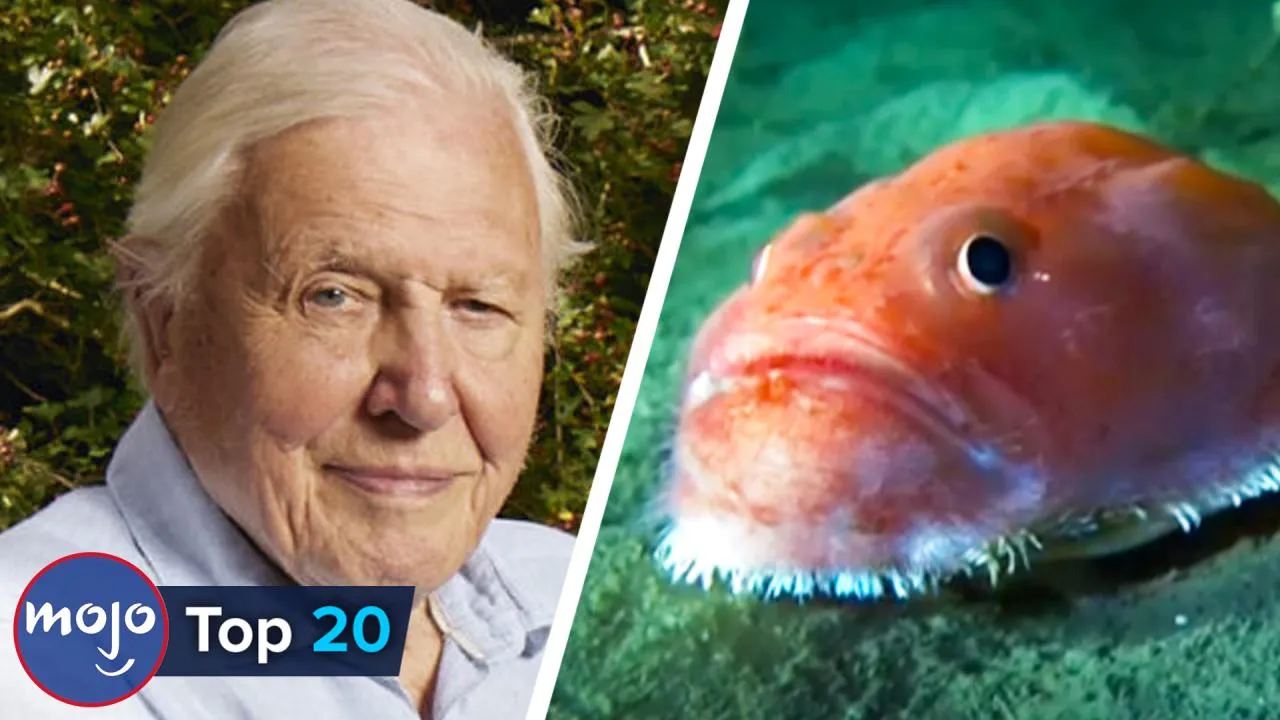
This bizarre creature lives on the seabed, where it waits for prey to get too close, and promptly snaps it up, much like a toad on land – only without the long tongue. It’s the same colour as Mr Blobby and just as eerie, especially when it stands up and begins to walk on some of the strangest feet in the animal kingdom. And keep an eye out for the spidercrab cameo in the background! The sea toad hardly moves at all, only repositioning itself occasionally while it seeks out more food. A moment later, we see something else unusual: a deep-dwelling octopus that forages for worms on the ocean floor.
#3: An Impala Escapes
This leopard has left its arboreal habitat in order to hunt on the ground, and has an impala in its sights. She approaches slowly, but prey animals have excellent senses, so it’s not easy for the leopard to get the jump on its quarry. Eventually, she finds a vulnerable impala, and springs into action, seizing the beast and dragging it down into the ditch. But that’s not the end of the story. Miraculously, the impala escapes the literal jaws of death, thwarting this powerful predator and living to graze for another day. It’s rare that, in a fight between an impala and a leopard, the leopard loses.
#2: The Fangtooth
The vicious fangtooth has teeth so large that it isn’t able to close its mouth, which isn’t a fate we’d wish on anybody. It lives in the ocean’s midnight zone, hunting the bioluminescent creatures that occupy these depths. It’s a frightening fish you wouldn’t want to come face-to-face with, though luckily, you probably never will, since the shallowest depth they ever approach is still 600 feet below the surface. And even more thankfully, most adults seem to be around six inches long, though like many of the deep ocean’s mysterious denizens, we’re not sure exactly how big they can grow…
#1: Lions vs Hyenas
This young male lion isn’t quite all grown up, and has left the pride’s territory for the first time. But it’s a mistake, because he soon finds himself besieged by a gang of opportunistic hyenas. Forget what you saw in “The Lion King”: in reality, lions and hyenas don’t make friends, and even a lion is no match for this many hyenas at once. Luckily for him, help soon arrives. A second male lion comes to assist, with two lions being too much for the hyenas to deal with. The lions are saved, comforting each other after their ordeal.
Let us know your favourite David Attenborough series in the comments.
