Top 20 Album Covers That Caused Major Backlash
- "This Is Hardcore" (1998)
- "The Pros and Cons of Hitch Hiking" (1984)
- "No Line on the Horizon" (2006)
- "Suede" (1993)
- "Placebo" (1996)
- "Discipline" (1981)
- "Wish You Were Here" (1975)
- "U2" (1991)
- "Anarchy" (1994)
- "Welcome to the Beautiful South" (1989)
- "Whatever People Say I Am, That's What I'm Not" (2006)
- "Bicycle Race"/"Fat Bottomed Girls" (1978)
- "It's Great When You're Straight…Yeah" (1995)
- "Houses of the Holy" (1973)
- "Skin Trade" (1987)
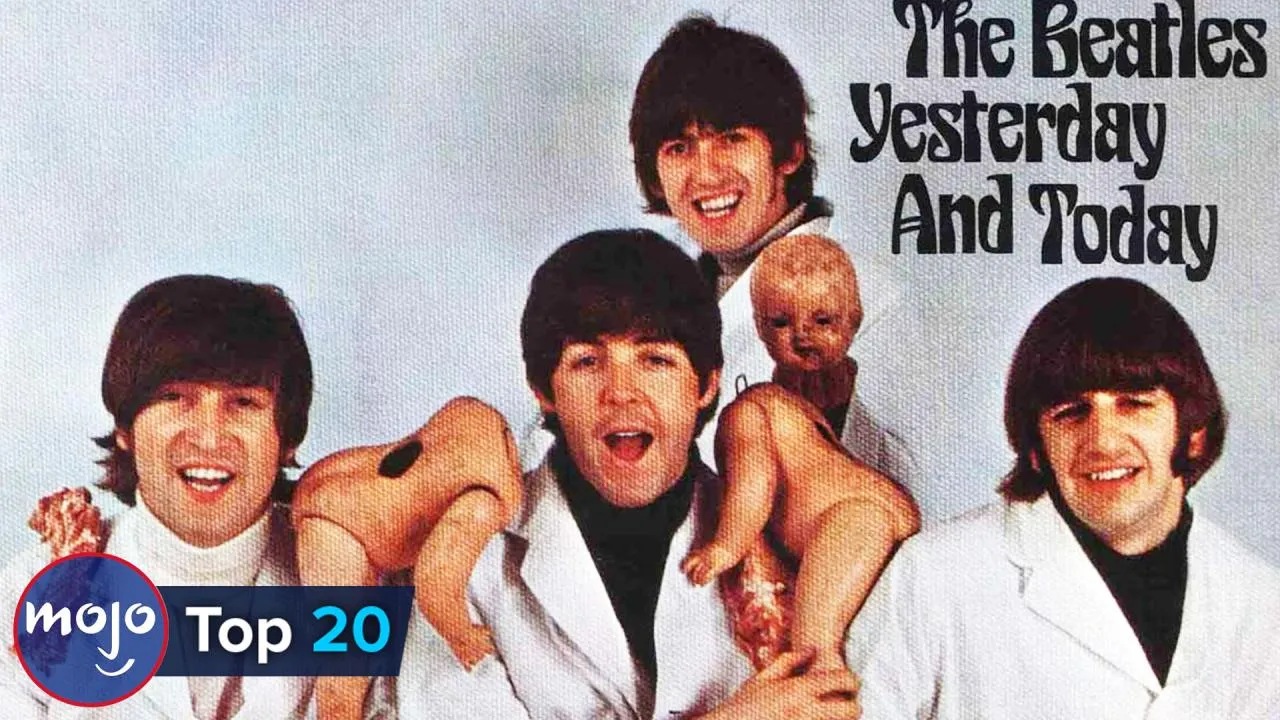
- "Yesterday and Today" (1966)
- "An Ideal for Living" (1978)
- "Unfinished Music No. 1: Two Virgins" (1968)
- "Diamond Dogs" (1974)
- "Electric Ladyland" (1968)
#20: “This Is Hardcore” (1998)
Pulp
We’re starting things off with the sixth Pulp album, released towards the end of the 90s Britpop trend. The artwork features a heavily edited photograph of a naked model with an empty look on her face, bent across red sheets. It was intended to be a bit of an unsettling image, reflective of the empty aftermath of the Britpop movement. It turned into a scandal, as many considered it demeaning. This led to the album’s adverts being vandalised on the London Underground. People graffitied phrases such as “This is Deamening” on posters, but some fans claimed that was the point of the image, and it was a commentary on the dehumanisation of the music industry.
#19: “The Pros and Cons of Hitch Hiking” (1984)
Roger Waters
Our next album comes from former Pink Floyd frontman Roger Waters. He became the centre of a lot of group drama during the 80s, leading him to leave in 1985, claiming it was a “spent force creatively.” In 1984, he dropped this as his debut album, featuring an image of a nude model’s backside on the cover. This garnered a bunch of criticism, eventually leading Columbia Records to censor the lady on later releases. Fascinatingly, it was nearly a Pink Floyd album. Waters offered two projects to his bandmates, saying he’d make one a solo project and they’d do the other together. They chose “The Final Cut”, which became the final album both Waters and Pink Floyd worked on together.
#18: “No Line on the Horizon” (2006)
U2
Our next controversy isn’t to do with the covers’ content being deemed offensive, but because it was an image someone else already used for an album. The artwork was an image taken by photograph Hiroshi Sugimoto, but after making a deal, it turned out someone else had already used it for an album. Richard Chartier and Taylor Deupree had used it for their 2006 LP, “Specification.Fifteen”. They then accused U2 of ripping them off, but Sugimoto stated it was simply a coincidence. No legal actions were taken, as Sugimoto was free to license his images to whoever he wanted, which led to the drama eventually fizzling out.
#17: “Suede” (1993)
Suede
Rock group Suede dropped their self-titled Britpop debut album in 1993, which went straight to the top of the charts. On the cover was a pair of individuals kissing. This got them a decent amount of backlash, since their gender was ambiguous. This was part of the reason the band chose it, but according to Brett Anderson, it was mainly because of the image’s “beauty.” Originally, it was an image taken by Tee Corinne, released in a 1991 book “Stolen Glances: Lesbians Take Photographs.” The original image revealed both women’s bodies, but Suede was only allowed to use the headshot to protect their identity. Quite a lot of fans believe it perfectly reflects the album, though, and it’s been immortalised in music history since.
#16: “Placebo” (1996)
Placebo
This alternative rock group dropped their self-titled debut album in 1996, which had a fairly memorable cover photo. It showed a child comically pulling his face down with his hands. Unfortunately, the child hated being on the album cover. It led to him being tormented significantly at school. Years later, in 2012, he threatened the group with a lawsuit because of the damage caused, which got so bad that he dropped out of school completely. It’s unclear whether the lawsuit went through; the band never responded, and no one reported on it after 2012. It’s a real shame that children end up making another child’s life hell for being included on a celebrated, globally famous album.
#15: “Discipline” (1981)
King Crimson
Few bands change up their members and style as frequently as progressive rock group King Crimson. One of their most influential albums was “Discipline” in 1984, which is widely considered a foundational album for a ton of genres, such as math and post-progressive rock. It’s difficult to see why the cover was scandalous, but it’s because the original featured a copyrighted Celtic knot, created by George Bain. They didn’t get the proper licensing to use it, leading to a minor dispute. It was solved when they replaced it with one created by illustrator Steve Ball, which they properly licensed.
#14: “Wish You Were Here” (1975)
Pink Floyd
A strong argument could be made that this monolithic 70s rock album has the greatest cover of all time. Regardless of how highly you rank it, it’s so memorable that people who have never even heard the album know it. It shows two men in business suits shaking hands, with one of them on fire, but he doesn’t mind. Quite a lot of retailers thought it was too violent and complained about the cover. In the end, it had multiple covers, with one showing a robotic handshake on top of a black background, which was much less violent. This was done for symbolic reasons, rather than because of label censorship.
#13: “U2” (1991)
Negativland
This EP ended up being so controversial that it led to a lawsuit and was withdrawn and deleted. It’s pretty easy to see why, as Irish rock band U2 had been about for 15 years at this point. Not only does the cover say “U2” in huge letters, misleading U2 fans into thinking it’s one of their releases, but it also includes unauthorized samples of a U2 track. U2’s label sued Negativland for copyright infringement, which effectively led to its destruction. It only had two tracks, which were released on a compilation album in 2001. The group then replaced it with an EP called “Guns”, which had a similar cover, just without the misleading name.
#12: “Anarchy” (1994)
Chumbawamba
“Tubthumping” is easily the most famous track by this anarcho-punk group. Before Tubthumping, they dropped this majorly political album, simply titled “Anarchy.” The album wasn’t scandalous for any political reasons, though. It’s because it showed a graphic picture of a baby’s head emerging from its mother’s womb. This was understandably considered too graphic by a ton of retailers, who decided to ban it and sell it in plain sleeves. Decades later, it’s still too much for music platforms. On digital platforms, it features a much less explicit drawing of some delightful flowers, which is also used for physical copies in a few countries.
#11: “Welcome to the Beautiful South” (1989)
The Beautiful South
This indie pop band released this as their first album in 1989, but it ended up requiring two separate covers. Originally, the design had two pictures. One was a woman pointing a pistol straight into her mouth, the next was a man lighting a cigarette. This led to Woolworths famously refusing to sell the LP, as they didn’t want young people ending up in a “gun-gobbling frenzy,” as they said. A second cover was created, which instead featured images of a pair of adorable cuddly toys. A third was made for Canada as well, which only had the man smoking on the front.
#10: “Whatever People Say I Am, That’s What I’m Not” (2006)
Arctic Monkeys
Few albums defined the 2000s quite like the Arctic Monkeys’ debut. Its cover was a simple black and white image of a man smoking a cigarette. The man was Chris McClure, lead singer of The Violet May. It was taken after the group gave him £70 to go for a night out, then snapped this iconic photograph in the early morning hours. It became scandalous when an NHS spokesperson accused it of encouraging smoking. In response, the band said it had the opposite effect, with their manager stating, “smoking is not doing him the world of good.” It wasn’t heavily censored, but Billboard decided to use an image without a cigarette.
#9: “Bicycle Race”/“Fat Bottomed Girls” (1978)
Queen
These two Queen hits were released alongside each other, ending up high on the Billboard charts in little to no time. “Fat Bottomed Girls” was a bit of a cheeky track written by Brian May, celebrating body positivity. The cover reflects the lyrics, showing the backside of a woman mid-bicycle race. Alongside it, the group also released a music video for “Bicycle Race,” which had quite a few shots of naked ladies cycling about Wimbledon. This had to be heavily edited in a lot of countries, and was even outright banned in some.
#8: “It’s Great When You’re Straight…Yeah” (1995)
Black Grape
“Happy Mondays” first broke up in 1993, then their lead singer, Shaun Ryder, formed the group, Black Grape. This was their debut album, which was released in 1995. At first glance, it’s difficult to see why anyone would find the album’s pop art cover problematic. Turns out it’s an image of Carlos the Jackal, a Venezuelan criminal who committed a plethora of atrocities in the 70s and 80s. Someone at the label liked this photo of him, but was completely unaware of his crimes. Loads of people thought the group was trying to glorify Carlos, but they played no part in deciding it as their cover.
#7: “Houses of the Holy” (1973)
Led Zeppelin
Few musicians altered the global musical landscape quite like Led Zeppelin. Their discography is adored across the world, featuring a variety of remarkable albums like “Houses of the Holy.” It also boasts one of their most memorable album covers, but unfortunately, it’s considered problematic by many. This is because it features a handful of naked children, photographed at the Giant’s Causeway in Ireland. People will defend it by saying it depends on how you interpret it, as they’re not being sexualised, but not everyone would be comfortable buying it in a record store. The children pictured even found it “disturbing”, but changed their opinions after listening to it. It was still controversial in the 2010s, as Facebook decided to ban it completely until 2019.
#6: “Skin Trade” (1987)
Duran Duran
On most modern platforms, you wouldn’t be able to tell what’s controversial about this cover. It’s often zoomed in so it just looks plain red, but it’s pretty easy to tell what it is when you learn it’s nicknamed the bum cover. Most places refused to sell this, leading to the censored plain red version. Only France and Canada ended up getting copies of the original. A lot of fans were perplexed by the controversy, given that the band has their routes in being risque, with their debut single being the provocative “Girls on Film.”
#5: “Yesterday and Today” (1966)
The Beatles
This studio album was released in 1966 and is one of their lesser-known works. A bunch of its tracks were also included on “Help!” and “Rubber Soul,” resulting in this LP being most famous for its cover. It showed the lads dressed up as butchers, then covered in bits of meat and a few broken-up dolls. It’s now nicknamed the “butcher cover,” which allegedly has two separate meanings. First was to poke fun at how people idolised them, the second was that it’s a protest against the Vietnam War. Retailers hated it for obvious reasons, so it was swapped with a far more tame image of them relaxing around a trunk.
#4: “An Ideal for Living” (1978)
Joy Division
This group was around for less than 5 years, but managed to become musical legends in that short time. One of their less-than-legendary moments was the cover for this 1978 EP. Their guitarist drew the image, which was of a member of the Hitler Youth banging a drum. This led to a ton of people wondering whether the group had Nazi sympathies themselves. They’ve denied it in multiple interviews, but apparently, they were just interested in WW2 history and fascism. That’s what Bernard Sumner and Peter Hook said at least, but drummer Stephen Morris said they wanted to keep memories of their ancestors’ wartime sacrifices alive.
#3: “Unfinished Music No. 1: Two Virgins” (1968)
John Lennon & Yoko Ono
This pair was pretty controversial during their time together, often considered an incredibly polarizing musical duo. This album was their first one together, recorded while John’s wife was on holiday. It was so outrageous that EMI was strongly opposed to selling it. Not only because of how strange the music was, but because the cover was a photo of Lennon and Ono completely naked. As such, it was sold in a plain brown cover, which censored everything except their faces and the subheading “Two Virgins.” Copies even got seized by authorities in a few places, with New Jersey police seizing over 30,000 of them.
#2: “Diamond Dogs” (1974)
David Bowie
One thing about Bowie that everyone can agree on is that he had a ton of iconic styles. One of his more controversial eras was his “Diamond Dogs” days, mainly because of the album cover. It features interesting artwork of a Bowie as a man-dog hybrid. It’s tough to see the issue until you see the full version, where you can clearly see the hybrid’s private parts. RCA Records decided to edit this out as they thought it was too risqué to include. A very minor quantity ended up making it into production, which are now some of the most sought-after Bowie vinyls ever made. Don’t expect to pay less than £5,000 for one if you’re lucky; some sell for over double that.
#1: “Electric Ladyland” (1968)
The Jimi Hendrix Experience
This was the final album ever released by musical legends, the Jimi Hendrix Experience. Hendrix had solid plans for the cover, but they didn’t come true. Instead, a blurry picture of him was plastered on the front of the LP. Not in the UK, though, which instead featured an image of 19 naked women. People were not happy with the decision, including Hendrix. A bunch of outlets banned it or instead sold it in a cover. It wasn’t the first time Hendrix had issues with his own album covers; he didn’t like the UK cover for his debut album, and famously criticised the religious imagery on “Axis: Bold As Love.” These original presses do fetch a pretty penny, though.
Were there any especially shocking covers we didn’t mention today? Let us know in the comments below!