Top 10 Creepiest Small Towns in the UK
#10: Borley, Essex
This village near the larger town of Sudbury isn’t so spooky anymore, but a hundred years ago, it was home to Britain’s most haunted building: Borley Rectory. There had been religious buildings on the site for centuries, which led to some of the building’s most famous ghost stories about a nun that haunts the property. The legend says that this nun, after being caught having an affair with a monk, was bricked up alive and left to die. It’s not remotely true, as years of subsequent historical research have shown, but the stories eventually led to renowned paranormal investigator Harry Price having a look around. He came back repeatedly, even after most of the Rectory was destroyed in a fire in the 1940s.
#9: Cricket St Thomas, Somerset
There are no famous ghosts reported in Cricket St Thomas. Instead, the town’s most famous, cryptid-esque citizen is Mr Blobby. Somerset became the site of the first of Noel Edmonds’ three Crinkley Bottom theme parks in the 1990s. Not wanting the northerners to be left out, another Crinkley Bottom was quickly built at Morecambe, Lancashire. Today, both of these two remain overgrown and abandoned in the middle of the countryside – though the third site, in Pleasurewood Hills, Suffolk, had its Blobby branding removed after only a year, and remains operational today. Mr Blobby’s house in the Somerset park was demolished in 2014 apparently because people were having raves there.
#8: Whitby, North Yorkshire
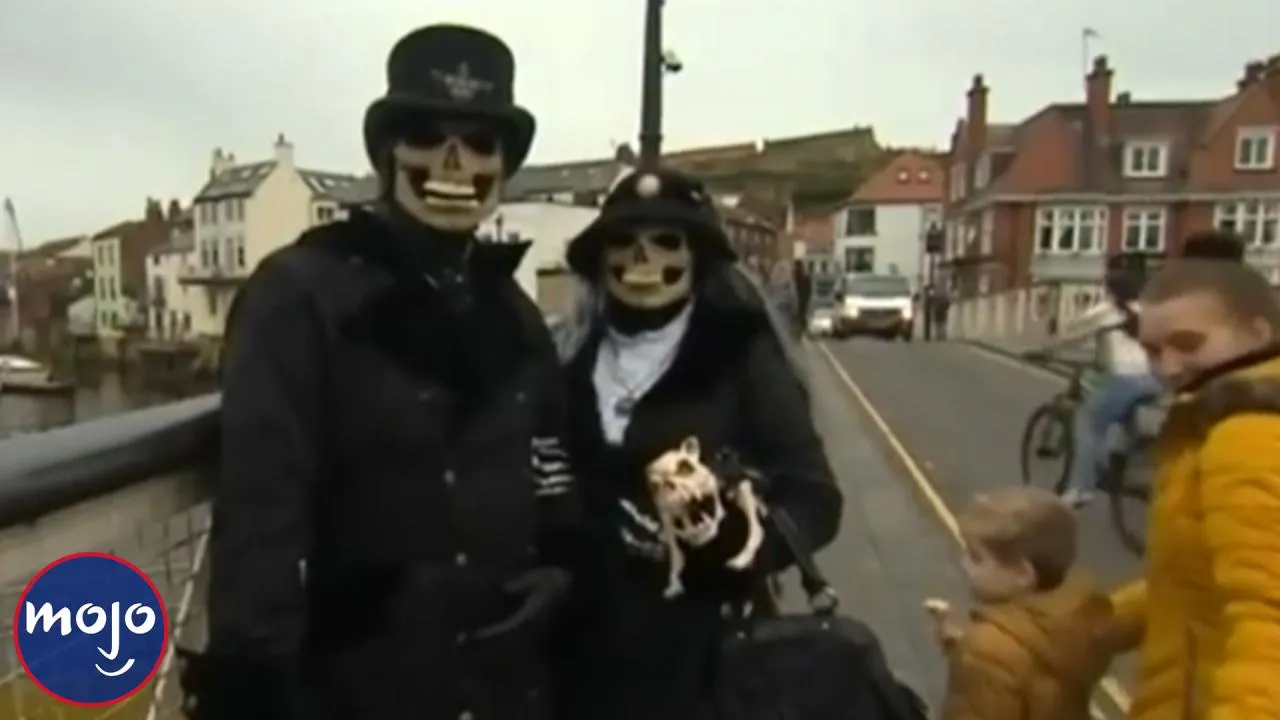
To this day, Whitby is known the world over as the home of Dracula. In the novel, after leaving Transylvania, Dracula finally reaches British shores at Whitby, beneath the ruins of Whitby Abbey. While there, he torments one of the novel’s most memorable characters, Lucy Westenra, until eventually turning her into a vampire as well. Today, Whitby wears its Gothic credentials on its sleeve, with tourist shops full of macabre gifts and offerings, not to mention the Abbey itself if you brave its infamous stone steps. It also hosts the massively popular Whitby Goth Weekend each year. But even today, it remains isolated on the coast, and relatively poorly served by public transport. And the atmosphere remains eerie on a misty, winter’s night.
#7: Woolpit, Suffolk
What do you think the oldest extra-terrestrial incident in British history is? If you guessed Rendlesham Forest, you’re wrong – though, interestingly, that’s also in Suffolk. In reality, one event that has a strong claim on being Blighty’s first alien encounter is the appearance of the Green Children of Woolpit, all the way back in the twelfth century. The children allegedly had green skin and spoke in an indecipherable language, with no parents to be found. Nobody’s too sure where the story came from, though “Horrible Histories” had some ideas. Regardless, the children can still be seen in Woolpit, including on the village sign. They’ve also served as the inspiration for countless novels.
#6: Imber, Wiltshire
There’s nothing supernatural about Imber, a little village in Wiltshire that’s been uninhabited since the 1940s. Instead, this creepy, derelict village was ordered to be abandoned by the British Army so that it could become part of a training area for urban warfare, which hardly seems pleasant. The army slowly bought all the land surrounding the village and then, in 1943, ordered everybody to evacuate within 47 days. They were never allowed back, with the buildings that were once their homes being subjected to gunfire, grenades, and other military drills. You can still visit occasionally, and the village church, St Giles’, hosts a service every year. But when it’s not one of the days visitors are allowed, you won’t be able to get near.
#5: Bodmin, Cornwall
Bodmin Moor has a great many local legends, but most of its ghost stories centre around Bodmin Gaol, a nightmarish building that still dominates the town’s skyline. It’s now partly a museum but also partly a hotel, so you, too, can stay in rooms once occupied by rats and criminals awaiting their executions. Further out from Bodmin and on the moorland proper you’ll find Jamaica Inn, made famous by the Daphne du Maurier novel of the same name. It’s got plenty of alleged hauntings and strange occurrences, and was even once home to an enormous collection of taxidermy animals. It’s no surprise that both of these buildings got their own episodes of “Most Haunted”.
#4: Pendle Hill, Lancashire
Though Pendle Hill itself isn’t a town, it’s surrounded by a handful of small towns and villages that were all part of the infamous Pendle Witch Trials in the early seventeenth century. The small village of Newchurch is thought to have been where Malkin Tower was, a building where the alleged witches once gathered before being arrested and ultimately executed. Roughlee and Fence are other villages in the area that have been touched by the witches, with some having monuments to them. There’s also a Pendle Heritage Centre you can visit in Barrowford, or, indeed, you can visit Pendle Hill itself, which was the subject of numerous, lurid “Most Haunted” investigations. People gather there to remember the witches each Halloween.
#3: Pluckley, Kent
It once held the Guinness World Record for being “the most haunted village in Britain”, until somebody at Guinness apparently thought better of giving out world records for something almost totally made-up. Despite having its award revoked, though, Pluckley remains infamously haunted, with at least twelve well-known ghosts. The ghosts are practically residents, given names like the Red Lady, the Watercress Woman, and even Robert Du Bois, a highwayman murdered in the aptly-named “Screaming Woods”. The village has no shortage of macabre legends and mysterious, local deaths. But Pluckley’s location in rural Kent means it’s actually a very pleasant place to spend some time on a hot summer’s day.
#2: Hagley, Worcestershire
In 1943, a group of local boys making mischief in the woods just outside of Hagley found the remains of a woman inside a tree. It was believed she died in 1941, but the woman’s identity or who murdered her have never been determined. Mysteriously, though, in 1944, ominous graffiti began to appear in and around Hagley, usually asking the question, “Who put Bella down the wych elm?” or a variation of it. This opened a new line of investigation, with police assuming that someone nearby knew who she was and that her name was “Bella”, but still, nothing came of it. Chillingly, the graffiti continues to appear to this day, though the murder has remained unsolved. Theories range from her being an accused witch to a German spy.
#1: Eyam, Derbyshire
Widely known as “the plague village”, Eyam willingly quarantined itself during the 1665 plague outbreak when it spread from London up to Derbyshire through some infested cloth. The village’s historic sacrifice has made it famous, with supplies left on the outskirts for the survivors while the plague was allowed to ravage them. Many of the artefacts from Eyam’s plague days, including its boundary stone where money was left for merchants, have been preserved to this day. Interestingly, though, there’s been some historical pushback recently about whether the popular version of the village’s pestilent history is entirely accurate, though we’ll likely never know for sure. We also don’t know how precisely how many people died, though it was certainly a few hundred.
“Eyam” = “Eem”
Let us know the creepiest small towns in Scotland, Wales, and Northern Ireland in the comments.