Top 10 Behind-the-Scenes Facts About Wuthering Heights (2026)
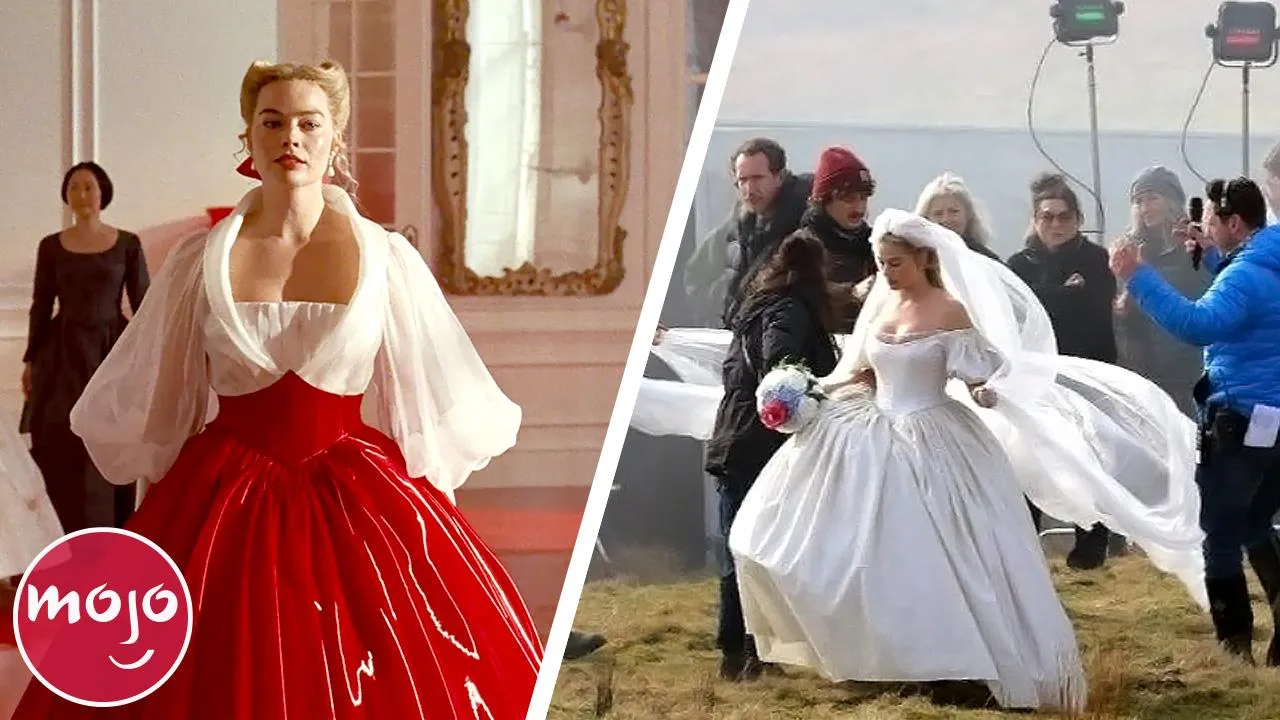
#10: Not Fennell’s First Collaboration with Margot Robbie
This adaptation of Emily Brontë’s classic novel marks the third film from Emerald Fennell, who previously directed “Promising Young Woman” and “Saltburn.” Those two films share a common link in the star of “Wuthering Heights,” Margot Robbie. You might be thinking, “Wait, Robbie wasn’t in Fennell’s last two films.” True, but Robbie served as a producer through the production company LuckyChap Entertainment, which she co-founded. Robbie and Fennell have worked together onscreen as well. We all know that Robbie played the titular character in Barbie, but Fennell also appeared in the film as the pregnant Midge. When Fennell needed someone to play Cathy in “Wuthering Heights,” Robbie, who again serves as a producer, suggested she take on the lead role.
#9: It Started a Bidding War
Warner Bros. ultimately acquired “Wuthering Heights” for $80 million, eight times the budget of “Promising Young Woman.” Although it’s the biggest production of Fennell’s career thus far, Netflix offered almost double what Warner Bros. was willing to pay. Netflix was reportedly “shocked” that the creative team walked away from their $150 million bid. Fennell and Robbie favored Warner Bros. largely because the studio could guarantee the film received wide theatrical distribution and a proper marketing campaign. Supposedly, Amazon also threw its hat into the ring, with its bid including a theatrical release. Netflix might’ve lost this bidding war, but with the streamer’s proposed acquisition of Warner Bros. Discovery seemingly moving forward, it may wind up owning “Wuthering Heights” anyway.
#8: Throwback Cinematography
Cinematographer Linus Sandgren won an Oscar for “La La Land,” which was shot in CinemaScope. This made Sandgren the ideal choice for “Wuthering Heights,” which also harkens back to a bygone era. You might even say one that’s gone with the wind, which served as a visual influence. For “Wuthering Heights,” Sandgren utilized 35mm VistaVision cameras. Paramount created VistaVision as an alternative to CinemaScope’s widescreen process, although both fell out of style with Panavision’s introduction. VistaVision has made a comeback, being used in “The Brutalist,” “One Battle After Another,” and now “Wuthering Heights.” Just as studios turned to techniques like VistaVision and CinemaScope to pack theaters in the 50s, modern filmmakers are taking a similar approach to get their movies seen on the big screen.
#7: Imprisoned Production Design
“Saltburn” production designer Suzie Davies reteamed with Fennell on “Wuthering Heights,” which largely employed practical sets made on sound stages. The sets are woven into the film’s themes, as the two leads find themselves imprisoned. This is reflected when the 6’ 5’’ Jacob Elordi enters the kitchen, his head practically touching the ceiling. Elordi’s Heathcliff isn’t the only one who feels caged. Although Cathy’s surroundings seem more glamorous on the surface, the dollhouse at Thrushcross Grange serves as a metaphor for the luxurious yet empty life that she’s trapped herself in. One could also compare Cathy to a fish in a bowl, which provides a visual motif. Davies’ sets convey how much Cathy risks giving up, yet how confined her world truly is.
#6: Costume Inspirations
While the source material takes place in the late 18th and early 19th centuries, Oscar-winning costume designer Jacqueline Durran pulled from several generations for this film version of “Wuthering Heights.” Durran’s influence spans from the Tudor period, to the Elizabethan era, to the Georgian era, to the Victorian era. Although some wardrobe choices are historically accurate, Durran didn’t hesitate to incorporate more modern touches. She devised nearly 50 costumes for Cathy, whose assorted looks echo Vivien Leigh’s red dress in “Gone with the Wind,” Lana Turner’s shimmering black gown in “Diane,” and Michèle Mercier in “Angélique, Marquise des Anges.” Cathy’s wedding dress also contains hints of Romy Schneider’s in 1955’s “Sissi,” as well as that film’s real-life subject, Empress Elisabeth of Austria.
#5: Charli XCX’s Soundtrack
Perhaps the most contemporary aspect of Fennell’s “Wuthering Heights” is the soundtrack. While Anthony Willis provides the score, the movie also includes original songs from Charli XCX. Around December 2024, Fennell reached out to the British music artist, who was interested in doing something completely different on the heels of her album, “Brat.” Charli formed an immediate connection to Fennell’s screenplay, creating a concept album at the suggestion of collaborator Finn Keane. The album’s first single was “House,” inspired by the documentary “The Velvet Underground.” It was followed up with “Chains of Love,” which would be prominently featured in the film’s official trailer. Between “Wuthering Heights” and the mockumentary “The Moment,” 2026 may go down as the year of Charli XCX’s cinematic ascension.
#4: Casting Jacob Elordi
Elordi previously worked with Fennell on “Saltburn,” where he played Felix Catton. When Fennell saw Elordi’s sideburn look in that film, she felt there was a resemblance to an illustration of Heathcliff from her old copy of “Wuthering Heights.” After wanting to adapt the novel for years, Fennell finally got the project off the ground with Elordi as her Heathcliff. This casting choice wasn’t without controversy, however. The novel describes Heathcliff as “dark-skinned,” leading some to accuse the film of whitewashing. Yet, it’s also been argued that Heathcliff’s race isn’t specified in the source material. Either way, the film isn’t lacking in representation, with Hong Chau as Nelly and Shazad Latif as Edgar. Fennell has stood by Elordi’s casting, while Robbie also defended the choice.
#3: Set Design That Lives & Breathes
The film’s production design feels alive, especially Cathy’s room at Thrushcross Grange. Robbie described this set piece as the “skin room,” as every inch of it is made to resemble Cathy’s own flesh. To achieve this effect, Suzie Davies printed an image of Robbie’s arm onto fabric, which was subsequently draped in latex. This adds a sense of claustrophobia to Cathy’s surroundings, as if she’s becoming one with the estate that’s more like a cell. You can even make out veins in the designs, while the walls practically sweat. It’s just one of the various human characteristics that Davies gave her sets. Another is the presence of plaster hands, which were made from molds that the crew provided.
#2: Unscripted Love Scene
With an R-rating, we can expect a much more overt interpretation of “Wuthering Heights” than what you read in high school. As steamy as the film might get, sometimes it’s the littlest actions that make us swoon. One of the film’s key romance scenes was improvised during a rehearsal. While the rain machine was being tested, Robbie suddenly felt the water coming down. To Elordi, it just seemed to be a natural instinct. To Robbie and Fennell, though, it was a genuinely romantic gesture that perfectly fit the tone of the scene. They thus decided to incorporate it into the film. During that moment, Elordi was Heathcliff.
#1: The Significance of the Quotation Marks
The marketing for “Wuthering Heights” has noticeably presented the title in quotation marks. Likewise, the trailer states that the film is “inspired by the greatest love story ever told,” but not necessarily based on it. Fennell believes that a novel as dense as “Wuthering Heights” can’t be fully adapted, hence why her film only focuses on a portion of it. On a more personal level, the film is a reflection of what the novel made Fennell feel. That said, everyone is going to feel something different reading “Wuthering Heights.” The same can be said about any book that’s adapted to the screen. To Fennell, this isn’t the definitive “Wuthering Heights,” but rather, another version that speaks to her relationship with the source material.
Are you looking forward to “Wuthering Heights?” Let us know in the comments.

