The 20 Most Historically Accurate Assassinations in Assassin's Creed
20 Most Historically Accurate Assassinations in Assassin’s Creed
Caitlin Johnson
Welcome to MojoPlays, and today we’re looking at the most historically accurate deaths in “Assassin’s Creed” games. We’re looking at any characters who die on-screen, not just assassination targets.
King Louis XVI
“Assassin’s Creed Unity” (2014)
The French Revolution was an unprecedented moment in world history, and was always destined to become fodder for an “Assassin’s Creed” game. Upon heading to Paris in the 1790s, there was one death we all wanted to see play out: the execution of King Louis XVI. While most of the high-level revolutionary politicking is background for “Unity”, with much of the game following Arno’s more personal story of his romance with Élise, we do still go to the King’s execution because Arno believes a high-ranking Templar will be there as well. In the cutscene, the King is led up to the guillotine and we hear the proclamation of his execution, which is word-for-word exactly what the executioner really did say when Citizen Capet lost his head.
Girolamo Savonarola
“Assassin’s Creed II” (2009)
In the “Bonfire of the Vanities” DLC for “Assassin’s Creed II” – which was famously meant to be part of the base game but was cut for time – Ezio returns to Florence because the Apple of Eden has fallen into the possession of a tyrannical preacher. The big bad in the DLC is Girolamo Savonarola, who’s been using the Apple to control people. He’s eventually captured and burned at the stake by the public, only for Ezio to leap in and take him out with the hidden blade. In real life, he was executed first by hanging, then had his body publicly burned. So, not quite being burned alive at the stake, but he WAS dead before they set him on fire.
Cesare Borgia
“Assassin’s Creed: Brotherhood” (2010)
Usually, Ubisoft will make a death more dramatic and violent than it really was – but in the case of Cesare Borgia, they actually made his fictional death far more dignified than his real one. In “Brotherhood”, Cesare is finally tracked to Spain by Ezio, who defeats him in a high-octane boss battle. In reality, while Cesare WAS on a campaign in Spain at the time, he was set upon by enemy knights early in the morning. The knights ambushed him, stabbed him, stripped him, and left him naked to be discovered later. However, we don’t know that Ezio DIDN’T do that; maybe he did and Ubisoft just decided not to put that in the game. But getting the time and place correct still makes this more historically accurate than most deaths in “Assassin’s Creed”.
Pausanias
“Assassin’s Creed Odyssey” (2018)
Kassandra journeys to Sparta and soon learns that one of Sparta’s two kings is working with the Cult of Kosmos. She has to investigate to find out which one, but the evidence points to Pausanias, and Kassandra outs him as a traitor to Sparta. This is mostly true, with Pausanias essentially deposed by his own people because he disagreed with Sparta’s generals over their warmongering at the time – not because he was conspiring with a secret cult. The outcome is the same, though, with Pausanias arrested and sentenced to death – however, in reality, he managed to escape and live the rest of his life in exile. You can, however, choose to kill him before he goes into exile, though this contradicts history.
Jacques de Molay
“Assassin’s Creed Unity” (2014)
To the surprise of everyone, “Unity” did another bait-and-switch intro similar to “Assassin’s Creed III”, introducing a playable character who ISN’T the main character of the game, this time an anonymous Templar working with Jacques de Molay. This opening sequence is far shorter than Haytham Kenway’s, taking about ten minutes at most, but it’s a portrayal of a key moment in history: the destruction of the original Templar Order. In real life, the Templars, led by de Molay, were forcibly dismantled and ultimately burned at the stake by the dozen. The whole prologue ends with King Philip the Fair watching while de Molay burns alive, which as far as we know is exactly what happened.
Enjoying this video? Be sure to check out MojoPlays’ 24/7 livestream for non-stop gaming content.
Pompey
“Assassin’s Creed Origins” (2017)
You don’t actually see Pompey’s death on screen, but Aya spends time with him and his fleet earlier on, in the only naval gameplay “Origins” had. His body is later discovered on the shores of Egypt, with Pompey having met a grisly end at the hands of the game’s main antagonist, Lucius Septimius. He’s also missing his head, which is true as well, with Pompey decapitated so that his head could be used to prove he was dead. It’s all extremely true to life, with Pompey likely killed on the orders of Ptolemy because they thought he was going to try and take control of Egypt and wrongly thought that killing Pompey would secure an alliance with Caesar against Cleopatra in Egypt’s civil war.
Pericles
“Assassin’s Creed Odyssey” (2018)
The great Athenian statesman Pericles was one of the many victims of the infamous Plague of Athens. The plague ravaged the city for years, starting in 430 BC, and killed an estimated 25% of all the people living there at the time. In “Odyssey”, Pericles is actually assassinated by Deimos, using the plague as a cover, which certainly adds to the dramatic effect. Interestingly, the Plague remains a mystery, with scholars to this day debating what the disease may have been. It was, for years, thought to have been bubonic plague, but more recently it’s been speculated that either typhus or typhoid were more likely – although, there are some theories even suggesting Ebola as a possible culprit.
Rodrigo Borgia
“Assassin’s Creed: Brotherhood” (2010)
Things aren’t going well for the Borgia family in this scene, with Rodrigo removing papal funding for Cesare’s military ambitions. Here, Cesare rebels against his father after being told he’s eaten a poisoned apple; he then force-feeds the apple to Rodrigo, who perishes. In real life, both Cesare and Rodrigo – usually known as Pope Alexander VI in history – fell ill after eating dinner, though the reason for the illness remains unclear. Most people don’t believe they were poisoned and instead contracted malaria, especially since Cesare was able to survive. But the place and time of death are correct, and the suspicion of poison remains.
Oda Nobunaga
“Assassin’s Creed Shadows” (2025)
The formidable warlord was defeated in a coup known as the Honnoji incident during a tea ceremony. While at Honnoji Temple, one of Nobunaga’s lieutenants, Akechi Mitsuhide, rebelled against him and attacked the temple. In the game, Nobunaga is first attacked by Naoe, who blames him for the death of her father; Yasuke then intervenes. After all this, though, Nobunaga commits seppuku while the temple burns. This is exactly what happened in real life, with the exception of Naoe not being a real person. Yasuke, his loyal retainer, WAS there, and was ultimately spared by Mitsuhide afterwards.
Blackbeard
“Assassin’s Creed IV: Black Flag” (2013)
One of the most profound moments in “Black Flag” is when Blackbeard dies, in one of the few “Assassin’s Creed” deaths where Ubisoft didn’t have to take any creative licence whatsoever. Blackbeard, AKA Edward Thatch, died in battle in 1718 off the coast of North Carolina. He’d been tracked down by the British after an extensive manhunt, and the initial goal was to capture him. He didn’t want to go down without a fight, though, despite getting caught off guard by a surprise attack, and fought to the death. And he was, indeed, beheaded, with his head put on display by his killer, Robert Maynard.
The Pazzi Conspirators
“Assassin’s Creed II” (2009)
Sometimes, “Assassin’s Creed” doesn’t need to take any creative license with historical events, because the real history is so exciting. The Pazzi Conspiracy is one such case. It began when Lorenzo and Giuliano de’ Medici were attacked by the conspirators, something the game reproduces as a mission where Ezio must protect Lorenzo in the aftermath. And in real life, too, the conspirators responsible were ruthlessly hunted down and killed by mobs of Florentines loyal to the Medicis. Ezio doesn’t need to kill all eighty of them, but he does track half a dozen of them across Tuscany. And when Ezio kills Francesco, he hangs his body from the Palazzo della Signoria, which the mobs DID do to the conspirators in real life.
Sibrand
“Assassin’s Creed” (2007)
It’s a little difficulty to ascertain the historical accuracy of the first game. Not a lot of written record survives about the biggest figures of the day as they fought for control of the Holy Land. With that said, some are still more correct than others; Robert de Sable, for instance, actually died in 1193, not 1191 as the game depicts – while William of Montferrat died in Lebanon, not Syria. Sibrand, though, DID die in 1191 and in the city of Acre. Unfortunately, like many Crusaders, we don’t know how he died. We actually don’t know his first name, either. But because of that, nobody can prove that he WASN’T assassinated in Acre’s port – not without a time machine, anyway.
Marco Barbarigo
“Assassin’s Creed II” (2009)
Though the most bombastic assassination in “Assassin’s Creed II” was flying into the palace to assassinate Carlo Grimaldi, not only did da Vinci’s flying machine almost definitely never work, but Grimaldi wasn’t a real person. However, Ezio’s other Venetian targets, the Barbarigo family, WERE real. In-game, Ezio uses Barbarigo’s brother Agostino to plot Marco’s death so that he can take over as the Doge of Venice – which he did. Ezio is a noble himself working in tandem with other Italian aristocrats to track down Marco at a private party and kill him. However, the dates are a little off; Barbarigo died in August, while in the game his death takes place during Venice’s Carnival, which ends on Mardi Gras.
Robespierre
“Assassin’s Creed Unity” (2014)
He’s the only entry on our list not personally assassinated by the player, but he still encounters them during the dramatic coup that ousted him from power. Élise and Arno track him down in the Hotel de Ville with the rebels at the gate, and we see that, in Ubisoft’s version of events, Élise is the one who shoots Robespierre in the jaw and leaves him to the wolves. In real life, he WAS shot in the jaw and nursed the injury all night until his eventual execution the following day. We don’t know exactly how it happened, but most historians believe the story that Robespierre’s injury was actually self-inflicted in a failed attempt to avoid execution.
Cleopatra
“Assassin’s Creed Origins” (2017)
Popular myth says that Cleopatra died after being bitten by an asp, a venomous snake native to Egypt. But this isn’t true, and in fact, Cleopatra is generally believed to have taken her own life with poison. Other scholars, however, suspect that she was murdered; as her final resting place has never been discovered, we have no way to know for sure. In “Origins”, Aya, angered at Cleopatra betraying the people of Egypt in favor of Rome, persuades Cleopatra to end it all, or Aya will return and finish the job herself. We don’t see the moment it happens and it’s all implication, but with the context of Cleopatra’s imminent death, it’s clear what Aya means.
Al-Mutawakkil
“Assassin’s Creed Mirage” (2023)
In 861, the Caliph al-Mutawakkil was murdered by his own guards as part of a long plot to oust him in favour of his oldest son after he angered the powerful military commanders he’d come to rely on. In “Mirage”, the Caliph is holding an Isu artifact for the Order of the Ancients, and Basim sneaks into the Winter Palace in Anbar to steal it. In the struggle, Nehal assassinates the Caliph and his second and favorite son walks in on the scene. Though no thief was involved with the assassination in real life, the instability that followed the Caliph’s assassination drives much of “Mirage”.
Charles Lee
“Assassin’s Creed III” (2012)
After decades of conflict, Connor finally tracks down Charles Lee, the last Templar on his list. He pursues him through Boston as Lee tries to leave and the two engage in an infamous chase, until Lee ultimately escapes and then goes all the way to Philadelphia. If you don’t know the details of how and where Charles Lee actually died, you may have thought that Lee, gravely wounded, going all the way to Philly just for Connor to kill him in a bar was strange. But it’s because Lee, of course, did not die in Boston, but during a visit to Philadelphia, hence the long pursuit. He wasn’t assassinated, though, instead dying of a fever.
Julius Caesar
“Assassin’s Creed Origins” (2017)
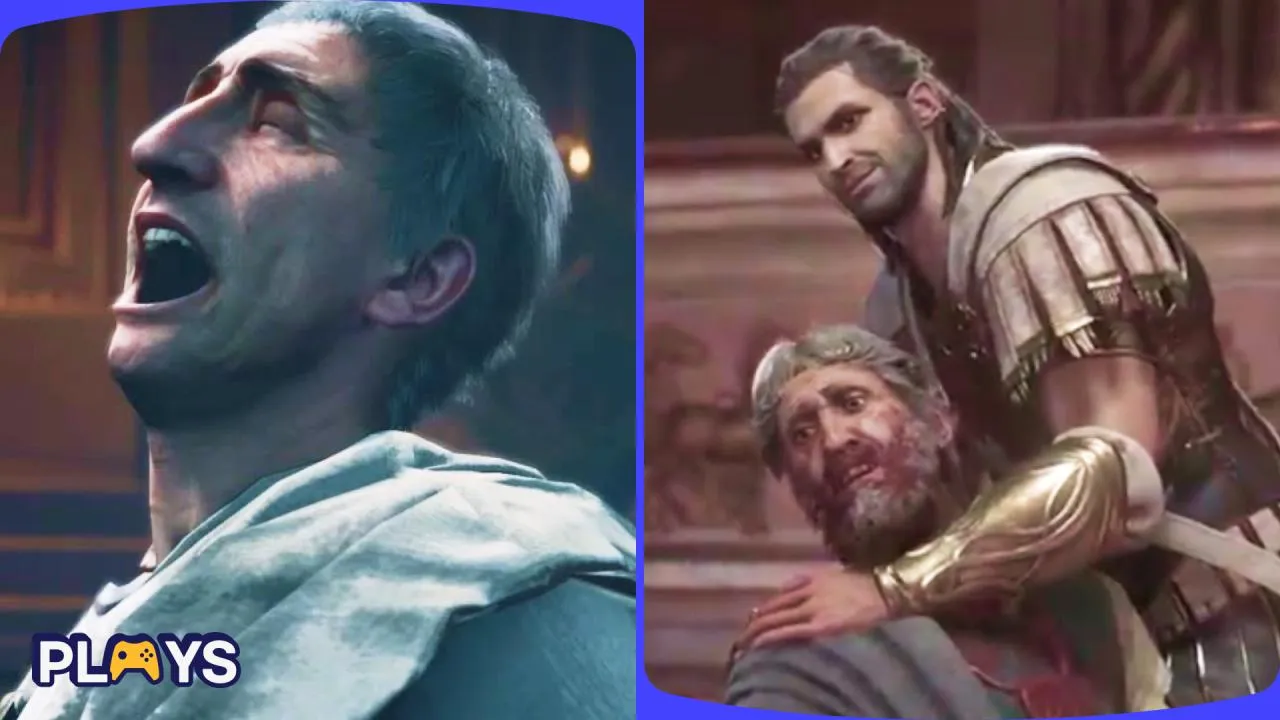
Before going for Cleopatra, Aya has a different famous face on her list: Julius Caesar. She arrives in Rome after it’s become clear that Caesar is being manipulated by the Order of the Ancients, led by Flavius and Septimius. In disguise, she sneaks into the Roman senate and observes Ceasar making a speech to his fellow Romans. Only when Aya steps out of the shadows and assassinates him do the other senators join in, including Brutus, as we find out that the senators responsible were some of the first members of the Hidden Ones. This is all relatively accurate to how the Ides of March played out in real life.
Bartholomew Roberts
“Assassin’s Creed IV: Black Flag” (2013)
Following Roberts’ brutal betrayal of Edward, he ends up being one of the last targets in the game. Edward pursues him to West Africa again when Roberts flees at the last minute. Edward boards the Jackdaw and begins to chase the Royal Fortune with Roberts on board, eventually getting near enough to enter open conflict. He boards the Royal Fortune and assassinates Roberts, who asks him as his dying wish to bury him at sea to stop the Templars from finding his body. This is all very true; Roberts did die during a sea battle off the coast of Africa, and DID wish to be buried at sea – which he was.
John Pitcairn
“Assassin’s Creed III” (2012)
The Battle of Bunker Hill is one of the most infamous missions in the series for its tedious optional objectives, one of which being to air assassinate the British leader, John Pitcairn, without being detected. By carefully manoeuvring through the enemy camp this is relatively simple but requires you to use one specific platforming route to reach Pitcairn on his horse. In real life, Pitcairn did die in battle at Bunker Hill, though he wasn’t stabbed by somebody jumping from a tree. He was shot and killed in the battle’s trenches while leading his men, rather than standing back and sending them to their deaths. But you CAN shoot him if you like – you just won’t get full synchronization if you do.
Let us know in the comments which “Assassin’s Creed” events had you picking up a history book.

