5 Celebrities Against AI vs. 5 Who Support It
5 Celebrities Who Called Out AI and 5 Who Defended It
Welcome to WatchMojo, and today we’re looking at notable comments from stars about artificial intelligence, between those who condemn it and those who advocate it.
Opposed: Scarlett Johansson
In 2023, actress Scarlett Johansson declined OpenAI’s request to model a ChatGPT voice after hers. She sued the company the following year for allegedly using the voice for the AI assistant “Sky” anyway. All of this came in the wake of legal action against Lisa AI for more obvious, unauthorized use of her physical and vocal likeness in an ad. Both companies responded by removing these characters, but Johansson’s fight against misuse of image didn’t end there. She was one of hundreds of artists to sign the Human Artistry Campaign initiative “Stealing Isn’t Innovation.” Johansson’s is just one of the loudest voices calling for corporate accountability and regulation on how AI utilizes real people’s identities.
Defended: Grimes
This synth-pop visionary was one of the first champions of a new form of digital music. Elise “Grimes” Boucher enthusiastically welcomed use of her art to train AI in 2023. Her only stipulation was that she receive half of the royalties generated from an AI song that references her. Grimes believes that this development could counter copyright’s overregulation of creative use of intellectual property. She personally regulates use of her music through elf.tech and its model GrimesAI. She also lent her voice to plushies by Curio. The toy Grok is unrelated to xAI’s chatbot, though Grimes’s former relationship with Elon Musk surely gives her a unique perspective of the industry. She nonetheless stands firm for the human touch in any art form.
Opposed: Tom Hanks
This legendary actor’s gripe is more with the use of AI than the technology itself. Tom Hanks’s most notable statement was a social media post in 2023, warning about a dental plan ad that used an AI clone of him to misrepresent his endorsement. He has since expressed fascination with AI, particularly how it could carry on his art after him. At the same time, he’s deeply unsettled by its unethical use in both legal and illegal contexts. Hanks is as concerned about film industry employment and audience desensitization as he is about fraud. While he understands the need to coordinate with AI, he’s not sure if that means a bright future for Hollywood.
Defended: Michael Caine
In 2025, Sir Michael Caine licensed one of the most iconic voices in film to ElevenLabs. James Earl Jones did the same with Lucasfilm in 2022, but couldn’t have fully known the implications before his passing two years later. The rampant training of AI audio on people’s voices made legally protecting them as assets an inevitability. Caine is one of the first and most qualified people to publicly endorse vocal licensing in this capacity. For a retired actor in his 90s, it’s also about immortalizing his voice so it can continue to tell stories long after he can. Caine’s culturally significant voice is one of many in Eleven Labs’s “Iconic Voices Marketplace.”
Livestream CTA:
Don’t miss out on these and other industry developments. Check out the 24/7 WatchMojo Pop Culture Livestream.
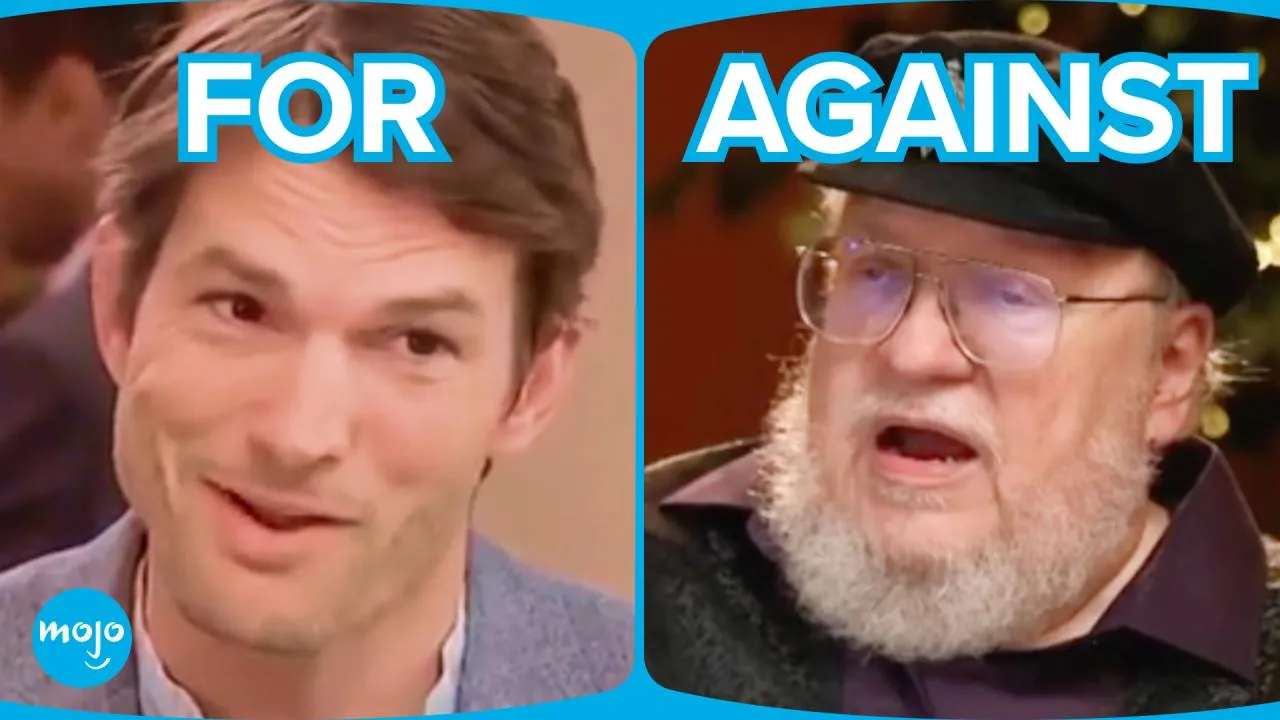
Opposed: George R. R. Martin
ChatGPT’s use of copyrighted literature was so rampant by 2023 that 17 members of the Authors Guild sued OpenAI. Leading the crusade is George R. R. Martin, who cited attempts to generate unauthorized installments in his “A Song of Ice and Fire” series. Michael Connelly, John Grisham and Jodi Picoult are also among the complainants of “systematic theft on a mass scale.” Martin is just particularly literate in his disdain for generative AI, despite conceding that it's “here to stay.” The Authors Guild collectively feels that the least AI companies can do is crack down on piracy and compensate those whose copyrighted material is referenced. As of 2026, their lawsuit against OpenAI is pending in the Southern District of New York.
Defended: will.i.am
One artist’s existential threat is another’s “new renaissance.” That's the term used by William “will.i.am” Adams of the Black Eyed Peas, who compares the AI music controversy to the advent of music sampling. The tech entrepreneur was an early investor in the industry, and founded FYI.AI in 2026 to develop automated workflow tools. He even taught a course on how to build and implement AI agents at Arizona State University. Ethical use is a cornerstone of the curriculum. Will.i.am is eager to both build the future and protect creators from being exploited or disenfranchised by it. Music is just one of the fields he's developing for this Age of AI.
Opposed: The Artist Rights Alliance
Music is one of the most heated topics in discussions about generative AI. So in 2024, the Artist Rights Alliance published an open letter calling for legal protection of musicians and their assets. The more than 200 signatories include Billie Eilish, Chappell Roan, Elvis Costello, Smokey Robinson, and several major bands. Of course, this initiative is only the most visible concentration of artists’ concerns. FKA Twigs and Martina McBride later echoed them in testimonies before separate U.S. Senate subcommittees. And revered singer-songwriter Nick Cave penned his own open letter decrying AI art as “a grotesque mockery of what it means to be human.” These artists certainly have incomparable skills for projecting emotion, but still feel threatened as creative technology advances.
Defended: Ashton Kutcher
It’s not exactly helpful to ignore the realities of industry developments. Still, actor and entrepreneur Ashton Kutcher faced backlash over a 2024 Berggruen Institute forum, in which he predicted that AI will render full films. The idea that studios will embrace this transformative cost-cutting follows his view that AI will become essential to businesses’ survival. But Kutcher is optimistic that competition with technological convenience will raise the standards for human-driven films. So too is he optimistic about AI enterprises making lives and careers more comfortable. In 2026, Kutcher left Sound Ventures to establish a tech firm that will focus on AI infrastructure. He hears the public’s outrage, but understands that they must coordinate with a new world to thrive in it.
Opposed: Sean Astin
Fran Drescher supported the 2023 Hollywood strike for AI regulation in her role as President of SAG-AFTRA. Her successor Sean Astin continued the union’s initiatives, all the way to a U.S. House Judiciary Subcommittee. His testimony in 2026 not only advocated for the protection of public figures’ careers, intellectual property and personal welfare. He suggested that the individual and social perils of deepfake technology are a crucial matter of public safety. Astin claimed that his industry is eager to embrace the technology, but with humanity as the central consideration. Video of the speech quickly went viral as a call for regulation to catch up to the potentially reckless pace of innovation.
Supported: James Cameron
The best filmmakers understand the balance between humanity and practical realities. In 2024, James Cameron joined the board of directors for Stability AI in support of its industrial applications. This was a shocking follow-up to earlier statements that artificial intelligence could bring the apocalypse he imagined in “The Terminator.” Cameron’s more nuanced stance is that businesses should embrace the efficiency brought by this permanent technology. He also prioritizes protecting as many jobs as possible, including actors who represent human material. Cameron promises that none of his “Avatar” films will use AI to make the CGI that’s deeply ingrained in their storytelling. But it could be irresponsible for a public figure to advise hiding away from this new industrial revolution and its creative potential.
How do you think artists should approach AI to protect their industry? Lend your voice in the comments below.

