10 HARDEST Point & Click Adventure Games
10 Hardest Point and Click Adventure Games
Welcome to MojoPlays, and today we’re counting down our picks for the ten hardest point and click adventure games that truly boggled our brains.
“Monkey Island 2: LeChuck’s Revenge” (1991)
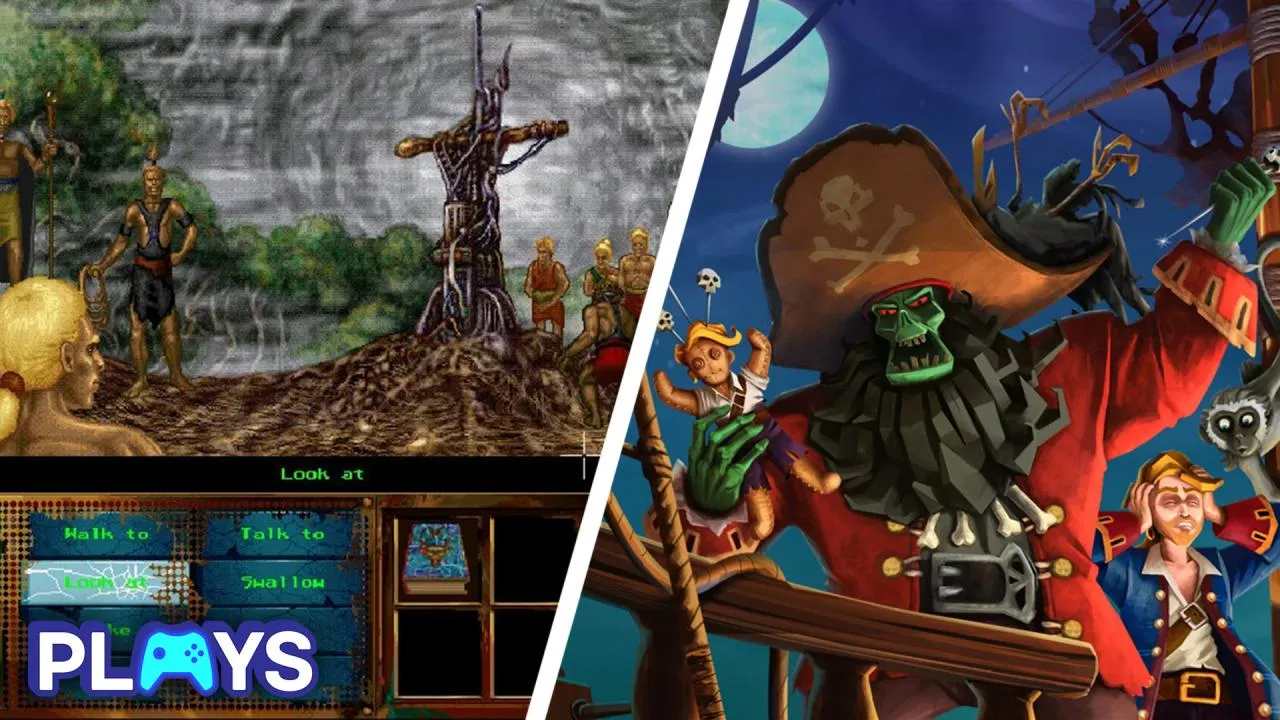
“LeChuck’s Revenge” is tough all around because it thrives on deliberately obscure puzzle logic, playful misdirection, and a kind of “pirate logic” that doesn’t always align with real-world intuition. Rather than guiding players with clear cause-and-effect solutions, it frequently expects them to experiment with unlikely item combinations, interpret witty and goofy jokes as clues, and revisit locations with little indication that progress has become possible. Its humor, while iconic, can also disguise critical hints, leading players to overlook essential information or misread dialogue as purely comedic flavor. On top of that, the game offers minimal hand-holding by modern standards, so progress often depends on patient exploration and revisiting every screen after new developments, all while thinking outside of the box. The result is a classic adventure that feels rewarding but intentionally opaque.
“Myst” (1993)
I’m pretty sure most of us older gamers have fond (or perhaps scarring) memories of trying to figure out this game with our friends back in the 90s. It’s downright iconic. “Myst” is widely regarded as a difficult point-and-click adventure because it strips away most of the traditional guidance systems players expect and replaces them with an almost entirely self-directed world of environmental logic. Instead of dialogue-heavy storytelling or explicit objectives, it relies on subtle visual cues, cryptic in-world books, and abstract mechanical puzzles that often require long chains of inference to connect cause and effect. Progress is intentionally nonlinear, so players can easily wander around aimlessly without clear indication of the intended progress path, leading to confusion about what is even solvable at a given moment. Many puzzles depend on observation and memory rather than inventory use, meaning success often hinges on noticing small environmental details that can be easy to overlook. “Myst” creates a sense of isolation and discovery that is immersive but frequently disorienting and confounding in equal measure.
“The Longest Journey” (1999)
This doozy of a game challenges players with puzzles that rely less on obvious inventory interactions and more on layered storytelling logic, timing, and interpretation of symbolic information… no easy feat. Rather than presenting a single, self-contained problem space, it constantly shifts between Stark and Arcadia, forcing players to mentally track parallel narrative threads and understand how changes in one reality reshape possibilities in the other. Many puzzles are designed around indirect reasoning, so progress can stall if players don’t fully absorb dialogue or notice subtle contextual hints. The game also resists linear guidance, meaning players must frequently backtrack with new understanding and re-evaluate earlier assumptions without explicit prompts that they should do so. It’s a deeply nuanced and layered experience that rewards the curious and punishes the careless.
“I Have No Mouth, and I Must Scream” (1995)
Are you looking for a highly complex and oppressive psychological and moral framework that constantly works against your intuition? Based on a bleak narrative where each character is trapped in personalized nightmares, progression often depends on understanding abstract, symbolic, or emotionally distorted environments rather than logical real-world reasoning, which makes solutions far less predictable than in more conventional adventure games. The game also features multiple protagonists with different scenarios that can branch into failure states quickly, so a single misstep or poorly judged interaction can permanently block progress or lead to brutal outcomes. Inventory puzzles and environmental interactions are frequently obscured by minimal feedback, meaning players may not even realize they’ve missed a critical clue until much later. Plus, the game’s reliance on trial-and-error can feel punishing given its heavy, foreboding atmosphere. It’s one of those games that gets under your skin with its creepy tone and settles into your brain with its extraordinarily difficult-to-grasp scenarios.
“King’s Quest V” (1990)
You could probably toss any “King’s Quest” on this list and it would be fair game; but for our money, it’s 1990’s fifth outing that really stacks the odds against you, even if you consider yourself a point and click aficionado. Unlike earlier games such as “King’s Quest I” through “III,” which still leaned heavily on parser-based input but often gave players more straightforward environmental puzzles, “King’s Quest V” removes the parser and replaces it with a pure point-and-click interface that feels more accessible at first—yet it compensates by making puzzles less intuitive and more dependent on obscure item usage, environmental observation, and experimentation. The game also has a high number of dead ends and soft locks, meaning players can unknowingly miss crucial items or actions early on and only discover much later that progress is impossible without restarting. Compared to later titles like “King’s Quest VI,” which improved puzzle logic and narrative signposting, the fifth game sits in an awkward transitional phase: it looks friendlier and more modern, but still retains the unforgiving design philosophy of older adventure games, making its difficulty feel especially sharp and sometimes unfair.
“Dark Seed” (1992)
“Dark Seed” is considered a notoriously difficult point-and-click adventure largely because it relishes in punishing game design with extremely limited player guidance. Yay…good times. The game’s puzzles are often opaque and unintuitive, relying on abstract logic or surreal associations inspired by H.R. Giger’s unsettling art style rather than grounded real-world reasoning, which makes solutions hard to deduce even when you understand the objectives. Progress can hinge on very specific timing—since the game operates on a strict in-game schedule (never an easy thing to deal with)—and missing key events or actions can lead to soft locks or dead ends without clear warning. In addition, the interface is clunky by modern standards, with minimal feedback, sparse environmental clues, and heavy pixel hunting required to find interactable objects. Together, these elements create a sense of confusion and trial-and-error gameplay that makes “Dark Seed” challenging even for seasoned adventure game players. Oh, and if you didn’t gather–it’s also incredibly creepy and disturbing.
“Gabriel Knight: Sins of the Fathers” (1993)
“Sins of the Fathers” is widely considered the hardest entry in this series because it combines classic early-’90s Sierra design with unusually unforgiving puzzle logic, limited guidance, and multiple ways to get stuck without obvious warning. Unlike later games in the series such as “Gabriel Knight 2: The Beast Within,” which leans more toward structured FMV storytelling with comparatively more directed progression, and “Gabriel Knight 3: Blood of the Sacred, Blood of the Damned,” which, despite its infamous puzzles, generally provides clearer environmental framing—”Sins of the Fathers” often expects players to deduce “moon logic” inventory combinations, revisit locations repeatedly under changing conditions, and exhaust dialogue trees to trigger essential story flags. It also relies heavily on pixel hunting and timing-sensitive progression, where missing a small clue or sequence step can silently block progress hours later, creating the series’ most notorious soft-lock potential. Best of luck!
“Discworld” (1995)
Old-school design tendencies with deliberately obscure, logic-bending puzzles that frequently require lateral thinking rather than intuitive problem-solving are the flavors of the day here in “Discworld.” Many of its challenges hinge on unusual wordplay, misleading item interactions, and solutions that depend on knowledge of the series’ specific humor and absurd logic rather than clear in-game cues. Unlike more modern adventure games that gently guide players with environmental hints or streamlined inventory use, “Discworld” often provides minimal direction, meaning players can get stuck for long periods simply because the correct solution is non-obvious or counterintuitive. On top of that, its puzzle structure sometimes requires actions to be performed in a very specific order, with little feedback when you go wrong, which increases trial-and-error frustration. Its dense writing and reliance on parody of fantasy tropes also provide trouble for many players, despite the game’s overall enjoyment.
“Broken Sword: The Shadow of the Templars” (1996)
“Broken Sword: The Shadow of the Templars” is often remembered (fondly or otherwise) as a deceptively difficult point-and-click adventure because it blends a cinematic storytelling style (which looks amazing) with puzzle design that relies heavily on inference, misdirection, and subtle environmental cues rather than obvious logic chains. Many of its challenges come from the way clues are distributed across dialogue, background details, and inventory items that only become meaningful much later, forcing players to mentally connect information across long gaps in gameplay. I mean do they think we are Sherlock Holmes? I think not. It also reflects a classic 1990s design philosophy where experimentation and thinking outside the box are absolutely essential, sometimes requiring unconventional item combinations or interpreting vague hints embedded in conversations. While not always the most punishing in terms of difficulty spikes, its tendency to obscure critical solutions within richly detailed scenes and its occasional reliance on non-intuitive leaps of logic have led many players to remember it as one of the more challenging entries in the genre at large.
“Riven” (1997)
Aptly subtitled “The Sequel to Myst,” you kinda know what you are getting into here if you have any familiarity with this genre, or of course, “Myst.” Easily one of the hardest point and click adventure games of all time, it pushes environmental puzzle design to an extreme level of abstraction, with minimal to zero guidance, and confounding interconnected logic. Unlike more conventional adventure games, it provides almost no explicit instruction, instead requiring players to decode meaning from architecture, sound cues, machinery, and the fictional language in the game itself. “Riven’s” world is also non-linear and densely interlinked through complex spatial shortcuts and linking systems, so understanding where you are is as important as knowing what to do. Many puzzles span large distances and multiple states, requiring players to remember subtle visual changes or mechanical behaviors across hours of exploration. The game’s deliberate lack of hand-holding and reliance on real-world reasoning applied to alien systems, means this game becomes less a sequence of puzzles and more a sustained exercise in environmental deduction. Fun? Yes. But, downright brutal to complete.
So, do you agree with our picks for this list? What are the hardest point and click adventure games you have played? Let us know in the comments.
