Top 30 Hardest Dance Moves To Pull Off
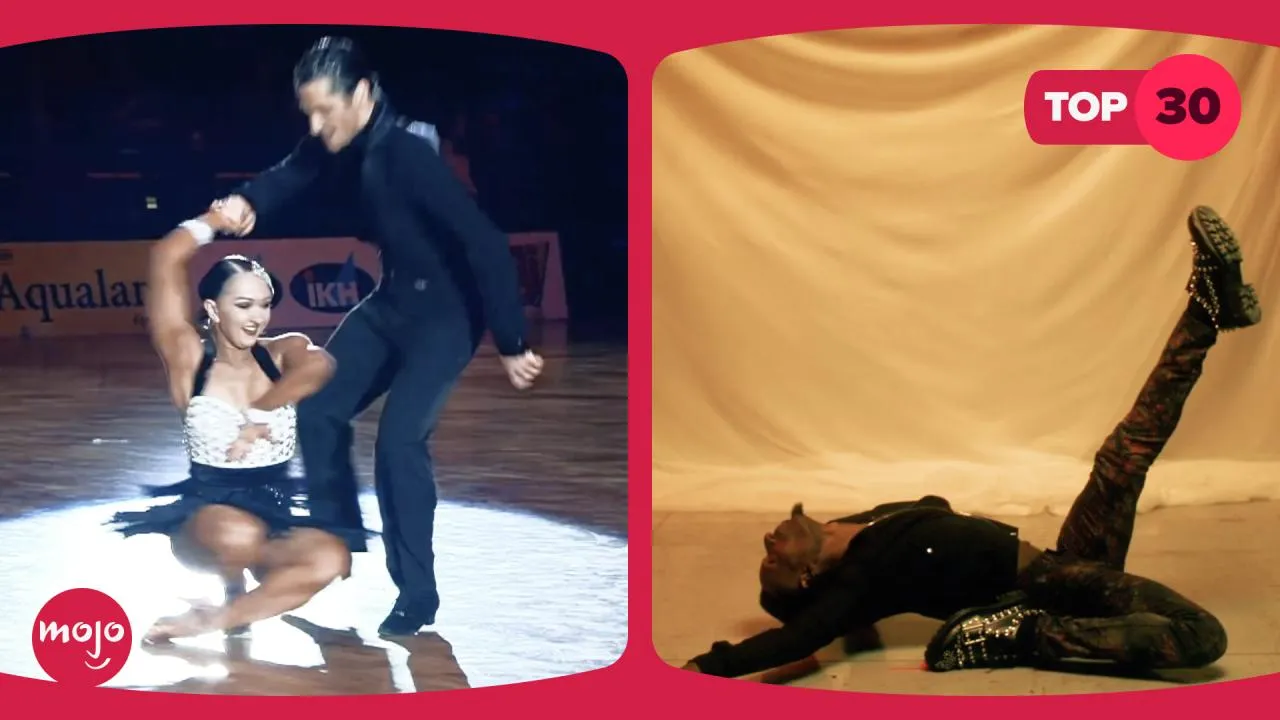
#30: The “Dirty Dancing” Lift
If you’ve ever watched “Dirty Dancing” and thought, “ How hard could that lift really be?” Well, you’re not alone, but you’re also in for a reality check. It might be the thing of pop-culture dreams, but in reality, it’s a test of nerves, timing, and trust that has sent countless hopefuls crashing down. Even Johnny and Baby don’t get it straight away! The lifter needs unwavering stability, while the flyer has to launch with pinpoint accuracy and hold their core as everything hinges on it, which it kinda does. When it works, it looks stunning. Weightless, euphoric, unforgettable. When it doesn’t, you’ll have the bruises as proof that you tried.
#29: Pin Drop
This move looks simple until your knees remind you otherwise. Dancers have to drop fast, absorb impact safely, and spring back up without breaking the flow. That means strength, coordination, and serious body awareness all working at once, especially as gravity isn’t really on your side. The hardest part is making the downward move look sharp instead of painful, because the best versions hit the ground with musical precision and then rebound like the dancer barely felt it. Done properly, it creates a dramatic snap in the choreography. Done badly, it turns into an awkward stumble and a very real reminder that floors are not forgiving.
#28: Zapateado
There’s a reason this footwork-heavy style earns respect in any room. Zapateado is all about rapid, intricate strikes of the feet, and the challenge is keeping speed without losing clarity. Every sound has to be crisp, every step has to be controlled, and the upper body still needs to look calm and composed. That’s harder than it sounds, because the feet are basically doing a high-speed conversation while the rest of the body stays elegant. When it’s executed well, the rhythm feels razor-sharp and almost hypnotic. Since your shoes are part of the percussion, there’s nowhere to hide mistakes, which is perfect if you’ve ever wanted your errors broadcast loudly.
#27: Voguing Dips
Voguing dips are the ultimate test of drama and daring, a signature move that separates the legends from the wannabes. These gravity-defying drops demand a cocktail of balance, flexibility, and laser-sharp control, because the goal is to sink low and snap back up without so much as a wobble. Done well, it’s bold, stylish, and just a little bit rebellious, like the laws of physics took a coffee break. The secret sauce is confidence; commit to the move, and you’re iconic. Hesitate for even a second, and you risk going from fierce to fiasco. In the world of voguing, dips are where you earn your stripes, and the crowd knows it.
#26: Moonwalk
The moonwalk has become a pop culture rite of passage, immortalized by Michael Jackson’s gravity-defying glide across the stage. What makes it so legendary (and so maddeningly difficult to master) is its total rebellion against how our bodies want to move. Your instincts scream to push off and step back, but the moonwalk demands you do the opposite: anchor your weight on the ball of one foot while the other floats backward. The tiniest miscalculation, a hint of pressure on the wrong foot, and the spell is broken. It’s a move that rewires your sense of balance and rewards hours of obsessive practice with a moment of pure, crowd-pleasing wonder.
#25: Fleckerl
If you’ve ever watched a Viennese Waltz and marveled at that dizzying, tornado-in-place moment, that’s the infamous Fleckerl in action. The Fleckerl is a relentless test of stamina, precision, and partnership. Every rotation is a spotlight moment, demanding you spin like a top while your feet barely leave the floor. The biggest challenge is staying locked in a stationary whirlwind, fighting centrifugal force with nothing but sheer core strength and laser-focused teamwork. One misstep, one wobble, and the illusion shatters. Forget the sweeping, cinematic glides of other waltz figures; here, it’s all about micro-movements, pinpoint-precise timing, and a frame so solid it could withstand a hurricane.
#24: Ami Kāhela
The Ami kāhela asks for complete body control while still looking calm and graceful. The hips pulse in a hypnotic rhythm, while the upper body stays statuesque, expressive, and composed, as if it has no idea the rest of the body is working that hard. That kind of isolation is a serious test, especially when you’re holding a deep, bent-knee stance that would make our knees creak in protest. Every weight shift has to be precise, every movement seamless, so the flow never breaks. It can look mesmerizing, smooth, grounded, and almost meditative. The real trick is making all that muscle work vanish beneath a mask of serenity, leaving the audience in awe.
#23: Stationary Lift & Drops
This belly dancing move asks you to rely on precise muscular isolation, which is often a new, challenging skill for most dancers. Instead of using entire muscle groups, you must engage very specific core muscles like the obliques, without involving the glutes or shoulders. Holding a bent-knee posture while keeping your upper body loose feels completely counterintuitive, and learning this technique takes slow, focused practice to rewire muscle control. When finally mastered, it looks effortless and fluid, adding dramatically controlled pauses, sharp accents, and sophisticated flair to your performances. This foundational movement truly defines the beauty of the dance. And getting it right feels oh so satisfying.
#22: En Pointe
Standing on the tips of the toes sounds magical until you remember the human body was not exactly built for it. Standing on the very tips of your toes might seem ethereal to the audience, but it demands superhuman strength in the feet, ankles, legs, and core, not to mention years of relentless training just to avoid injury. The real artistry is in making this punishing feat look light as air, as if the dancer is floating above the stage. Balance, alignment, and control are non-negotiable, and even then, every step is a triumph. That weightless, dreamlike quality is what makes this step both beautiful and notoriously difficult to master.
#21: Swing Aerials
Swing aerials bring speed, height, and serious risk into one thrilling package. The dancer has to build momentum, launch at exactly the right moment, and trust their body to rotate cleanly through the air. Timing is everything because even a tiny mistake can throw off the whole arc. Strength matters too, especially in the core and upper body, since the movement depends on controlling the swing instead of fighting it. After years of practice, the pros can make it look so exhilarating, almost like even gravity momentarily stopped to watch in awe. That rush of weightlessness is what makes swing aerials legendary, and why dancers chase that perfect flight.
#20: Irish Step
Great Irish step dancing doesn’t just scare the bejesus out of Chandler Bing. It can also instill fear in any dancer trying to master the amazing ability to have one’s legs flail about as if independent from one’s body. From the rigid placement of the arms, to the surprising amount of strain put on your butt muscles, this “flailing” takes so much more skill and practice then most people probably assume. The truth is most of us aren’t going to be the lord of this dance, but that just means we have to appreciate it even more when someone is.
#19: Straight Leg Scorpion/Needle
This is a very impressive extension, to say the least. It basically involves doing the splits while standing on one leg and holding the other leg in the air behind your head. This is one of those moves where people that can do them think they’re pretty easy - just look at how many versions of the “do a needle fast” tutorials there are online. However, while the trained and flexible might call it simple, the amount of work and dedication it takes to get to that point puts it on our list.
#18: Devil’s Elbow
Try to do this move and you could easily assume it was crafted up by the Devil himself. But alas, it wasn’t. A brutal pole dancing maneuver, it was created by dance instructor and multiple title winner, Carlie Hunter. Interestingly, she came up with the name because of how much it hurt when she first began learning it. And we don’t doubt that at all, given that it requires you to hold onto the pole in the crook of your arm as you spin around. Our arms feel bruised just watching it.
#17: Worm
There’s always at least one person that breaks out the worm at a wedding, and even Katy Perry couldn’t contain herself during one guy’s audition on “American Idol”. But just because everyone and their brother does it, doesn’t make it easy to execute - especially well. Getting the proper exaggerated body flow without smashing your face into the floor or hurting yourself isn’t as simple as most people may think. So, learn the technique and practice, and you could be the star of your next party rather than the star of an embarrassing YouTube fail video.
#16: Pot Stirrer
Not to be confused with Joey Tribbiani’s hysterically bad “stirring the pot,” the Pot Stirrer requires skill, training, balance, and practice. Joey’s move basically sees his arms and hips awkwardly moving some air around. But our pick features a dancer in a crouched position being stirred around by their partner at a feverish pace. It’s like watching an amazingly athletic and focused human swizzle stick. It’s impressive on its own, but imagine having to get up after said spinning and jump right into more dancing. We’re dizzy just thinking about it.
#15: Samba Roll
Often, if a dance maneuver doesn’t involve obvious athleticism and/or crazy strength or flexibility, it isn’t seen as being that difficult. Of course, any dancer will tell you that looks can be deceiving. And the samba roll is a perfect example of that. It’s defined as a move in which “two dancers turn together with their arms stretched out.” That may sound easy, but it isn’t! It requires a tremendous amount of coordination as well as a deceiving amount of flexibility and balance in order to maintain the proper positioning. But wait, there’s more. Your samba rhythm and hips will also be put to the test with the Botafogo and Voltas steps.
#14: Prisiadki
A classic in Eastern Slavic dance, this complex move requires the performer to remain in the squatting position while alternately kicking out each leg. And it’s as hard as it sounds. The balance and core strength required to maintain the proper positioning while your legs fly out from underneath you are made evident immediately. Needless to say, the untrained tend to fall right on their back side before the first kick is even finished. And as if squatting and kicking in one place wasn’t hard enough, try doing it while moving forward.
#13: Multiple Turns
From salsa to ballet to Michael Jackson- spinning is a popular dance move used by many. And to do it correctly requires impressive balance and the ability to maintain focus as your surroundings fly around you. Learning to maintain the right positioning and spotting your turns, aka moving your head to keep a specific point in your sights, is key. Mastering one spin takes a little work, but mastering the ability to do multiple in a row, going round and round like a record player? That takes the difficulty level up a notch.
#12: One-Footed Wing
In tap, a wing is a three-part move that involves scraping the side of your foot out, brushing it back in and then ending with a flat, full tap using the balls of your feet. As with many tap maneuvers, including the 3-sound ‘ripple’, it’s harder than it looks. But it’s nothing compared to a one-footed wing, which involves doing it all while standing on one leg. And what about leaving the ground altogether with the impressively difficult Irish dance move known as the birdie? It’s not for the faint of heart!
#11: Arabesque
On the surface, this might seem like a rather simple ballet position - with the dancer standing on one leg and extending the other in the air behind them. But simple doesn’t always equate to easy. Not to mention the fact that there’s a definite difference between a good arabesque and a great one. Achieving the latter is something many performers continually strive for, even years into their careers. When perfected and incorporated into a full routine, it’s absolutely enchanting. Plus, the move can provide an important snapshot of a dancer's grace and technique, which says a lot.
#10: Paddle & Roll
Some people think that tap dancing is easy, and involves nothing more than stomping around with special shoes on. But they couldn’t be more wrong. It’s actually much harder than it looks. Look no further than the paddle and roll to see what we mean! When done slowly, it looks like some basic heel digs, taps, and front foot slaps. In other words, nothing too complicated. But then you see what it’s supposed to look like at full speed, and ‘easy’ is the last word that comes to mind. Also in this realm is the shuffle slap up changes. For both moves, the rhythm, syncopation, and speed present challenges to overcome.
#9: Grand Jeté
When people think of the beauty and grace of ballet, they’re likely to imagine dancers doing grand jetés. The move involves leaping off the ground, extending one leg in front with the other hovering parallel to the ground. As if doing the splits on the floor wasn’t already hard enough, this move basically requires you do one in the air! To get it right, one has to muster up enough height to be able to fully extend their legs, all while maintaining an upright and strong position with their torso. As they say in French, it’s grand difficile!
#8: Headspin
The headspin is most associated with breakdancing and b-boy culture. But the move has seemingly existed for decades, as evidenced by the 1933 film “Wild Boys of the Road.” While some dance moves fool you into thinking they’re simple at first glance, this one looks as hard as it is. For most of us, just standing on our heads is difficult to achieve. So the prospect of incorporating spinning is daunting, to put it mildly. The balance, core strength, and concentration needed to spin without falling over or getting ridiculously dizzy is endlessly impressive. Now imagine ending the move with a freeze just because you can!
#7: The Monkey Flip
The monkey flip is a move that most experienced breakdancers probably have in their arsenal. And while it’s pretty standard and easy once you get it, the learning process can be intimidating. Basically, you start by putting a hand on the ground behind you while crouched. You then use it to flip yourself onto a handstand, and back over onto your feet. It’s definitely a great way to transition up from the floor. But throwing yourself backwards on one hand and trusting you won’t come crashing down is a fear you have to overcome for this one.
#6: Penché
The francophiles out there likely know that the word “penché” translates to “bent over.” And that’s exactly what this ballet move entails. But as you probably guessed, there’s a lot more to it than just that. Almost anyone can bend over. But doing so on one leg while the other is at a 90 to 180 degree angle is a whole other story. As is often the case with ballet moves, the penché demands that the person executing it possess balance, flexibility, power, and grace. In other words, it requires time and training!
#5: Cabriole
This is just one of many difficult ballet moves. Imagine extending one leg out then jumping into the air, bringing the other one up to it and thus pushing it further up. Then, try to land back on your supporting limb in a steady manner. As the natural tendency is to bring the initially elevated leg back down, perfecting this move is a whole lot harder than you may think. Once mastered though, it’s a truly beautiful sight. You can also try to take on double cabrioles afterward if you’re feeling bold! We can only assume they’re twice as hard, but it’s worth it.
#4: Flare/Flair
The flare can be seen in gymnastics as well as breakdancing, having found a perfect place in both worlds – though its spelling varies between them. Gymnasts can perform the move during floor routines, but the maneuver’s true power is on display when they utilize the pommel horse. Watching their legs swing in circles never gets less mesmerizing. The strength required to hold your torso up is one thing, but the constant swirling takes things up several notches. While breakdancers obviously don’t use a pommel horse, they’ve created some amazing variations as well. Just take a look at the air flare!
#3: Grand Adage
The grand adage doesn’t just involve one move – that would be too easy! Instead, it employs a series of them during a section of a ballet. It’s part of a routine, often the “pas-de-deux”, in which you’re required to make slow and deliberate movements with leg lifts in each direction. The dancer must be in complete control of their body at every stage, employing strength and balance to make the gestures appear smooth and seamless. To say the concentration and muscles required to pull this off don’t come easily is a serious understatement!
#2: Fouetté
Don’t be fooled into thinking this is as easy as doing a simple spin or pirouette. A fouetté is even harder, as it involves the dancer using their “working leg” and moving it in order to whip themselves around on each turn. Nailing the timing and balance is deceptively tricky, especially when you see someone like Sharon Wehner in “Swan Lake.” She’s incredibly elegant, and actually makes doing 32 of them in a row look easy! Yet if you ask anyone who knows anything about ballet, they’ll tell you that fouettes are not for the faint of heart.
Before we unveil our top pick, here are a few honorable mentions.
Body Rolls
They Require Extreme Spinal Isolation, Fluidity & Precise Core Muscular Control
Iron X
It Demands Elite Upper Body Strength to Hold Horizontal Against Gravity
Barrel Turn
Just Try Maintaining Balance and Spotting While Spinning with a Tilted Torso
#1: One-Handed Chair Flare
A number of breakdancing moves begin on the ground and involve spinning your body. There’s the windmill, in which your upper back generally maintains contact with the ground. There are also Taisuke criticals, named after bboy Taisuke, where he launches into the air, barrel rolls, and ends up back on two hands. But the one-handed chair flare undoubtedly reigns supreme in its complexity. You’re essentially throwing yourself into the air with one arm and doing a 360 degree spin with your body before landing on that same limb. Try not to look absolutely terrified in the process! If you’ve figured this move out, you can consider yourself a real pro.
Have you tried any of these dance moves? Let us know how it went and how long it took to master them in the comments!

