Top 20 Differences Between The Reacher TV Show and Books
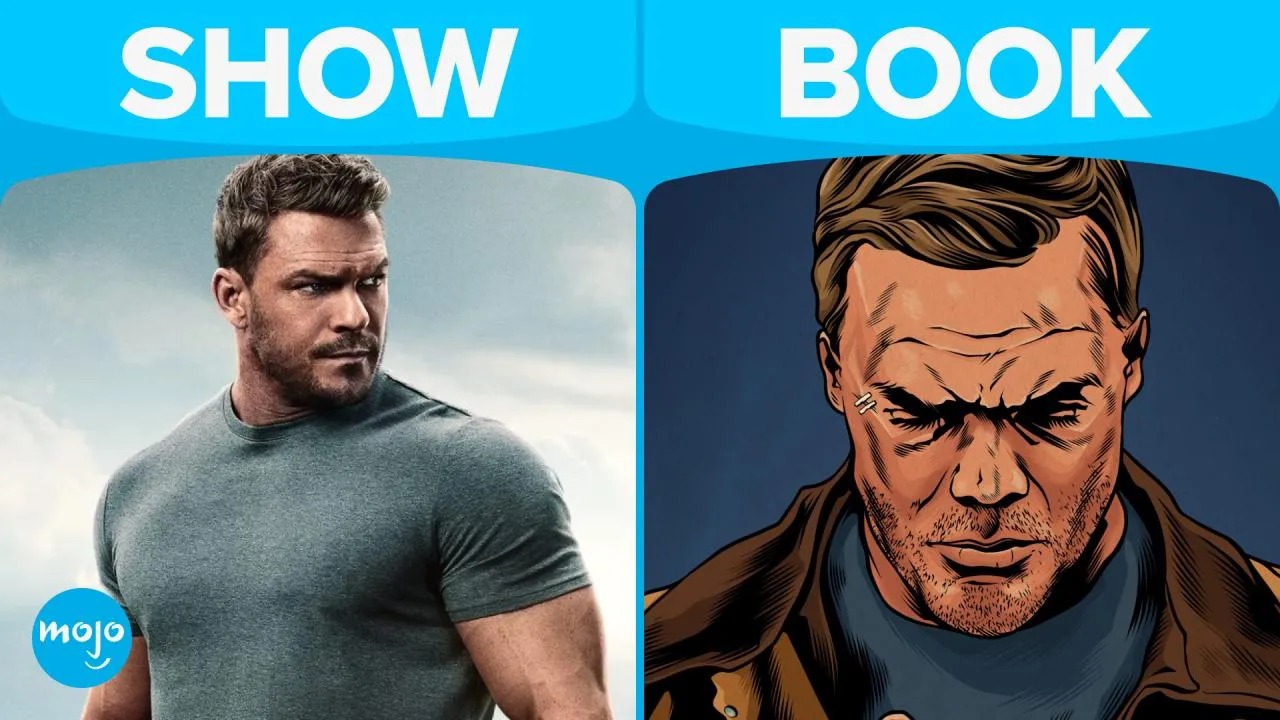
#20: Old Soul in a New World
Jack Reacher – no middle name – was introduced in the 1997 book “Killing Floor.” A lot has changed between then and the show “Reacher’s” premiere in 2022. In the books, the low-profile drifter begrudgingly carries a passport after 9/11 tightens national security. This is his only form of ID from the beginning of the TV series. Never mind the tech updates and the omnipresence of the Internet. This makes it easier to crack Franz’s password and New Age’s “Little Wing” program in Season 2. Even the phone that Reacher sneaks into the Beck house in Season 3 was a secure e-mail device in 2003. Reacher’s investigations may be more convenient in the modern world, but they're still not easy.
#19: Big Guy, Bigger Personality
The way Lee Child’s books take us into Reacher’s internal monologue is about as imposing as his external form. In the absence of first-person narration, the show gives the brooding investigator the habit of voicing his constant calculations to those around him. This actually has a huge influence on his personality. As stoic as Reacher is on the screen, he’s practically robotic on the page. His reluctance to engage in dialogue is completely flipped into rapid-fire chattiness and humor to showcase his remarkable intelligence. It’s hard to imagine that “Reacher said nothing” is a recurring line in Child’s books. By getting creative with externalizing the brain behind the brawn, the show presents the ultimate snappy action hero.
#18: Reacher’s Ruthlessness
One of the first things that distinguished Amazon’s “Reacher” as a macho actioner was its raw violence. Our hero is no gentle giant in the books, but the show has turned escalating his brutal methods into a running gag. By Season 3, raising the body count becomes a priority in the adaptation. For example, the scene in which Reacher slaughters Angel Doll’s associates, then stores their bodies in shipping containers, is not in the source material. Neither was the viral Season 4 scene of Reacher pulling someone’s head through jail bars until an ear peels off. These set pieces are meant to fill the gaps in action in Child’s stories, but they also show the vicious side of Reacher’s coldness.
There's no need to overthink your entertainment. Scan the QR code to punch into the WatchMojo Pop Culture Livestream, featuring thrilling content 24/7.
#17: The 110th Flashbacks
Instead of sticking to the chronological order of Lee Child’s book series, “Reacher” Season 2 jumps straight to the 11th book, “Bad Luck and Trouble.” Like in the book, Jack Reacher rallies his former U.S. Army unit to hunt down whoever’s targeting his team. Here’s where the show takes a sharp turn: While the book unfolds in the present, the show leans heavily on flashbacks. These scenes not only dive into Reacher’s military past. They also explore his bond with his colleagues and the origins of iconic catchphrases. Sure, the book has its share of looking back, but since we can’t see Reacher’s inner thoughts on-screen, these flashbacks offer us a deeper understanding of his backstory and a more intense storyline.
#16: Missing “One Shot”
The ninth book in Lee Child’s series, “One Shot,” served as the basis for the 2012 “Jack Reacher” film starring Tom Cruise. In “Reacher” Season 2, there’s a brief but intriguing nod to that story when Reacher mentions James Barr, an important character in the book who’s wrongfully accused. Like in the film, Reacher helps to clear his name. On the show, Reacher recalls meeting Barr in Indiana and states that Barr owes him one, hinting that the events in “One Shot” may have happened between seasons 1 and 2. Perhaps the showrunners are steering clear of re-adapting what’s already on the big screen, or maybe it's still in the cards. Either way, it’s a nice nod for devoted fans.
#15: Change in Location
After bringing the fictional town of Margrave, Georgia to life in Season 1, “Reacher” takes particularly drastic liberties with the settings of subsequent books. Season 2 moves “Bad Luck and Trouble” from the West Coast to the East. Season 3 makes up for that by dedicating a whole episode to an original manhunt in Los Angeles. This detour slowed down momentum just enough to catch up on character development that “Persuader” covered earlier in the story. Mostly, though, the reason for these shifts comes down to taxes. Consequently, though, Season 4 kicks off in Philadelphia, because New York was already played out.
#14: Justice for Teresa Daniel
Reacher's adventures with DEA agent Susan Duffy begin with a mission to extract her woman on the inside. The twist with Teresa is more complicated than her last name being changed from Justice to Daniel. “Persuader” depicts Teresa Justice as an undercover DEA agent posing as a secretary for Zachary Beck’s business front. Her alias Teresa Daniel is her real name on the show, where she’s a civilian informant whose history of forced smuggling was leveraged against her. This deepens Duffy’s guilt about placing her in danger with the unofficial operation. It also makes the liberty of Duffy personally rescuing Teresa in the Season 3 finale all the more triumphant.
#13: Merrick vs. Mark
We meet Jacob Merrick in tragedy after the death of his sister Anna. In “Gone Tomorrow,” we meet Jacob Mark after the death of his sister Susan. These two men then tell Reacher very different life stories over coffee. The book’s adoptive siblings hadn't seen much of each other since Susan’s nasty divorce and estrangement from her son Peter Molina. On the show, Jacob was practically a surrogate father to Anna’s son Ben after her boyfriend died in a car accident. Merrick is more immediately emotionally invested than his literary counterpart in unraveling the plot that put his sister and nephew in danger. So he’s more reluctant than Mark to trust institutions with delivering justice on the horrific journey ahead.
#12: Russell Plum
We’re all familiar with the trope of quirky, conspiracy-minded tech nerds who help out the bulkier action heroes. But Russell Plum is such a highlight of Season 4 for his comic relief and investigative skills that it’s disappointing to know he’s not in “Gone Tomorrow.” The rogue journalist was created for the show mainly to expedite the investigation into the book’s particularly dense conspiracy. This leaves more room for action, but Plum feels like more than a plot device thanks to clever writing and Kevin Weisman’s impeccable casting. His refreshing charm and realistic competence exemplify how details matter even when you need someone to crack down on monotonous plot details.
#11: Harley’s Persuasion
One of Reacher’s coldest kills in Season 3 was when he left Harley to burn. He and Duffy had just snuck onto the henchman’s boat to find evidence of Teresa Daniel’s imprisonment, leading to a literal firefight. No such action sequence exists in “Persuader,” in which Harley walks in on our heroes finding a stockpile for Xavier Quinn’s arms deal. With no need to interrogate the villain, Reacher defensively shoots him with a nearby Mossberg Persuader – hence the title of the book. The shotgun is more cleverly used in place of a chisel to kill Quinn in the season finale. As for Harley’s fiery demise, it was decidedly less disturbing in the book, but also much less cinematic.
#10: Runaway Bodyguard
Season 3 really starts to rev up when Reacher delivers Richard Beck’s bodyguard John Cooper for interrogation in the DEA’s cabin hideout. In “Persuader,” it’s two unnamed bodyguards being held at a motel. They eventually get away by killing two agents and stealing their car, only to be lethally intercepted by Reacher. Cooper meets a similar fate after brutally killing Steven Eliot to escape. This young agent doesn’t die at all in “Persuader!” Just when you thought his shocking fate on the show couldn’t raise dramatic stakes more, ask the readers what they thought of the surprise.
#9: Detective Russo
Season 2 doesn’t just alter the flow of “Bad Luck and Trouble.” It introduces a brand-new character, Guy Russo, played by Domenick Lombardozzi. After Calvin Franz’s murder, Russo steps in as the lead detective on the case, clashing with Reacher more than once. Though he isn’t exactly a fan of Reacher’s methods, Russo eventually becomes a solid ally. This honorable detective was never in the book, and neither was his heroic death that helped in solving the case. This builds a singular emotional arc from two characters in the book, Thomas Brant and Curtis Mauney. And it ends up being one of the most potent dramatic highlights on the show.
#8: A.M.’s Punishment
The mysterious A.M., real name Azhari Mahmoud, gets far more character development in Season 2 than in “Bad Luck and Trouble.” Amazon Prime’s adaptation takes its time to build him up as a truly fearsome antagonist. Contracted by Shane Langston, he’s a cold-blooded killer deeply involved in a deadly scheme targeting Reacher’s former military unit. In the book, after Reacher and his squad capture him, they tie him up, leaving him for the FBI. The show takes a darker turn. After Reacher confronts him about his role in his friends’ deaths, the 110th Squad ruthlessly guns him down. It’s obvious Alan Ritchson’s Reacher is far more brutal than his book counterpart.
#7: Mrs. Beck
The Beck family drama of Season 3 is layered by the matriarch’s death from illness many years ago. Elizabeth Beck is very much alive in “Persuader,” but it’s not a good life. Behind Zachary Beck’s fortune is a criminal operation that the attachés of arms dealer Xavier Quinn protect by abusing Elizabeth into compliance. This element and most of the plot points involving Elizabeth in the book are taken over by her son Richard on the show. The primary motivation was to simplify the story while fleshing out Richard. But as a compelling consequence, where Elizabeth’s presence drives much of “Persuader’s” narrative drama, her absence drives Season 3’s character drama.
#6: The Becks’ Fate
In a powerful twist in the Season 3 finale, Zachary Beck defies Quinn to protect his son, and is executed by the crime lord personally. The shady businessman was always a reluctant pawn even in the book, but it never gave him his redemption. Reacher instead incapacitates Beck and leaves him to the authorities during the raid on his estate. Meanwhile, his wife Elizabeth and their son Richard escape to start a new life. Since there is no Elizabeth on the show, the sole surviving Beck is inspired by Reacher to embark on his own nomadic journey. This symbolically completes the collapse of Beck’s corrupt wealth, set up by a father’s noble sacrifice.
#5: The Marlo Burns Ambush
During Reacher’s investigation into New Age Technologies and its connection to Franz’s death, we meet Marlo Burns. She’s the Director of Operations at New Age, who led Reacher and his unit into an ambush after providing them with Saropian’s address. But here’s the catch – in the book, Burns is Margaret Berenson, the HR of New Age, who offers no useful intel. And there’s no ambush at all. The show’s version of events also introduces Langston, who learns just how dangerous Reacher is after the ambush. In the book, Langston exists as Allen Lamaison, the corrupt director of New Age. Even if these changes add more tension to the series, they mark a big departure from the source material.
#4: Less of a Lone Wolf
After being wrongfully arrested for murder, Reacher joins forces with police officers Oscar Finlay and Roscoe Conklin to uncover the truth behind his brother’s death. While that is how “Killing Floor” kicks off, our hero almost single-handedly manages the case from there. “Reacher’s” inaugural season dramatically expands Finlay and Roscoe’s characterization, as well as their participation in the case. This formula persists with the comrades in each seasonal adaptation of Lee Child’s books. Turning these mostly solo stories into a consistent ensemble piece makes for more dynamic storytelling, while presenting the overarching theme that anyone can be a hero. Just as long as Reacher maintains the skills and authority to call the shots.
#3: Season 4’s Geopolitics
“Gone Tomorrow” tackled America’s post-9/11 climate in 2009. But the 2026 adaptation explicitly dismisses the U.S.’s illicit former ties to Osama bin Laden as common knowledge now. In the book, a photo of Congressman John Sansom during the Soviet-Afghan War would kill his presidential ambition and embarrass al-Qaeda. So terrorist operatives Lila and Svetlana Hoth pose as a Ukrainian mother and daughter to get that photo by any means necessary. Season 4 presents Lila and Amisha Hoth as Indonesian assassins trying to obtain a photo of John Sampson with a war criminal. Written behind them is a formula that could be used to develop a chemical weapon… with help from an image enhancer. This is a post-AI climate, after all.
#2: Unraveling the Hoths’ Plan
“Gone Tomorrow” ends more cynically than “Reacher” Season 4. The show does see the demise of John Sampson’s political career, but with honor. Amisha Hoth demonstrates her bioweapon at a campaign event as retribution for Sampson assassinating her sadistic mentor General Putra. The Congressman sacrifices himself to thwart the terrorist attack. Book counterpart Sansom saves only himself by obtaining the already-destroyed Osama bin Laden photo after Reacher single-handedly raids the Hoths’ hideout. On the show, backup comes to take out the operation and secure evidence of the bioweapon program. “Gone Tomorrow” embittered its final victory by acknowledging how the system ultimately protects itself. But as the adaptation ends with Reacher trusting Russell Plum to expose Operation Mongoose, there’s still hope for truth and justice.
#1: Never Enough Neagley
The only one on “Reacher” who can steal the show from its namesake is Frances Neagley, electrically played by Maria Sten. Reacher’s 110th comrade-turned-security specialist provided pivotal support in Season 1, then took second billing in the second season. But she actually doesn’t appear in Lee Child’s books until the sixth installment. She wasn’t even in “Persuader,” despite being an important investigative and logical asset in Season 3. Neagley going from an expository device for Jack Reacher to a fan favorite character speaks to the genius in showrunner Nick Santora’s liberties with Child’s mythos. Sten is absent from Season 4, though, as she was busy filming Amazon’s totally original spin-off series “Neagley.”
What do you think are the most satisfying twists in this adaptation of the “Reacher” book series? Share the details in the comments below.

